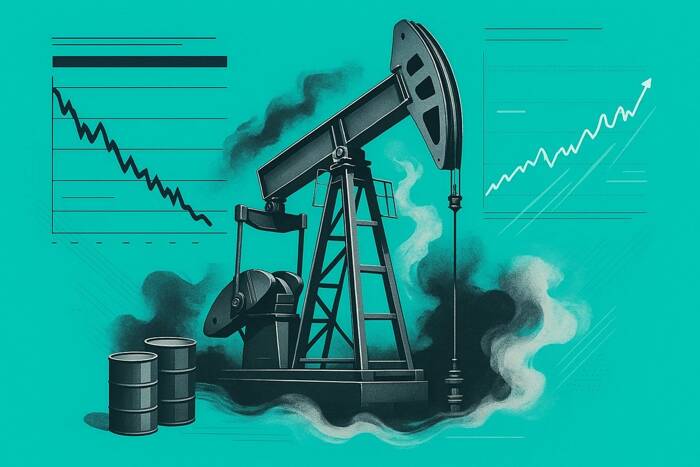
The global oil market is experiencing a significant upheaval, with crude benchmarks witnessing a sharp correction that has investors re-evaluating their positions. What began as a period of sustained gains, with Brent crude recently soaring above $112 per barrel, has abruptly shifted into a downturn. As of today, April 19, 2026, Brent Crude is trading at $90.38, a notable decline of 9.07% within the day, having already traversed a wide range between $86.08 and $98.97. Similarly, WTI Crude has fallen to $82.59, down 9.41% with a daily range of $78.97 to $90.34. This dramatic reversal, which has seen Brent shed nearly 20% from its high of $112.78 on March 30, presents a critical juncture for energy investors, challenging prior bullish sentiment and testing crucial technical support levels.
The Abrupt Reversal: Brent Plunges Below Key Averages
The narrative of an “oil rally testing its 50-day moving average” has been fundamentally reshaped by the market’s recent performance. While crude prices had indeed shown resilience, pushing towards multi-month highs, the sharp decline observed over the past two weeks, culminating in today’s steep losses, signals a decisive break from that upward momentum. Our proprietary data confirms a dramatic 14-day trend for Brent, falling from $112.78 on March 30, 2026, to $90.38 by April 17, representing a significant $22.4 or 19.9% drop. This rapid depreciation has undoubtedly pushed Brent below its previously ascendant 50-day moving average, which, given the recent price trajectory, was likely hovering in the $100-$105 range. The market is no longer testing this average from below in a rally; rather, it is now testing it from above, or has decisively broken below it, indicating a potential shift in the short-to-medium term trend to a bearish outlook. The 20-day moving average, a more responsive indicator, would also have been breached by this swift decline, suggesting that the immediate technical picture has deteriorated significantly.
Immediate Support Levels Under Pressure Amidst Volatility
In this volatile environment, identifying and defending key support levels becomes paramount for investors. The intraday trading ranges for both Brent and WTI reveal the immediate battlegrounds for market participants. For Brent, today’s low of $86.08 represents a critical line in the sand, while WTI’s low of $78.97 serves a similar function. If buyers fail to defend these levels, the risk of further downside momentum increases significantly. The speed and depth of the current sell-off suggest a strong conviction among sellers, and any rebound will require substantial buying interest to overcome this pressure. Investors should closely monitor these daily lows as indicators of market sentiment and potential areas for short-term stabilization. A sustained breach below these levels could open the door to further declines, potentially targeting psychological support levels in the low $80s for Brent and mid-$70s for WTI, which would represent a more pronounced retracement of earlier gains.
OPEC+ in the Spotlight: Investor Questions Mount
The timing of this sharp market correction could not be more critical, as it directly precedes key OPEC+ meetings. Our proprietary reader intent data shows a significant uptick in questions surrounding “OPEC+ current production quotas” and predictions for “the price of oil per barrel by end of 2026.” These inquiries underscore the market’s reliance on the cartel’s actions to stabilize prices. The upcoming OPEC+ Joint Ministerial Monitoring Committee (JMMC) Meeting on Sunday, April 19, followed by the full Ministerial Meeting on Monday, April 20, will be under intense scrutiny. With Brent having plummeted nearly 20% in less than three weeks, the pressure on OPEC+ to address supply concerns, or at least reaffirm their commitment to market stability, is immense. Any indication of maintaining current production cuts, or even deepening them, could provide a much-needed floor for prices. Conversely, a lack of decisive action or a signal towards easing cuts could exacerbate the current sell-off, significantly impacting investor outlooks for the remainder of 2026.
Forward Outlook: Geopolitical Tensions, Inventories, and the Path to Recovery
Beyond OPEC+, several other factors will shape the crude market’s trajectory in the coming weeks, influencing investor sentiment and their forecasts for 2026. The geopolitical landscape remains a persistent wildcard, capable of injecting significant volatility at short notice. On the fundamental supply-demand front, the market will eagerly await the API Weekly Crude Inventory report on Tuesday, April 21, and the EIA Weekly Petroleum Status Report on Wednesday, April 22. These reports, alongside the Baker Hughes Rig Count on April 24, will offer crucial insights into U.S. inventory levels and production activity. Consecutive builds in crude inventories could signal weakening demand or oversupply, adding further pressure to prices. Conversely, drawdowns could provide a bullish catalyst. For investors seeking to navigate this tumultuous period, the focus must remain on these key data points and the impending OPEC+ decisions. While the recent rally has been severely tested and appears to have broken down, a coordinated response from producers and clear signals on demand recovery could pave the way for a stabilization, and eventually, a re-evaluation of upside targets, perhaps towards the $100 psychological level or even re-testing the previous $112.78 highs, but only after sustained evidence of market rebalancing.