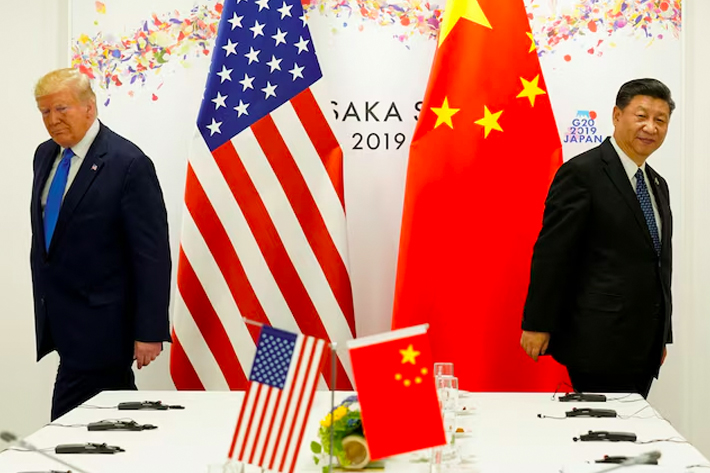
The intricate dance of global geopolitics continues to cast a long shadow over the energy markets, with US-China trade relations remaining a pivotal factor for investors. While the immediate focus might shift to supply-side dynamics or regional conflicts, the underlying health of the world’s two largest economies and their trade relationship, valued at an astounding $660 billion annually, fundamentally dictates global demand trajectories for crude oil and refined products. High-level discussions, such as those held in Kuala Lumpur involving Chinese Vice Premier He Lifeng, US Treasury Secretary Scott Bessent, and Trade Representative Jamieson Greer, serve as critical barometers for this relationship. These past meetings, from October 24 to 27, represented a significant effort to de-escalate tensions ahead of a planned leaders’ summit, yet the enduring challenges highlight persistent volatility that energy investors must carefully navigate.
Geopolitical Headwinds Batter Oil Prices
The precarious state of global trade relations, particularly between the United States and China, continues to exert significant pressure on commodity markets. As of today, Brent crude trades at $90.38 per barrel, marking a sharp 9.07% decline within the day, with an intraday range spanning $86.08 to $98.97. Similarly, WTI crude has fallen to $82.59, down 9.41% from its open, fluctuating between $78.97 and $90.34. This acute daily downturn is not an isolated event but part of a broader bearish trend; Brent crude has shed nearly 20% over the last two weeks, plummeting from $112.78 on March 30 to its current level. This pronounced market weakness reflects growing concerns over global economic slowdowns, heavily influenced by persistent trade frictions. When the world’s economic engines face headwinds from tariffs, export restrictions, and retaliatory measures, the ripple effect inevitably hits energy demand forecasts, compelling investors to re-evaluate their positions and driving prices lower. Gasoline prices have followed suit, currently standing at $2.93, a 5.18% drop, underscoring the broad-based impact of these macroeconomic anxieties.
The Kuala Lumpur Crucible: A Precedent for Future Market Stability
While the specific high-stakes talks between Chinese Vice Premier He Lifeng, US Treasury Secretary Scott Bessent, and Trade Representative Jamieson Greer in Kuala Lumpur from October 24 to October 27 are a historical event, their implications for how US-China relations impact global markets remain acutely relevant. These discussions, aimed at finding common ground before a leaders’ summit, underscored the deep-seated tensions and the challenge of achieving comprehensive agreements. Experts like Wu Xinbo from Fudan University noted China’s shifting, tougher posture, believing negotiations alone are insufficient without countermeasures. This historical context of high-level engagement and the difficulty in reaching consensus sets a precedent for how future dialogues will unfold and, critically, how they will be perceived by energy markets. Looking ahead, investors must be keenly aware of how such geopolitical maneuvering influences the demand side of the oil equation. Any perceived escalation or even a lack of significant de-escalation in trade relations could further dampen global growth prospects. This backdrop is particularly crucial as we approach significant supply-side events. The upcoming OPEC+ Joint Ministerial Monitoring Committee (JMMC) Meeting on April 19, followed by the full OPEC+ Ministerial Meeting on April 20, will be critical. Should global trade uncertainty persist, OPEC+ might face increased pressure to consider production adjustments to stabilize prices against weaker demand forecasts. Conversely, any unexpected positive signals from future high-level US-China engagements could provide a much-needed boost to demand sentiment, potentially influencing OPEC+’s strategy.
Investor Focus: Navigating Price Trajectories and Supply-Side Shifts
Our proprietary reader intent data reveals a clear focus among investors on future oil price trajectories and the underlying factors influencing them. Many are asking: “What do you predict the price of oil per barrel will be by end of 2026?” and “What are OPEC+ current production quotas?” These questions highlight the market’s anxiety regarding both demand stability and supply management. The recent substantial declines in Brent and WTI crude underscore the vulnerability of prices to macroeconomic shocks and geopolitical friction, such as the US-China trade disputes. Continued uncertainty on the trade front, exemplified by Beijing’s dramatic expansion of rare earth export curbs in response to US technology blacklists, adds a significant layer of risk to demand forecasts. This makes predicting end-of-year prices exceptionally challenging, as it hinges on the delicate balance between potential demand erosion from trade wars and the effectiveness of supply-side interventions. Investors are also closely monitoring OPEC+’s actions. While current production quotas are subject to ongoing review, the upcoming April 19 JMMC and April 20 Ministerial Meetings will provide crucial insights into the cartel’s strategy in light of recent price volatility and global economic signals. Should trade tensions continue to suppress demand, a coordinated supply response from OPEC+ might become more probable to prevent further price depreciation. Furthermore, the weekly API and EIA inventory reports, scheduled for April 21, 22, 28, and 29, along with the Baker Hughes Rig Count on April 24 and May 1, will offer real-time indicators of market balance and US production trends. For individual energy companies, like Repsol, whose performance investors are also inquiring about, the macro environment shaped by these trade dynamics and OPEC+ decisions will be paramount. A volatile and uncertain market demands a robust and adaptable investment strategy.
China’s Strategic Leverage: Rare Earths and Supply Chain Dominance
The US-China trade relationship is not merely about tariffs; it’s increasingly a battle for strategic dominance over critical supply chains. Beijing’s move to tighten control over rare earths exports, even extending its reach extraterritorially, represents a significant escalation and a fundamental shift in its approach to economic and trade negotiations. This strategy, as experts like Cory Combs of Trivium China highlight, mirrors US rules limiting advanced computer chip exports, demonstrating China’s intent to wield its substantial leverage. With China processing over 90% of the world’s rare earths, essential for everything from electric vehicles to advanced military technology, this control gives Beijing a powerful countermeasure against US pressure tactics. This strategic weaponization of critical minerals introduces a new layer of risk and uncertainty for global industries and, by extension, the energy sector. Disruptions or restrictions in the supply of these materials can impact manufacturing, technological innovation, and economic growth across various sectors, inevitably influencing overall energy demand. For energy investors, understanding this evolving landscape means recognizing that trade disputes are no longer just about goods and services, but about controlling the very foundations of modern industry. This deepens the complexity of forecasting long-term economic stability and energy consumption patterns, demanding a more nuanced assessment of geopolitical risk beyond conventional trade metrics.