Energy markets are once again at a critical inflection point, facing an intense “Energy Price Test” that demands vigilant analysis from investors. Recent trading sessions have underscored significant volatility, driven by a complex interplay of evolving supply dynamics, demand uncertainties, and geopolitical undercurrents. As we approach a pivotal OPEC+ ministerial meeting and digest fresh inventory data, the direction of both crude oil and natural gas prices hangs in the balance. This analysis leverages OilMarketCap’s proprietary data pipelines, offering a unique perspective on the forces shaping the investment landscape and addressing key questions posed by our astute readership.
Crude Oil Under Siege: A Retreat from Recent Highs
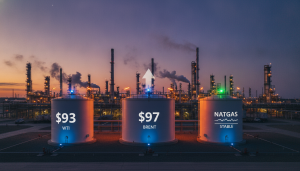
The crude oil market has experienced a sharp correction, challenging the bullish sentiment that characterized the early part of the year. As of today, Brent Crude trades at $90.38 per barrel, marking a substantial 9.07% decline within the day, having ranged from $86.08 to $98.97. Similarly, WTI Crude has seen a steep drop to $82.59, down 9.41% over the same period, with its daily range spanning $78.97 to $90.34. This aggressive daily downturn is not an isolated event; our proprietary 14-day trend data reveals Brent has plummeted from $112.78 on March 30, 2026, to its current $90.38 as of April 17, 2026 – a staggering $22.4 or 19.9% reduction. This pronounced bearish momentum signals a significant re-evaluation by the market, potentially driven by concerns over global economic slowdowns impacting demand or shifting expectations regarding future supply. Gasoline prices have followed suit, currently at $2.93, down 5.18% from their daily high of $3.1, reflecting broad pressure across refined products.
OPEC+’s Imminent Decision and Output Risks
All eyes are now firmly fixed on OPEC+, which convenes for a Full Ministerial Meeting on Sunday, April 19, 2026. This gathering is particularly critical given the recent slide in crude prices and the persistent investor inquiries regarding “OPEC+ current production quotas.” The cartel’s decisions on output levels will directly influence the supply-demand balance and, consequently, global oil benchmarks. With prices having fallen nearly 20% in just over two weeks, the group faces renewed pressure to stabilize the market. Any indication of maintaining or even increasing current output levels could exacerbate the downward trend, introducing significant “OPEC+ Output Risks” as highlighted in our market outlook. Conversely, a decision to deepen cuts or extend existing ones could provide a floor for prices. Beyond Sunday’s meeting, investors will closely monitor subsequent data releases, including the API Weekly Crude Inventory reports on April 21 and April 28, and the EIA Weekly Petroleum Status Reports on April 22 and April 29. These reports will offer crucial insights into U.S. inventory levels, a key indicator of demand and domestic supply trends that often influence OPEC+’s strategic considerations.
Natural Gas: Contrasting the Crude Narrative with a Bull Channel
While the crude oil market grapples with bearish forces, the natural gas sector appears to be navigating a more resilient, even bullish, trajectory. Our analysis suggests a persistent “Gas Bull Channel,” driven by a distinct set of fundamentals that differentiate it from crude. Unlike oil, natural gas markets are heavily influenced by regional supply disruptions, evolving geopolitical tensions impacting pipeline flows, and seasonal demand patterns, particularly for heating and electricity generation. Although specific price data for natural gas is not highlighted in the current snapshot, the observed divergence in market sentiment indicates that investors perceive sustained upward pressure or robust demand fundamentals for gas. This could stem from factors such as tightening global LNG supplies, increased industrial consumption, or even a strategic shift by some energy consumers towards gas as a bridge fuel. For investors, this presents a compelling contrast: a potential safe haven or growth opportunity in natural gas, even as crude oil faces significant headwinds. Monitoring global storage levels, weather forecasts, and geopolitical developments will be paramount for those looking to capitalize on this potential bull channel.
Addressing Investor Concerns: Outlook and Portfolio Implications
Our proprietary reader intent data reveals a clear focus on forward-looking analysis, with a prominent question being, “What do you predict the price of oil per barrel will be by end of 2026?” Investors are also actively seeking insights into specific companies, as evidenced by questions like, “How well do you think Repsol will end in April 2026?” Predicting year-end oil prices involves navigating a multitude of variables, including global economic growth, the pace of the energy transition, and, crucially, OPEC+ policy. Given the current market test and the recent sharp decline, a cautious outlook is warranted. While the short-term trend is undeniably bearish, significant supply disruptions or a faster-than-expected economic recovery could still provide upside. However, the path to $100+ oil by year-end appears more challenging now than it did just two weeks ago. For companies like Repsol, their performance will not only hinge on benchmark oil and gas prices but also on their diversified asset base, refining margins, and strategic investments in lower-carbon solutions. Monitoring upcoming industry data, such as the Baker Hughes Rig Count on April 24 and May 1, will offer clues on future production trends and capital expenditure decisions by exploration and production companies, providing further granularity for investment theses.
The Energy Market’s Defining Test Ahead
The coming weeks represent a defining “Energy Price Test” for the global oil and gas markets. The confluence of a critical OPEC+ meeting, ongoing inventory assessments, and the divergent narratives between crude oil’s recent weakness and natural gas’s potential bullish channel creates a complex, yet potentially rewarding, environment for investors. While the immediate outlook for crude appears challenging, the strategic decisions made by key producers, coupled with evolving demand signals, will dictate the trajectory for the remainder of 2026. Savvy investors will need to remain agile, leveraging real-time data and forward-looking analysis to identify opportunities and mitigate risks in this highly dynamic sector. The emphasis should be on understanding the nuanced factors driving each energy commodity, rather than painting the entire sector with a single brushstroke.