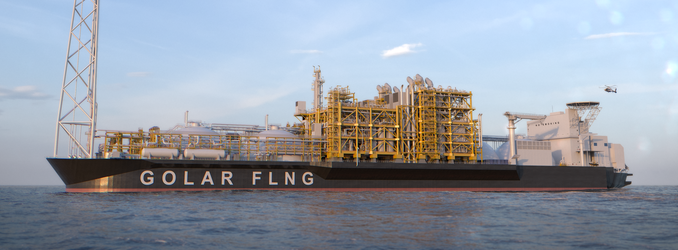
Golar LNG has solidified its position as a leading floating LNG (FLNG) service provider with the Final Investment Decision (FID) for its 3.5 mtpa MK II FLNG unit, chartered by Southern Energy S.A. (SESA) for a robust 20-year term. This strategic move, following definitive agreements signed in May 2025, unlocks substantial long-term earnings visibility for Golar, underscoring the growing importance of flexible LNG export solutions in an evolving global energy landscape. Investors should pay close attention to this development, as it not only establishes a significant foothold in Argentina’s emerging LNG market but also showcases an innovative revenue model designed to capture commodity upside while ensuring stable returns.
Argentina’s Ascendance as an LNG Exporter and Golar’s Strategic Foothold
The FID for the MK II FLNG marks a pivotal moment for Argentina, cementing its trajectory to become a significant global LNG exporter. Southern Energy S.A., a consortium comprising domestic energy powerhouses Pan American Energy (30%), YPF (25%), Pampa Energia (20%), alongside international players Harbour Energy (15%) and Golar itself (10%), is spearheading this ambitious initiative. The consortium’s backing lends considerable weight and expertise to the project, demonstrating a unified push to monetize Argentina’s vast Vaca Muerta shale gas reserves. Golar’s 10% equity stake in SESA provides an additional layer of participation in the project’s success, beyond its direct charter revenue. The MK II unit, currently undergoing conversion in China and slated for delivery in 2028, will join Golar’s FLNG Hilli in the San Matías Gulf. Hilli is set to commence its own 20-year charter with SESA in 2027. This two-unit strategy will establish a combined nameplate capacity of 5.95 mtpa, allowing for significant economies of scale, shared infrastructure, and enhanced operational efficiencies that are critical for long-term project viability and competitiveness in the global LNG market.
De-Risking Returns: Fixed Charter and Commodity Upside in a Volatile Market
Golar LNG’s financial arrangement for the MK II FLNG is a masterclass in balancing stability with upside potential, a structure particularly appealing to investors navigating the inherent volatility of energy markets. The company is set to receive a fixed net charter hire of $400 million per year for two decades, providing a strong baseline of predictable earnings visibility. Beyond this robust fixed component, Golar benefits from an attractive commodity-linked tariff, equal to 25% of FOB prices exceeding $8/MMBtu. This hybrid model directly addresses the perennial investor question, “is WTI going up or down?”, by offering insulation against downside while capitalizing on potential commodity price surges. As of today, Brent crude trades at $94.45 per barrel, down 1.08% within a day range of $93.98-$95.69, while WTI crude sits at $86.12, down 1.49%. The broader market has seen Brent crude decline by nearly 20% over the last 14 days, from $118.35 to $94.86, highlighting significant price swings. Yet, even with this recent correction, current crude prices remain elevated compared to historical averages, suggesting a generally strong energy pricing environment. This robust market backdrop bodes well for the commodity-linked component of Golar’s charter, as high crude prices often correlate with stronger natural gas and LNG prices, making the $8/MMBtu threshold for additional revenue highly attainable and potentially very lucrative for Golar and its shareholders.
Navigating Future Headwinds and Opportunities: What Investors Are Asking
The long-term nature of this agreement, coupled with its innovative revenue structure, speaks directly to investor concerns about future market direction. Many investors are keenly asking about the “price of oil per barrel by end of 2026,” seeking clarity in a market buffeted by geopolitical tensions, supply dynamics, and demand fluctuations. Golar’s strategy with SESA provides a compelling answer to such uncertainty, offering a substantial de-risked earnings stream of $8 billion over 20 years, as highlighted by CEO Karl Fredrik Staubo. This long-term visibility from the fixed charter hire helps to mitigate the impact of short-term commodity price volatility, a key concern for many. Furthermore, Golar’s equity stake in SESA provides an additional avenue for growth and value creation as Argentina’s LNG export capabilities mature. While the project remains subject to regulatory and customary closing conditions, which are expected to be satisfied in 2025, these are standard procedures for projects of this magnitude. The structure of the deal ensures that Golar is well-positioned to benefit from a potentially robust LNG market without being solely exposed to its inherent fluctuations, offering a balanced risk-reward profile for investors.
Upcoming Market Signals and the Long-Term Outlook for LNG Investment
The broader energy market continues to present a dynamic landscape, and shrewd investors are constantly monitoring upcoming events for signals that could influence the long-term viability and profitability of projects like the SESA FLNG. In the immediate future, key events such as the OPEC+ JMMC Meeting today, April 21st, and the subsequent EIA Weekly Petroleum Status Reports on April 22nd and 29th, will offer crucial insights into global crude supply and demand balances. Further down the calendar, the Baker Hughes Rig Counts on April 24th and May 1st will indicate North American production activity, while the EIA Short-Term Energy Outlook on May 2nd will provide critical forecasts for energy prices and consumption. While these events primarily focus on crude oil, their outcomes often ripple across the entire energy complex, influencing sentiment and, indirectly, the long-term outlook for natural gas and LNG. The strategic significance of FLNG projects like Golar’s MK II, particularly in an energy-hungry world striving for security and diversification, remains strong. As countries look to reliable and cleaner-burning alternatives, LNG is poised to play a crucial role in the energy transition for decades to come. Argentina, with its vast shale gas potential and Golar’s proven FLNG technology, is set to capture a significant share of this evolving market, making this investment a compelling proposition for long-term growth.