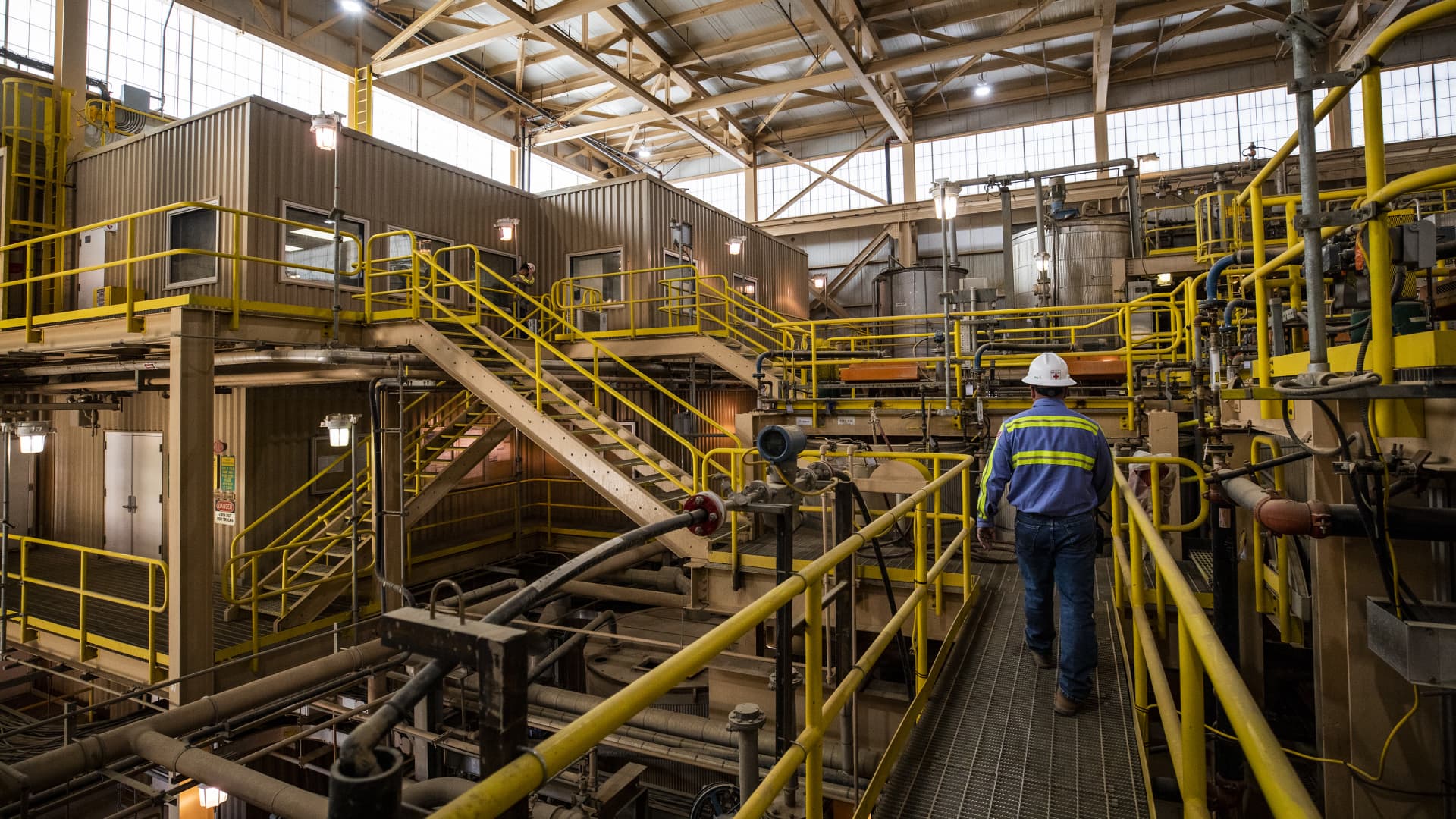
In a significant move that underscores the evolving landscape of global resource investment, MP Materials has seen its stock price target more than triple from a prominent financial institution. This dramatic re-rating, from $20 to $67, reflects a powerful confluence of strategic government backing and substantial private sector commitment, positioning the rare-earths miner as a critical player in the burgeoning domestic supply chain for essential materials. While the implied upside from Wednesday’s closing price of $58.22 is a modest 15%, the re-evaluation of MP Materials’ long-term trajectory is nothing short of transformational, signaling a paradigm shift in how crucial resource companies are valued in the current geopolitical and technological climate. For energy investors accustomed to the cyclical swings of crude and natural gas, this development highlights the increasing importance of diversified exposure to foundational elements of the energy transition and national security.
The Geopolitical Imperative Driving Valuation
The core of MP Materials’ re-rating lies in two pivotal agreements that fundamentally alter its risk profile and strategic standing. Firstly, the Defense Department’s strategic investment, which includes a guaranteed price floor for MP Materials’ output, effectively insulates the company from the volatile commodity pricing historically dictated by global market forces. This move transforms MP Materials from a mere producer vulnerable to pricing pressures into a strategic partner, critical for national interests. The Pentagon’s decision to become MP Materials’ largest shareholder sends an unmistakable signal regarding the US government’s unwavering commitment to cultivating a secure domestic supply chain for rare earths and magnets – materials indispensable for advanced technologies, defense systems, and the burgeoning electric vehicle sector.
Secondly, the $500 million agreement with Apple to procure rare earth magnets provides a substantial commercial anchor, offering long-term revenue visibility and validating MP Materials’ operational capabilities. These dual catalysts significantly de-risk the company’s operations, providing both demand security and price stability. For investors, this translates into a more predictable earnings stream and a reduced susceptibility to the geopolitical machinations that often plague commodity markets. The strategic importance of rare earths, often dubbed “the vitamins of modern industry,” cannot be overstated, and this investment clearly articulates a national effort to secure these vital inputs away from concentrated foreign control.
Navigating Current Market Dynamics and Future Catalysts
Despite the monumental increase in its price target, the financial institution has maintained a “hold” rating on MP Materials. This seemingly counterintuitive stance reflects the rapid appreciation the stock has already experienced, with shares gaining over 270% this year alone, and more than 85% since the Defense Department investment was initially announced on July 10th. The market appears to have swiftly priced in these significant catalysts, suggesting that while the long-term outlook is robust, immediate major upside may be constrained in the short term.
Our proprietary reader intent data reveals a strong focus on forecasting, with many investors asking for a “base-case Brent price forecast for next quarter” and the “consensus 2026 Brent forecast.” This highlights a market grappling with future commodity price trajectories and seeking predictability. In this context, the de-risking of MP Materials through long-term government and corporate contracts becomes particularly attractive, offering a degree of stability absent in many other commodity-exposed assets. The analyst commentary suggests that future catalysts for MP Materials would likely revolve around securing additional offtake agreements for its magnet products and further expansions in production capacity. These are medium-term drivers, indicating that while the foundation is set, patience may be required for the next phase of substantial value realization.
The Broader Energy Landscape: Stability Amidst Strategic Shifts
The narrative surrounding MP Materials unfolds against a backdrop of a dynamic global energy market. As of today, Brent crude trades at $94.59, reflecting a slight dip of 0.36% within a tight daily range of $94.59 to $94.91. WTI crude mirrors this sentiment at $90.83, down 0.5% in a range of $90.81 to $91.50. Gasoline prices stand at $2.99, down 0.67%. While these figures suggest relative stability in the very short term, the broader trend shows significant movement; Brent crude, for example, has seen a nearly 9% decline over the past 14 days, falling from $102.22 on March 25th to $93.22 on April 14th. This volatility underscores the inherent unpredictability of traditional commodity markets, making de-risked strategic resource plays like MP Materials particularly compelling for investors seeking to diversify their exposure within the broader energy and materials complex.
Investors are increasingly looking beyond conventional oil and gas, recognizing that the energy transition requires vast quantities of critical minerals. The stability in today’s crude prices, following a period of decline, might free up capital for strategic investments in these foundational sectors. The “hold” rating on MP Materials, despite its strong long-term prospects, encourages a prudent approach, suggesting that while the story is compelling, entry points and further accumulation should be evaluated against the backdrop of both company-specific developments and the broader macroeconomic environment.
Anticipating Macro Shapers: Upcoming Energy Events and Investor Focus
Looking ahead, the next two weeks are packed with key energy events that will inevitably shape the macro backdrop for commodity investors, influencing capital allocation across the entire resource spectrum. The upcoming OPEC+ Joint Ministerial Monitoring Committee (JMMC) meeting on April 18th, followed by the Full Ministerial meeting on April 20th, will be closely watched for any shifts in production policy that could impact global crude supply and pricing. Simultaneously, industry-specific data releases such as the Baker Hughes Rig Count, scheduled for April 17th and April 24th, will provide crucial insights into drilling activity and potential future supply trajectories in the traditional oil and gas sector.
Furthermore, the regular API Weekly Crude Inventory reports on April 21st and April 28th, alongside the EIA Weekly Petroleum Status Reports on April 22nd and April 29th, will offer granular detail on US supply and demand fundamentals. These events, while focused on conventional hydrocarbons, inevitably influence investor appetite and capital allocation across the broader resource sector, including strategic materials like rare earths. For investors asking about “how Chinese tea-pot refineries are running this quarter” or seeking “what’s driving Asian LNG spot prices,” these upcoming reports provide crucial pieces of the global energy puzzle. The securement of a domestic rare earth supply chain, as exemplified by MP Materials’ recent successes, can be seen as a strategic hedge against the very geopolitical and supply chain vulnerabilities that these macro energy events often highlight, offering a diversified investment thesis within the evolving energy landscape.