

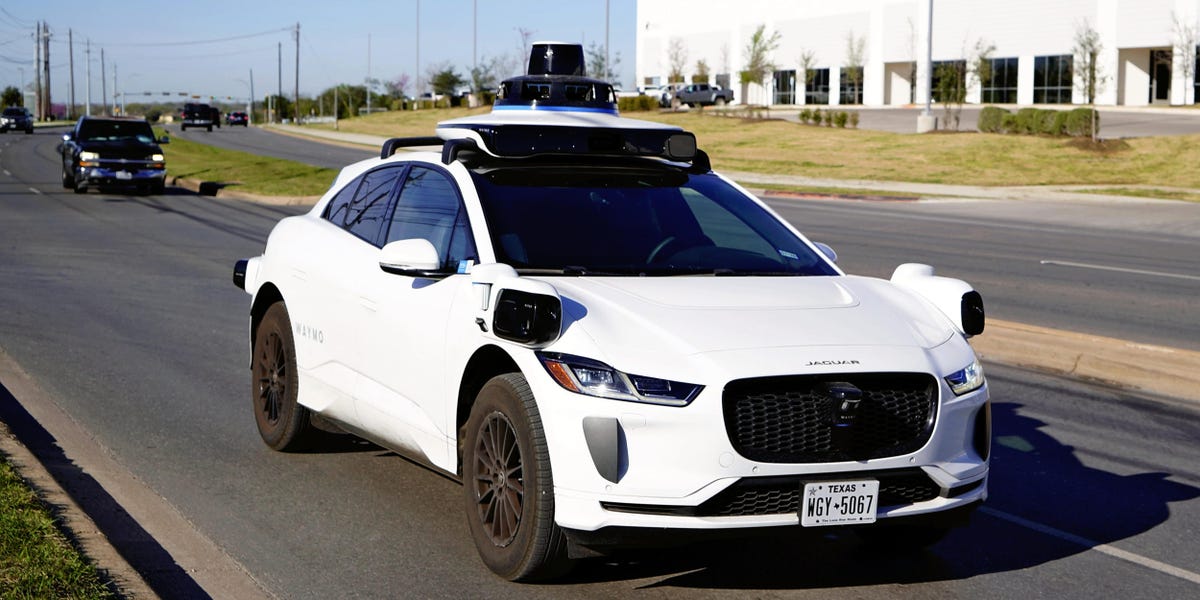
Waymo is a robotaxi service owned by Google’s parent company, Alphabet. Since opening its service to the public in 2020, Waymo has said it has provided millions of paid, fully autonomous rides.
The company continues to expand its service, in part by partnering with other ride-hailing platforms, and has begun testing its robotaxis outside the US.
Waymo’s beginnings
Waymo was initially formed by Google and was known as the Google Self-Driving Car Project. After seven years of research and development, it eventually spun out into its own company in 2016. Alphabet remains the majority owner of the company.
Google started developing Waymo and its self-driving technology in 2009 at the Google X lab, which was led by Google cofounder Sergey Brin. Sebastian Thrun, a pioneer in the self-driving industry, was chosen to lead the project.
After almost two years of testing the technology, Google and The New York Times revealed its existence in late 2010.
Andrej Sokolow/picture alliance via Getty Images
US lawmakers raised concerns at the time about the lack of regulations for this new technological frontier. Google was a prominent supporter, lobbying for regulation. By 2012, Nevada’s Department of Motor Vehicles had licensed a self-driving Prius running Google’s software, marking the first time that a self-driving vehicle had been licensed in the United States.
In 2022, Alphabet CEO Sundar Pichai distanced Waymo and Alphabet’s other subsidiaries from Google by granting them more autonomy to design job structures and compensation outside Google’s job architecture.
Waymo was affected by Google layoffs in 2023, when the company cut roughly 8% of staff.
Despite the restructuring, Waymo’s offices are still located in Mountain View, California, just a short drive from the Googleplex, Google’s global headquarters.
What does Waymo do?
Mario Tama/Getty Images
As of 2025, Waymo provides driverless taxi services throughout the San Francisco Bay Area, Los Angeles, Phoenix, Austin, and Atlanta. In Austin and Atlanta, Waymo offers its service through Uber’s ride-hailing app.
Related stories

Business Insider tells the innovative stories you want to know
Business Insider tells the innovative stories you want to know
In 2014, Google was granted a patent for a transportation service involving automated vehicles that would be funded by advertising fees. That May, Google unveiled a prototype autonomous vehicle that did not contain a gas pedal, brake pedal, or steering wheel.
In 2015, they gave their first fully autonomous ride to a legally blind friend of principal engineer Nathaniel Fairfield; unlike earlier tests, there was no police escort, no test driver, and it was not on a closed course.
In 2016, the self-driving car project was spun out of Google and made a subsidiary of Google’s parent company, Alphabet Inc. At this time, the company also ordered 100 Chrysler Pacifica hybrid minivans to test the technology.
Waymo announced a partnership with Jaguar in 2018 to build up its fleet of robotaxis, using the legacy automaker’s all-electric I-PACE SUV. The company also partnered with Hyundai and the Chinese EV company Zeekr to expand its robotaxi models.
Waymo started its public operations in Phoenix in 2020. By May 2025, Waymo said it had surpassed 10 million paid rides across its operating cities.
To increase its robotaxi fleet, Waymo built a 239,000-square-foot factory in Mesa. With the new facility, Waymo said it will retrofit more than 2,000 I-PACE vehicles with autonomous capabilities throughout 2026.
The company also has shared ambitions to license its autonomous technology to automakers. In April 2025, the company said it was in early talks with legacy automaker Toyota, with plans to bring autonomous driving to personally owned vehicles.
Who can take a Waymo?
So far, Waymo operates in Phoenix, the San Francisco Bay Area, Los Angeles, Austin, and Atlanta. The robotaxis can only operate within geo-fenced areas, meaning they cannot freely travel in every part of the city, including highways and some airports. Waymo says it will expand its service to highways, but it has not provided a timeline.
Allen J. Schaben/Los Angeles Times via Getty Images
Prospective riders within operating areas can download the Waymo One app and hail a robotaxi. In Austin and Atlanta, riders have to toggle through the Uber app to request a robotaxi. Like major competitors, riders are quoted the fare while booking.
Waymo ride prices are based on the distance and time of a trip, and a minimum price is charged for all trips. In April 2023, when a Business Insider reporter tested the technology in Phoenix, a five-mile, 20-minute Waymo ride cost $11, the same price as an Uber trip to the same location.
Waymo doesn’t disclose pricing data, but a third-party study published in June 2025 showed that Waymo’s robotaxis are more expensive than Uber and Lyft, costing around $5 more than the average ride from its competitors.
Is Waymo safe?
Waymo says its driverless vehicles are safer than human drivers, but as with any technology that remains a work in progress, autonomous taxis are not perfect.
Data from Waymo provided to the California Public Utilities Commission showed that the company’s robotaxis were involved in at least 419 collisions between March 2022 and March 2025.
Still, an analysis by Business Insider found that Waymo significantly reduced the rate of collisions during those three years. Between March and May 2022, the rate of collisions was about 147 per 100,000 rides. Between January and March 2025, the rate reduced to about 7 collisions per 100,000 rides.
When comparing human drivers over the same distance within the company’s operating cities, Waymo says its autonomous driver experiences 93% fewer pedestrian crashes with injuries and 79% fewer crashes with airbag deployments.
Waymo’s robotaxis have been documented experiencing some technical issues, however. One rider told Business Insider that his Waymo ride was stuck driving in circles. A San Francisco resident recorded footage of the robotaxis honking at each other at a Waymo depot.
Who are Waymo’s competitors?
Courtesy Waymo
Waymo faces competition from several companies, including Tesla’s robotaxi, Amazon’s Zoox, and a few other software-focused companies that have autonomous technologies.
In June 2025, Tesla began offering driverless rides with 10 to 20 cars operating within a geo-fenced area of Austin. Tesla CEO Elon Musk said the company can quickly expand its service and took multiple shots at Waymo, saying that the Alphabet company’s robotaxis cost more to expand.
Amazon-backed Zoox is building a purpose-built robotaxi — meaning the vehicle will have no steering wheels and will only be used as a taxi — and is testing in several US cities as of July 2025. The company announced in June 2025 the opening of its 220,000 square-foot production facility in California.
There are also software-oriented companies such as Wayve and May Mobility that develop autonomous technologies and are seeking to provide robotaxi services by partnering with ride-hailing platforms.
For example, May Mobility, an Ann Arbor-based company founded in 2017, has partnered with Lyft to deploy an autonomous fleet in Atlanta in the summer of 2025.
Robotaxis also operate outside the US. In China, driverless taxis are quickly expanding with companies like Baidu’s Apollo Go and WeRide.
In March 2025, Waymo deployed 25 Jaguar I-PACE SUVs to Japan to begin mapping out parts of Tokyo.
