The global oil and gas landscape has entered a profoundly volatile phase following the direct involvement of the United States in the escalating Middle Eastern conflict. What began as regional tensions has now broadened, creating an environment ripe for significant supply disruptions and challenging existing market assumptions. Investors are grappling with an unprecedented level of uncertainty, as the potential for conflict to impact critical energy infrastructure and transit routes has dramatically increased. This latest development fundamentally alters the risk calculus for crude oil, natural gas, and refined products, demanding a swift re-evaluation of investment strategies and price forecasts.
Market Realignment: Geopolitical Premium Takes Hold
While markets initially reacted with sharp price surges to the news of intensified conflict and US strikes, our real-time data illustrates how a geopolitical risk premium has quickly embedded itself into the price structure. As of mid-afternoon on April 15th, WTI Crude is currently trading at $91.28 per barrel, maintaining a firm position within a day range of $86.96 to $93.30. This robust pricing stands in stark contrast to the broader trend observed in the two weeks prior, where Brent crude had experienced an 8.8% decline, moving from $102.22 on March 25th to $93.22 by April 14th. The recent escalation has effectively halted and reversed this downward momentum, injecting a substantial risk premium. Gasoline prices, a direct reflection of crude costs and refinery margins, also reflect this shift, currently holding at $2.96 per gallon, despite a fractional 0.34% dip today. This sustained strength, even after an initial reactive jump, signals that the market views the current geopolitical friction as a durable factor, not a transient event.
The Strait of Hormuz: A Bottleneck with Global Implications
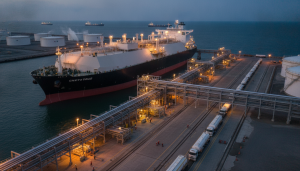
Central to the current market jitters is the renewed threat to the Strait of Hormuz. This narrow waterway, connecting the Persian Gulf to the Arabian Sea, is a critical artery for global oil trade, facilitating the passage of approximately 20 million barrels of oil and oil products daily—roughly one-fifth of the world’s total shipments. With Iran’s parliament reportedly approving measures to close the Strait, the implications for global energy supply are severe. Industry experts widely concur that a full closure, even a temporary one, would precipitate an oil price shock far exceeding the volatility experienced in 2022. Should Western forces intervene to reopen the Strait, as is highly anticipated, the conflict could be prolonged and intense, pushing crude prices well above $100 per barrel. Even a degree of harassment to shipping, falling short of a complete closure, would introduce immense logistical challenges and immediately heighten the global risk premium on all oil and gas transactions, making the Strait of Hormuz the most critical chokepoint to watch.
Addressing Investor Concerns: Navigating Price Forecasts and Uncertainty
In this rapidly evolving environment, investors are rightly seeking clarity, with many actively asking for a base-case Brent price forecast for the next quarter and a consensus 2026 Brent forecast. The reality is that the geopolitical premium currently at play makes traditional forecasting models highly challenging. The direct involvement of the US, coupled with Iran’s warning of “all options” to defend its sovereignty, introduces an unpredictable variable that defies easy quantification. While analysts previously grappled with demand-side concerns and OPEC+ policy, the current focus has irrevocably shifted to supply-side security. A prolonged disruption or direct attacks on Gulf energy production infrastructure could indeed propel crude prices significantly above $100. For the next quarter, investors should brace for a sustained higher floor for Brent, likely in the $95-$105 range, with significant upside potential if the Strait of Hormuz faces severe, prolonged disruption. The consensus 2026 Brent forecast will undoubtedly need to be revised upwards to account for this newly embedded geopolitical risk.
Upcoming Catalysts and Forward-Looking Analysis
The next two weeks will be crucial for discerning the immediate market trajectory, with several key events on the energy calendar that demand investor attention. The OPEC+ Joint Ministerial Monitoring Committee (JMMC) meeting on April 18th, followed by the Full Ministerial meeting on April 20th, will be paramount. Investors will scrutinize any statements regarding supply policy in response to the heightened geopolitical risk. Will OPEC+ maintain current cuts, or will the escalating tensions prompt a reconsideration of supply levels to stabilize markets or capitalize on higher prices? Concurrently, the Baker Hughes Rig Count reports on April 17th and 24th will provide insights into US domestic production activity, offering a glimpse into potential non-OPEC supply responses. Furthermore, the API Weekly Crude Inventory (April 21st, 28th) and the EIA Weekly Petroleum Status Report (April 22nd, 29th) will be vital for understanding current US supply-demand dynamics and how the domestic market is reacting to the global supply uncertainty. These data points, combined with any further geopolitical developments, will be instrumental in shaping oil and gas market sentiment and price action in the coming weeks.