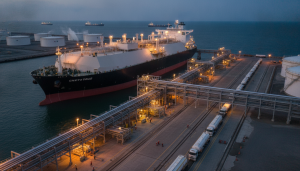
The Alaska LNG project, a colossal undertaking designed to deliver North Slope natural gas to Asian markets, continues to capture the attention of global energy investors despite its formidable price tag exceeding $40 billion. Decades in the making, the project has received renewed political backing, positioning it as a national priority. While proponents express confidence in securing the necessary investment, citing strategic advantages and geopolitical leverage, energy analysts remain cautious, underscoring the critical need for clear commercial logic to underpin such a massive capital commitment. For investors evaluating long-term energy plays, understanding the blend of political will, strategic benefits, and market realities surrounding Alaska LNG is paramount.
The Enduring Allure of Alaska LNG Amidst Skepticism
For years, the vision of an 800-mile pipeline traversing Alaska’s challenging terrain, from the North Slope down to the Cook Inlet for liquefaction and export, has tantalized stakeholders. However, the project’s “eyewatering price tag of more than $40 billion” has consistently been its primary hurdle, preventing it from moving beyond the planning stages for “literally decades.” Despite this historical commercial skepticism, the current administration has vocally championed Alaska LNG, framing it as a strategic national priority. This renewed push suggests a belief that the project’s intrinsic value extends beyond conventional commercial metrics. Proponents envision a staged development, initially serving Alaska’s domestic demand, which faces declining natural gas supplies in the Cook Inlet, before scaling up to international exports. This phased approach aims to mitigate some of the initial investment risk by demonstrating local utility and infrastructure development.
Geopolitical Imperatives and Supply Chain Superiority
A significant part of the revived confidence in Alaska LNG stems from its compelling geopolitical and logistical advantages. The project offers a unique value proposition for Asian allies, particularly Japan and South Korea, who have been urged to invest. Notably, LNG exports from Alaska could reach Japan in approximately eight days, a stark contrast to the roughly 24 days required for U.S. Gulf Coast exports navigating the congested Panama Canal. Furthermore, the route bypasses contested waters in the South China Sea, a critical strategic consideration for energy security. Beyond direct commercial benefits, the Department of Defense’s potential “offtake agreement” to supply gas to “super strategic, important bases across Alaska” underscores the project’s dual-purpose appeal, blending energy security with national defense. This strategic dimension, coupled with the opportunity for countries to “shrink their trade deficit with the United States” by purchasing American energy, highlights the political leverage being applied to secure investor commitments.
Market Realities and Investor Focus on LNG Dynamics
While political will and strategic benefits are strong selling points, investors ultimately scrutinize the commercial viability against prevailing market conditions. As of today, Brent Crude trades at $96.23, marking a 1.52% increase within a day range of $91-$96.38. This current price point, while robust, follows a notable 14-day trend where Brent declined by nearly 9%, from $102.22 on March 25th to $93.22 on April 14th. Such fluctuations naturally lead investors to ask crucial questions, aligning with what our readers are currently asking: “What’s driving Asian LNG spot prices this week?” and “What is the consensus 2026 Brent forecast?” The long-term nature of Alaska LNG, with exports to Asia projected to begin in the early 2030s, means that investors are intensely focused on the sustained trajectory of global energy prices and the stability of LNG demand. The assertion that “financing is pretty straightforward” once commercial offtakers are secured heavily relies on these offtakers seeing a clear, profitable path forward for decades, a calculation influenced by today’s market signals and future price expectations.
Forward Momentum and Key Milestones on the Horizon
Despite the skepticism, concrete steps are underway, and the project’s lead developer anticipates a final investment decision (FID) within the “next six to 12 months” for the initial leg of the pipeline connecting the North Slope to Anchorage. This upcoming FID represents a critical near-term milestone for a project with such a long development timeline, with initial deliveries to southern Alaska projected for 2028 or 2029. For investors tracking the global energy landscape, a series of upcoming events will provide essential context for evaluating the long-term viability of projects like Alaska LNG. The OPEC+ Joint Ministerial Monitoring Committee (JMMC) meeting on April 18th, followed by the Full Ministerial meeting on April 20th, will offer insights into global crude supply policy. Additionally, the weekly API and EIA crude inventory reports on April 21st, 22nd, 28th, and 29th will shed light on demand trends and supply-demand balances. While these events do not directly determine Alaska LNG’s FID, they collectively shape the investment climate and global price deck that underpin any multi-decade energy infrastructure play. A stable or tightening market signaled by these updates could bolster confidence, making long-term LNG commitments more appealing and addressing the “outstanding questions about the timeline and logistics” that potential Asian investors continue to pose.