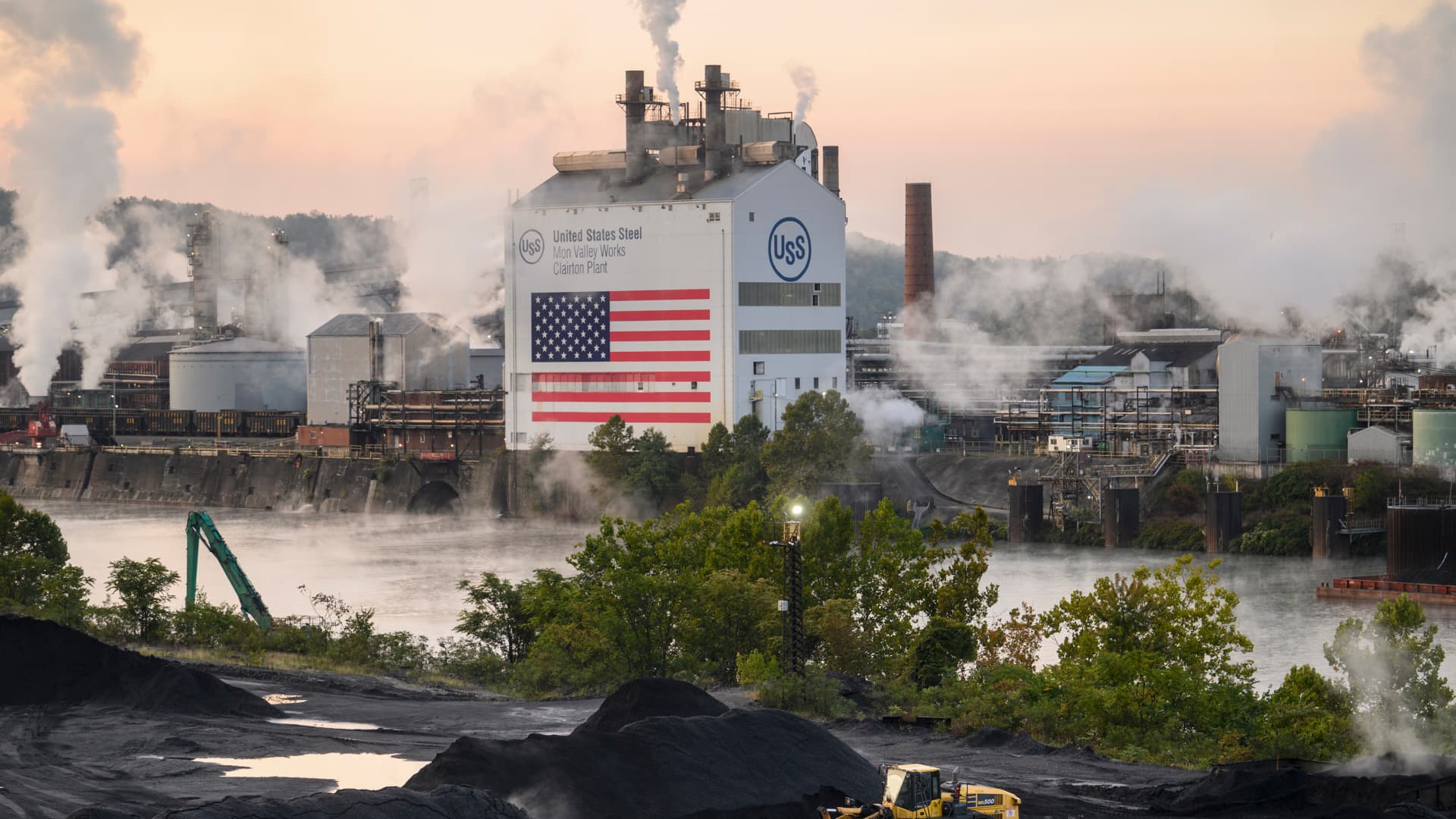
The intricate landscape of industrial mergers and acquisitions has once again captured the attention of market participants, with the proposed acquisition of U.S. Steel by Japan’s Nippon Steel taking center stage. The deal, valued at $55 per share, has navigated a complex path involving shifting political stances and high-level government intervention, creating a unique situation for investors to dissect. A recent rally held by former President Donald Trump at U.S. Steel’s historic Irvin Works facility in West Mifflin, Pennsylvania, brought renewed focus to the transaction, following his public statements that he had effectively cleared the controversial deal.
For investors tracking strategic assets and commodity markets, the specifics of this multi-billion-dollar transaction remain paramount, yet clarity has been elusive. On May 23, Trump utilized his social media platform, Truth Social, to characterize the arrangement as a “partnership.” He asserted that U.S. Steel’s headquarters would firmly remain in Pittsburgh and that Nippon Steel committed to injecting a substantial $14 billion over 14 months into the venerable American industrial titan, which boasts a legacy spanning over 120 years. Further elaborating, Trump told reporters that this constituted an “investment” and “partial ownership,” emphasizing that control would undeniably reside with the United States. However, official details from the White House and the involved corporations regarding the precise structure of this “partnership” have largely been withheld from the public.
Conflicting Narratives on Corporate Control
The ambiguity surrounding the deal’s structure presents a significant point of contention for market analysts. In stark contrast to the former President’s description, U.S. Steel’s own filing with the Securities and Exchange Commission (SEC) on April 8 painted a different picture. According to this official document, the transaction is explicitly termed a “merger,” under which U.S. Steel would transition into a “wholly owned subsidiary” of Nippon Steel North America. Despite this, the filing notes that U.S. Steel would continue its operations as a distinct entity. This discrepancy between political rhetoric and regulatory disclosures creates a challenging environment for investors attempting to assess the future operational autonomy and strategic direction of U.S. Steel.
The journey to this point has been anything but straightforward. The initial bid of $55 per share by Nippon Steel was met with strong opposition, culminating in President Joe Biden’s rejection of the proposed acquisition in January. Biden cited national security concerns, specifically arguing that the deal could jeopardize critical domestic supply chains—a critical consideration for the industrial sector and broader economic resilience. However, the political winds shifted in April when Donald Trump ordered a fresh review of the transaction, indicating a softening of his previous opposition to the Japanese steelmaker’s acquisition of U.S. Steel. His announcement of the “partnership” came just one day after the Committee on Foreign Investment in the United States (CFIUS) was slated to conclude its review and offer recommendations on mitigating any potential national security risks.
The “Golden Share” Mechanism and Governance
A pivotal element in the evolving structure of this deal appears to be the implementation of a “golden share,” a concept detailed by Pennsylvania Senator Dave McCormick. Speaking recently, McCormick revealed that the U.S. government would hold this special share, granting it significant influence over corporate governance. This “golden share” would empower the U.S. government to approve a certain number of board seats. Furthermore, the agreement stipulates that U.S. Steel will maintain an American CEO, and a majority of the board members will be U.S. citizens. McCormick characterized this as a “national security agreement” signed directly with the U.S. government, emphasizing its role in ensuring that production levels are not curtailed, thereby safeguarding domestic industrial capacity.
While Nippon Steel is expected to have representation on the board as part of its overall corporate structure, the intent behind these safeguards is clear: to ensure U.S. control over a vital industry. White House Trade Advisor Peter Navarro further underscored this sentiment, stating that “Nippon Steel is going to have some involvement, but no control of the company,” and unequivocally asserted that “U.S. Steel owns the company.” This position, however, directly conflicts with the SEC filing’s description of U.S. Steel becoming a wholly owned subsidiary, presenting a significant area of uncertainty for shareholders and future corporate strategy. The U.S. Trade Representative, Jamieson Greer, also hinted at ongoing discussions and involvement, signaling the deep governmental oversight embedded in the transaction.
Investment Implications and Market Outlook
For investors, the political machinations surrounding this deal are as critical as the financial terms. The $55 per share offer represents a substantial premium, but the ultimate value for shareholders will depend on the clarity and stability of the post-acquisition governance. The involvement of a “golden share” introduces a unique layer of governmental oversight into a publicly traded company, potentially influencing operational decisions and long-term strategic planning. This could be viewed positively by some as a protective measure for national interests, while others might see it as an added layer of bureaucracy and uncertainty for an international acquirer.
The implications extend beyond U.S. Steel itself, casting a shadow over future international M&A activity involving strategic U.S. assets. The precedent set by this deal, particularly regarding the extent of government intervention and the enforcement of “national security agreements,” will likely inform how foreign entities approach investments in critical American industries. Investors in the broader industrial and commodity sectors should monitor these developments closely, as they reflect evolving U.S. policy towards foreign investment, supply chain resilience, and economic nationalism. The eventual resolution of the U.S. Steel-Nippon Steel transaction will provide crucial insights into the interplay between global capital markets and national sovereignty in an increasingly complex geopolitical landscape, influencing investment decisions across energy, metals, and other foundational sectors.