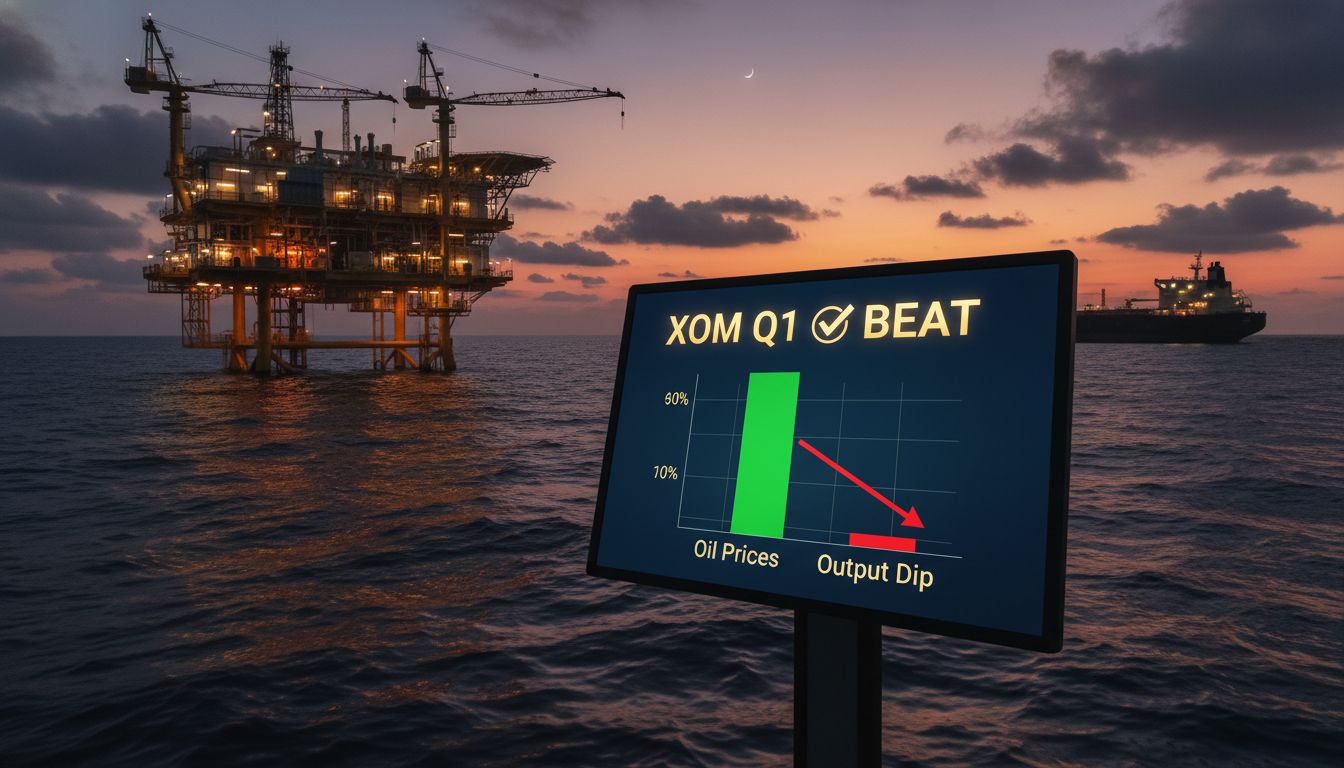
Integrated energy giant ExxonMobil (NYSE: XOM) delivered a robust first-quarter performance, significantly surpassing Wall Street’s profit and revenue forecasts. The company’s adjusted earnings for the period were bolstered by a powerful surge in global crude prices, effectively mitigating the impact of lower hydrocarbon output from its Middle Eastern and Kazakh operations.
For the quarter ending March 31, ExxonMobil reported adjusted earnings, excluding specified items, of $4.9 billion, translating to $1.16 per share. This impressive figure comfortably exceeded the analyst consensus, which had projected earnings per share of $0.98.
Total revenues and other income for the U.S. supermajor reached $85.14 billion during the quarter. This represents a solid increase from the $83.13 billion recorded in the comparable period of the previous year and significantly outpaced market expectations of $82.18 billion, underscoring the company’s strong top-line generation even amid a complex operating environment.
Geopolitical Headwinds and Financial Resilience
ExxonMobil’s financial disclosures highlighted $700 million in identified items impacting the quarter. These losses stemmed primarily from settled financial hedges that could not be fully offset by the corresponding physical oil shipments, a direct consequence of ongoing supply disruptions emanating from the Middle East. These disruptions underscore the acute sensitivity of global energy markets to geopolitical instability and the strategic measures companies must take to manage risk.
Despite these headwinds, the company’s strong refining margins and robust trading activities played a pivotal role in driving the sequential increase in earnings. While scheduled maintenance and the aforementioned Middle East disruptions led to a reduction in overall oil and gas production volumes, the resilience of ExxonMobil’s integrated business model helped to stabilize and elevate its financial results.
Management emphasized that “higher prices and margins, combined with advantaged volume growth, and structural cost savings, provided a substantial boost.” These positive factors were, however, partially tempered by elevated expenses associated with strategic investments and the persistent volume impacts from the Middle East region. This balance reflects a company navigating both opportunities and challenges on a global scale.
Upstream Dynamics: Price Power vs. Production Pullback
Investors closely tracked ExxonMobil’s upstream segment, where the impact of fluctuating commodity prices is most keenly felt. Prior to the official earnings release, ExxonMobil had signaled that a significant upswing in oil and gas prices, partly attributable to escalating tensions in the Middle East, could elevate its first-quarter upstream earnings by as much as $2.9 billion. This price tailwind proved crucial in offsetting the anticipated production declines.
Globally, ExxonMobil’s oil-equivalent production saw a 6% decrease in the first quarter when compared to the preceding fourth quarter of 2025. Net production settled at 4.6 million oil-equivalent barrels per day, a figure lower than the previous quarter’s output. This decline was primarily a consequence of planned operational turnarounds and the direct impact of geopolitical events affecting its operations in key regions.
However, strategic bright spots emerged. ExxonMobil’s commitment to its high-growth assets paid dividends, notably in Guyana, where quarterly production achieved a new record. The South American nation’s output exceeded 900,000 gross barrels of oil per day, a testament to the success of the company’s long-term investment strategy in this prolific offshore basin. This production milestone underscores Guyana’s increasing importance to ExxonMobil’s global portfolio and its role in future supply growth.
Strategic Portfolio Diversification and Regional Focus
The first quarter saw ExxonMobil strategically leverage its core assets in Guyana and the Permian Basin to counter production shortfalls in regions plagued by geopolitical strife. Its operations in Qatar and the UAE, in particular, experienced severe impacts from the regional conflict and the associated challenges with navigation through the Strait of Hormuz, a critical chokepoint for global oil transit. These disruptions necessitated an accelerated focus on diversified production hubs to maintain overall output stability.
The company’s continued investment in the Permian Basin, a cornerstone of U.S. shale production, also played a crucial role. While specific Permian production figures for the quarter were not highlighted as extensively as Guyana’s record, the basin remains a key growth engine, providing flexible and scalable production that can respond to market demands and offset volatility elsewhere. This strategic emphasis on robust, lower-cost assets is a key element of ExxonMobil’s long-term value creation proposition for shareholders.
ExxonMobil’s ability to navigate a volatile global energy landscape, converting higher commodity prices into strong earnings despite operational challenges, reinforces its position as a resilient investment in the energy sector. The company’s strategic asset development, particularly in Guyana, and its integrated business model continue to be critical drivers of financial performance and shareholder value.


