
Close Menu
  • Home
  • Market News
    • Crude Oil Prices
    • Brent vs WTI
    • Futures & Trading
    • OPEC Announcements
  • Company & Corporate
    • Mergers & Acquisitions
    • Earnings Reports
    • Executive Moves
    • ESG & Sustainability
  • Geopolitical & Global
    • Middle East
    • North America
    • Europe & Russia
    • Asia & China
    • Latin America
  • Supply & Disruption
    • Pipeline Disruptions
    • Refinery Outages
    • Weather Events (hurricanes, floods)
    • Labor Strikes & Protest Movements
  • Policy & Regulation
    • U.S. Energy Policy
    • EU Carbon Targets
    • Emissions Regulations
    • International Trade & Sanctions
  • Tech
    • Energy Transition
    • Hydrogen & LNG
    • Carbon Capture
    • Battery / Storage Tech
  • ESG
    • Climate Commitments
    • Greenwashing News
    • Net-Zero Tracking
    • Institutional Divestments
  • Financial
    • Interest Rates Impact on Oil
    • Inflation + Demand
    • Oil & Stock Correlation
    • Investor Sentiment

Subscribe to Updates

Subscribe to our newsletter and never miss our latest news

Subscribe my Newsletter for New Posts & tips Let's stay updated!

What's Hot

US Oil & Gas Prices: March 2026 Outlook

March 31, 2026

IMF Warns Energy Shock as Bangladesh Seeks US Waiver

March 31, 2026

Oil Importers Face Critical Chokepoint Supply Risks

March 31, 2026
Facebook X (Twitter) Instagram Threads
Oil Market Cap – Global Oil & Energy News, Data & Analysis
  • Home
  • Market News
    • Crude Oil Prices
    • Brent vs WTI
    • Futures & Trading
    • OPEC Announcements
  • Company & Corporate
    • Mergers & Acquisitions
    • Earnings Reports
    • Executive Moves
    • ESG & Sustainability
  • Geopolitical & Global
    • Middle East
    • North America
    • Europe & Russia
    • Asia & China
    • Latin America
  • Supply & Disruption
    • Pipeline Disruptions
    • Refinery Outages
    • Weather Events (hurricanes, floods)
    • Labor Strikes & Protest Movements
  • Policy & Regulation
    • U.S. Energy Policy
    • EU Carbon Targets
    • Emissions Regulations
    • International Trade & Sanctions
  • Tech
    • Energy Transition
    • Hydrogen & LNG
    • Carbon Capture
    • Battery / Storage Tech
  • ESG
    • Climate Commitments
    • Greenwashing News
    • Net-Zero Tracking
    • Institutional Divestments
  • Financial
    • Interest Rates Impact on Oil
    • Inflation + Demand
    • Oil & Stock Correlation
    • Investor Sentiment
Oil Market Cap – Global Oil & Energy News, Data & Analysis
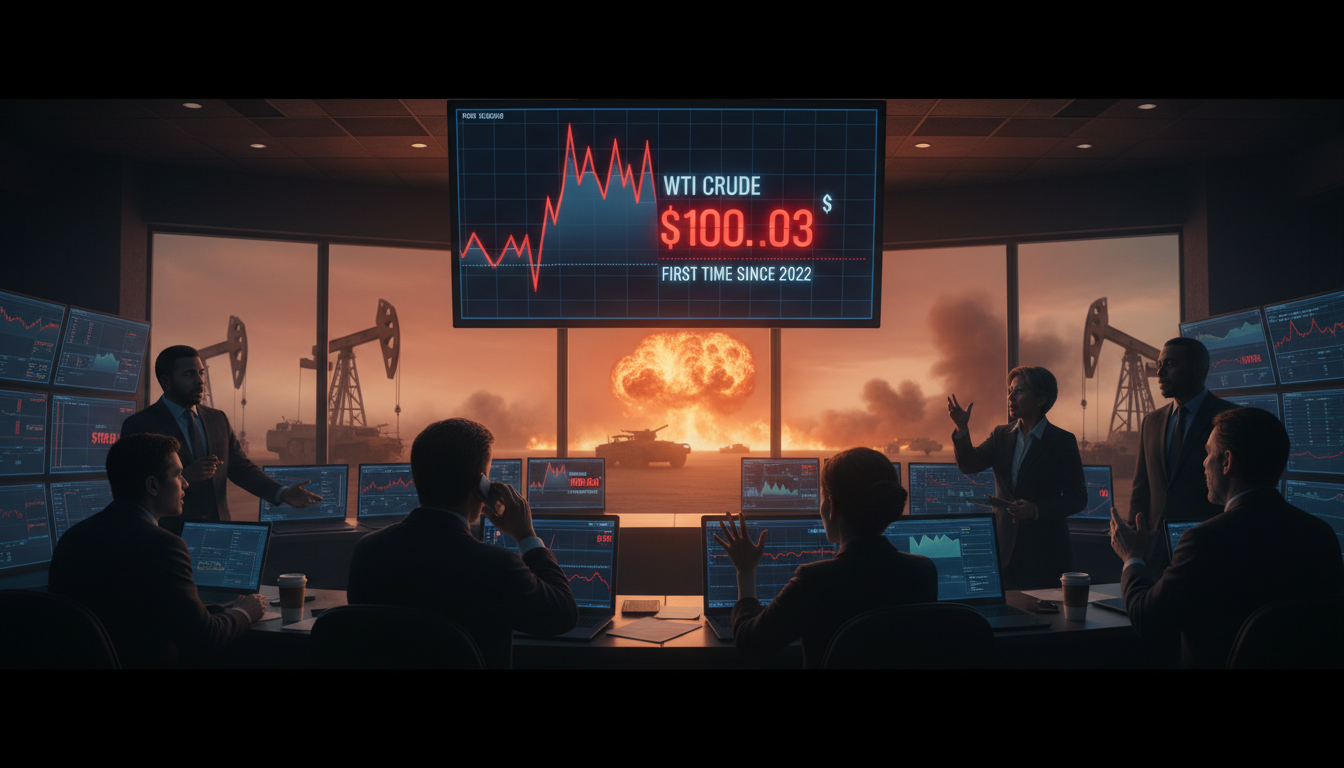
Home » WTI Breaks $100 First Time Since 2022 on Iran War
North America

WTI Breaks $100 First Time Since 2022 on Iran War

omc_adminBy omc_adminMarch 31, 2026Updated:March 31, 2026No Comments4 Mins Read
WTI Breaks $100 First Time Since 2022 on Iran War
Share
Facebook Twitter Pinterest Threads Bluesky Copy Link

Oil Prices Breach $100: Geopolitical Turmoil Rewrites Energy Market Dynamics

The global oil market has reached a critical inflection point, with U.S. crude prices surging beyond $100 per barrel for the first time since 2022. This significant milestone directly reflects the escalating conflict involving Iran and the profound, ongoing disruption to shipping through the Strait of Hormuz. These developments are tightening global oil flows and injecting a substantial geopolitical premium into crude valuations, forcing investors to reassess supply security risks.

West Texas Intermediate (WTI) crude, the key U.S. benchmark, settled near $103 per barrel, while international Brent crude approached the $113 per barrel mark. This upward momentum is fundamentally driven by the severe limitations on vessel traffic navigating the Strait of Hormuz, a strategic maritime corridor that is effectively choking off a vital artery for global energy shipments. Alarmingly, this narrow waterway typically facilitates approximately one-fifth of the world’s total oil flows, making any impediment to its passage a direct threat to global supply stability.

Physical Supply Dominates Market Concerns Amid Regional Tensions

Investor attention has decisively shifted from broader macroeconomic conditions to the tangible availability of physical supply. The current environment is one where genuine concerns about barrels reaching the market outweigh demand-side narratives. The ever-present threat of further damage to critical oil and gas infrastructure within the Persian Gulf looms large. Specifically, the vulnerability of major export facilities, such as Iran’s Kharg Island terminal, could precipitate a dramatic escalation in supply losses, sending shockwaves through an already constrained market. Traders and analysts are meticulously tracking every development, understanding that an attack on such a crucial hub would have immediate and severe repercussions.

The regional conflict has, by now, entered its fifth week, intensifying an already volatile landscape. A notable buildup of U.S. military assets in the area, coupled with persistent attacks involving various regional actors, further elevates the risk profile for oil and gas production and export operations. This militarization underscores the gravity of the situation, signaling to the market that the potential for direct confrontation or severe disruption remains high. For energy investors, this translates into a heightened risk premium embedded in every barrel, as the stability of supply from this pivotal region becomes increasingly precarious.

Analyzing the $100 Threshold: A New Era of Supply Constraint

The decisive breach of the $100 per barrel threshold is not merely a psychological barrier crossed; it signals a fundamental shift in market expectations. Analysts universally agree that this move reflects a market now anticipating a prolonged period of constrained supply and persistently elevated geopolitical risk. This is a departure from previous price surges driven by demand spikes or temporary disruptions. Instead, it indicates a structural re-evaluation of energy security. However, the inherent unpredictability of geopolitical events means that the potential for rapid escalation or, conversely, de-escalation, continues to inject extreme volatility into crude markets, demanding agile and informed investment strategies.

Despite ongoing diplomatic efforts aimed at de-escalation, uncertainty remains exceptionally high. Commodity trading desks and institutional investors are closely monitoring every nuance of developments within the Strait of Hormuz and across surrounding energy infrastructure. A key challenge confronting the market is the limited capacity of producers outside the Middle East to quickly offset any significant supply losses. The world’s existing spare production capacity is already strained, reinforcing the upward pressure on prices. This lack of a readily available supply buffer means that any further shocks from the region will have an outsized impact on global prices and supply chains.

Navigating Volatility: The Enduring Impact of Middle East Security Risks

As the conflict wears on, global oil markets are increasingly being dictated by tangible physical disruptions and acute security risks impacting critical upstream and export systems across the Middle East. For investors, this environment demands a deep understanding of the intricate links between geopolitics and commodity fundamentals. Investment decisions in the oil and gas sector must now rigorously account for the ongoing threat of supply-side shocks emanating from this volatile region. While the long-term energy transition remains a focus, the immediate reality is that energy security and the stability of traditional hydrocarbon supplies are paramount concerns, with significant implications for portfolio performance in the coming months.


Source

Breaks Iran Time War WTI
Share. Facebook Twitter Pinterest Bluesky Threads Tumblr Telegram Email
omc_admin
  • Website

Related Posts

Saudi Asia oil pricing faces war volatility

March 31, 2026

War to June Fuels Strategist’s $200 Oil Call

March 31, 2026

Strategist Warns: June War Pushes Oil to $200

March 31, 2026
Add A Comment
Leave A Reply Cancel Reply

Top Posts

Federal Reserve cuts key rate for first time this year

September 17, 202513 Views

WTI Hits $85: Oil Market Outlook for Investors

May 1, 202510 Views

Inflation or jobs: Federal Reserve officials are divided over competing concerns

August 14, 20259 Views
Don't Miss

BV Expands Climate Bonds Certification Globally

By omc_adminMarch 31, 2026

The global landscape of sustainable finance is undergoing a profound transformation, with robust third-party verification…

Nasdaq, Adyen Back First EU Carbon Removal Deal

March 31, 2026

DHL Expands Green Freight, Bolsters ESG in Europe

March 31, 2026

G-7 Signals Oil Intervention Amid Iran Tensions

March 31, 2026
Top Trending

Nasdaq, Adyen Validate New EU Carbon Standard

By omc_adminMarch 30, 2026

GRI Proposes Stricter ESG Pollution Disclosure

By omc_adminMarch 30, 2026

Fairglow €3M Boosts Green Energy in Beauty

By omc_adminMarch 30, 2026
Most Popular

The 5 Best 65-Inch TVs of 2025

July 3, 202526 Views

AI’s Next Bottleneck Isn’t Just Chips — It’s the Power Grid: Goldman

November 14, 202514 Views

The Layoffs List of 2025: Meta, Microsoft, Block, and More

May 9, 202511 Views
Our Picks

WTI Breaks $100 First Time Since 2022 on Iran War

March 31, 2026

WTI Above $100 on Conflict; Investors Eye Supply Risk

March 31, 2026

US Embassy Venezuela Reopens; Sanctions Focus

March 31, 2026

Subscribe to Updates

Subscribe to our newsletter and never miss our latest news

Subscribe my Newsletter for New Posts & tips Let's stay updated!

Facebook X (Twitter) Instagram Pinterest
  • Home
  • About Us
  • Advertise With Us
  • Contact Us
  • DMCA
  • Privacy Policy
  • Terms & Conditions
© 2026 oilmarketcap. Designed by oilmarketcap.

Type above and press Enter to search. Press Esc to cancel.