

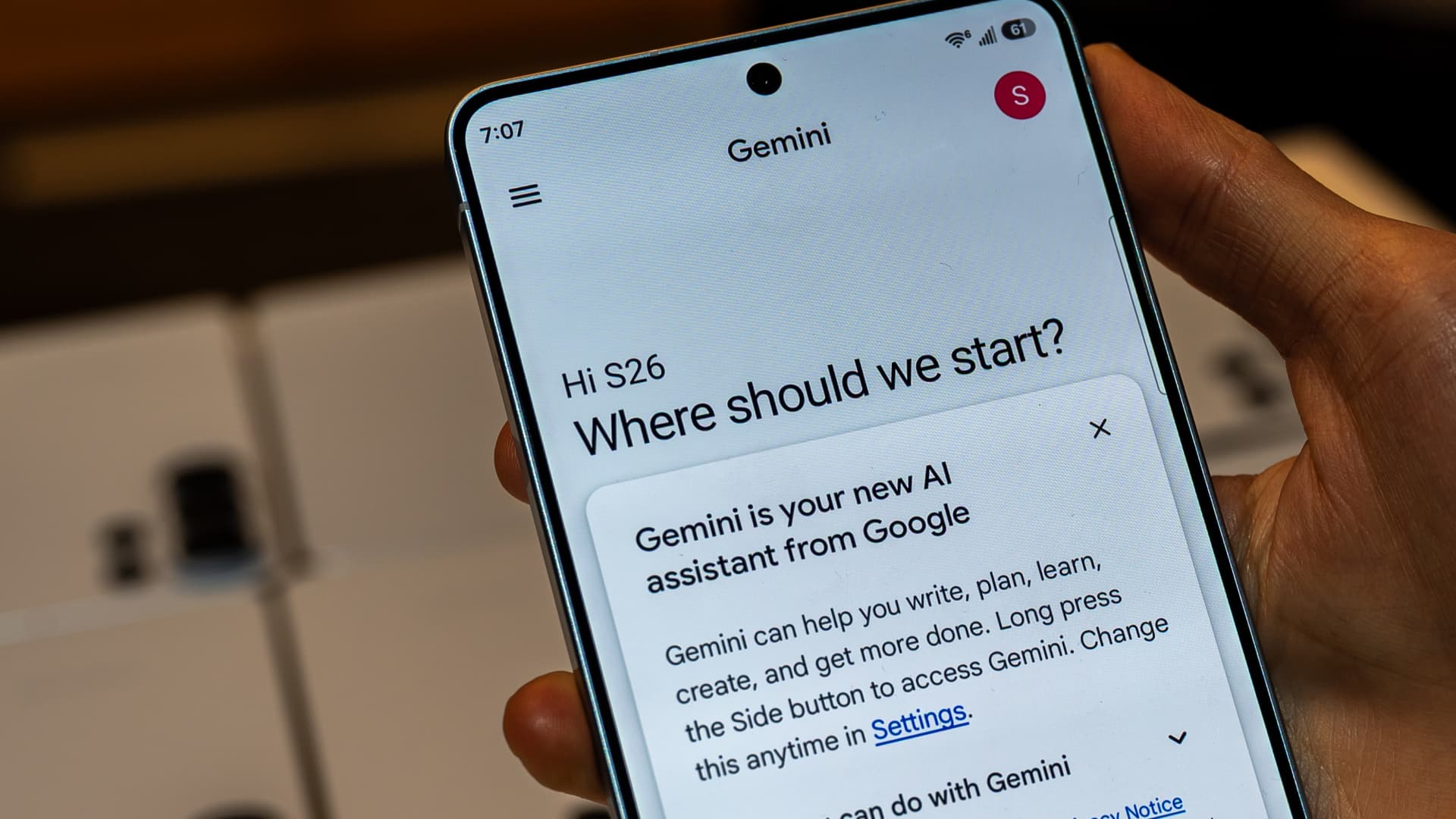
The Gemini AI assistant on a Samsung 26S Ultra smartphone during a product preview event in San Francisco, California, US, on Monday, Feb. 23, 2026.
David Paul Morris | Bloomberg | Getty Images
Samsung on Wednesday unveiled the Galaxy S26 series, its latest flagship smartphone lineup that puts Alphabet‘s Gemini artificial intelligence front and center.
It gives the search giant’s AI technology a major mobile foothold just before it’s expected to power a revamped Siri on Apple‘s iPhones.
The S26 is notable for the sheer number of AI systems packed into a single device.
Samsung is melding together three separate AI engines: Google’s Gemini for agentic tasks like booking rides and acting across apps, Perplexity for web-based queries, and an upgraded version of Samsung’s own Bixby as the on-device assistant powered by a more capable in-house large language model.
It’s a multi-agent approach that reflects just how central the AI arms race has become to selling smartphones — and how aggressively Samsung is hedging its bets across providers rather than relying on any single one.
Still, the deepest of those partnerships is with Google.
Samsung was the first phone maker to ship Gemini when it launched the Galaxy S24 in January 2024. It deepened the integration with the S25 a year later, making Gemini accessible with a long-press of the side button. Now with the S26, Gemini can do something it couldn’t before: Take autonomous action inside third-party apps, not just Samsung’s own.
The relationship hasn’t always been smooth as Samsung spent years pushing its own Tizen operating system and Bixby assistant in an effort to carve out independence from Google’s ecosystem. But in the AI era, the two companies have locked arms more tightly than ever, even as Samsung simultaneously courts Perplexity to diversify its options.
The result is that Samsung has become the single most important distribution channel for Google’s consumer AI — and one that Apple, despite its own billion-dollar Gemini deal, can’t yet match.
Here comes an upgraded Siri
In January, Apple confirmed a multiyear agreement reportedly worth $1 billion annually to use Google’s Gemini models as the foundation for an overhauled Siri. But that upgrade timeline keeps slipping.
Apple had targeted an iOS 26.4 update in March or April for the initial rollout, but Bloomberg reported earlier this month that some features are now being pushed to May or even September.
Samsung’s S26, available for pre-order now with general availability on March 11, means Gemini’s most advanced agentic capabilities will reach consumers first through Samsung handsets.
Apple commands roughly 25% of the global active smartphone installed base to Samsung’s 18%, according to Counterpoint Research, and iPhone users tend to spend significantly more on apps and services.
The Apple deal is the bigger prize, but Samsung is where Google gets to prove its AI works in the real world right now — a live showcase for the technology that will eventually underpin Siri’s comeback.
Using the Samsung agent
The centerpiece of Samsung’s pitch is agentic AI, and Gemini is the engine making that possible.
Charles Uptegrove, a product manager for Samsung’s flagship devices in the U.S., told CNBC in a briefing that the AI assistant can work directly with native Samsung apps such as Calendar, Reminder, and Samsung Notes.
“A user can ask Gemini to find and add an important event directly to their calendar,” Uptegrove said. “Consumers can also use Gemini to pull information from a YouTube video, such as asking to summarize its content and add it to Samsung Notes.”
The most concrete example involves Uber.
Users can summon Gemini, ask it to book a ride, and let the AI handle the entire process in the background — opening the app, selecting options, scrolling through screens — while the user does something else. Samsung said it plans to expand this to additional ride-share apps and eventually food delivery services like Instacart and DoorDash.
It’s a meaningful step up from the S25, where Gemini could only interact with Samsung’s own native apps. Now the AI agent can reach into third-party services, handling multi-step tasks in the background.
Still, it’s worth keeping Samsung’s reach in perspective.
Apple overtook Samsung as the world’s top smartphone seller in 2024, ending its roughly 12-year run atop the market. In November, Counterpoint Research found that Apple iPhone shipments were poised to beat Samsung for the first time in 14 years.
Beyond AI, the S26 Ultra introduces what Samsung calls the mobile industry’s first built-in Privacy Display, which controls how individual pixels disperse light to keep the screen readable for the user while obscuring it from side angles.
Samsung said it has reached 400 million Galaxy AI-enabled devices globally, and expects to double its mobile devices powered by Gemini to 800 million units this year, but the number that matters most for Google right now isn’t Samsung’s — it’s the timeline to Apple’s Siri overhaul.

