The week ending January 9, 2026, was anything but ordinary for crude oil markets. As of late Thursday, WTI was trading at $58.42, up $1.10 or 1.92% for the week so far, with a weekly high of $58.87 and a low of $55.76. While these numbers might suggest relative stability, the forces at play beneath the surface tell a far more dramatic story—one that could reshape global energy markets for years to come.
The Venezuela Shock
The single biggest story this week was President Trump’s military operation that resulted in the capture of Venezuelan President Nicolás Maduro on Friday, January 3. U.S. special forces seized Maduro and his wife from their compound in Caracas and flew them to New York to face drug trafficking charges. Trump announced the U.S. would “run the country” during a transition period and invited American oil companies to invest billions to rebuild Venezuela’s infrastructure.
Venezuela sits on roughly 303 billion barrels of proven reserves—the largest in the world—yet currently produces only around 800,000 barrels per day, less than 1% of global output. The market’s reaction was surprisingly muted. Rather than spiking, oil prices actually dipped early in the week as traders weighed competing scenarios. If Venezuela stabilizes and sanctions lift, those reserves could eventually flood an already oversupplied market. Conversely, political instability could disrupt current production, though rebuilding would require years and tens of billions in investment.
Wednesday’s…
The week ending January 9, 2026, was anything but ordinary for crude oil markets. As of late Thursday, WTI was trading at $58.42, up $1.10 or 1.92% for the week so far, with a weekly high of $58.87 and a low of $55.76. While these numbers might suggest relative stability, the forces at play beneath the surface tell a far more dramatic story—one that could reshape global energy markets for years to come.
The Venezuela Shock
The single biggest story this week was President Trump’s military operation that resulted in the capture of Venezuelan President Nicolás Maduro on Friday, January 3. U.S. special forces seized Maduro and his wife from their compound in Caracas and flew them to New York to face drug trafficking charges. Trump announced the U.S. would “run the country” during a transition period and invited American oil companies to invest billions to rebuild Venezuela’s infrastructure.
Venezuela sits on roughly 303 billion barrels of proven reserves—the largest in the world—yet currently produces only around 800,000 barrels per day, less than 1% of global output. The market’s reaction was surprisingly muted. Rather than spiking, oil prices actually dipped early in the week as traders weighed competing scenarios. If Venezuela stabilizes and sanctions lift, those reserves could eventually flood an already oversupplied market. Conversely, political instability could disrupt current production, though rebuilding would require years and tens of billions in investment.
Wednesday’s EIA Report: Mixed Signals
The EIA report released Wednesday, January 7, provided a split personality view of the market. Crude oil inventories unexpectedly tumbled by 3.8 million barrels for the week ending January 2—a significant drawdown that economists hadn’t anticipated. The market had expected inventories to rise by 1.1 million barrels instead. At 419.1 million barrels, U.S. crude stocks now sit about 3% below the five-year average.
However, the bullish crude draw was offset by surging product inventories. Gasoline stocks jumped 7.7 million barrels and are now 3% above the five-year average, while distillate inventories climbed 5.6 million barrels, though they remain 4% below average. This “drawdown but fuel up” scenario suggests refineries are running hard but demand for finished products remains soft—a troubling sign for the overall health of oil consumption.
The Oversupply Picture
The broader context remains bearish. The EIA forecasts global oil inventory builds could exceed 2 million barrels per day in 2026. Strong production growth from the U.S., Brazil, Guyana, and Canada continues to overwhelm relatively weak demand growth. The EIA projects Brent will fall to an average of $55 per barrel in the first quarter of 2026 and remain near that level throughout the year.
OPEC’s Challenge
OPEC+ faces mounting pressure as it attempts to support prices through production restraint. The cartel is keeping voluntary cuts in place, but non-OPEC countries are adding supply faster than global demand is growing. The EIA expects OPEC+ to produce about 1.3 million barrels per day less than targeted production in 2026 simply to prevent further price deterioration. Saudi Arabia and its allies are essentially ceding market share to protect prices, but with limited success.
Russia and China: Sanctions and Strategic Stockpiling
This week brought continued uncertainty around Russian oil flows despite sanctions, with the market watching closely how much Russian crude actually gets disrupted. China, meanwhile, continues building strategic reserves aggressively—stockpiles have hit record levels exceeding 1.2 billion barrels—which has provided some price support. However, China’s underlying demand growth remains tepid as electric vehicle adoption accelerates.
Market Volatility
What’s notable this week is the absence of geopolitical risk premiums. Typically, military action in a major oil-producing nation would send prices soaring. Instead, traders took a measured approach, recognizing that immediate supply disruptions are unlikely given Venezuela’s minimal current production. The market is clearly more concerned about oversupply than geopolitical theatrics.
Weekly Light Crude Oil Futures
Trend Indicator Analysis
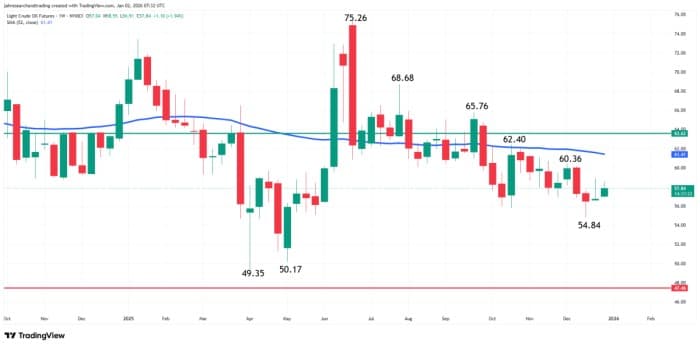
Light crude oil futures are consolidating inside the $60.36 to $54.84 range for the third week. The mid-point of this range at $57.60 is controlling the near-term direction of the market.
Weekly Technical Forecast
The direction of the weekly Light Crude Oil Futures market for the week ending January 16 is likely to be determined by trader reaction to $57.60.
Bullish Scenario
A sustained move above $57.60 will signal strong short-covering and renewed buying interest. If this move generates sufficient upside momentum, the 52-week moving average at $61.19 will come into play. However, unless the buying is strong enough to overtake this indicator, traders will remain in “sell the rally” mode.
Bearish Scenario
A sustained move below $57.60 will indicate active selling pressure. This could trigger a sharp decline into the December bottom at $54.84. This will put the main bottoms at $50.17 to $49.35 back on the radar.
Outlook for Next Week
Traders will watch for any developments in Venezuela’s political situation and monitor weekly inventory data for signs of accelerating surplus. Winter demand remains crucial, though no major weather-related supply disruptions are expected.
Short-term, expect continued downward pressure as the oversupply narrative dominates. The Venezuela story could be transformative long-term if stability returns and investment flows in, but that’s a multi-year proposition. For now, investors should expect a market characterized by abundant supply, weak refined product demand, and limited upside potential despite the headlines.
Technically, trader reaction to $57.60 sets the short-term tone. The longer-term is being controlled by the 52-week moving average. As long as the market remains below $61.19, traders will be “sell the rally” mode.



