

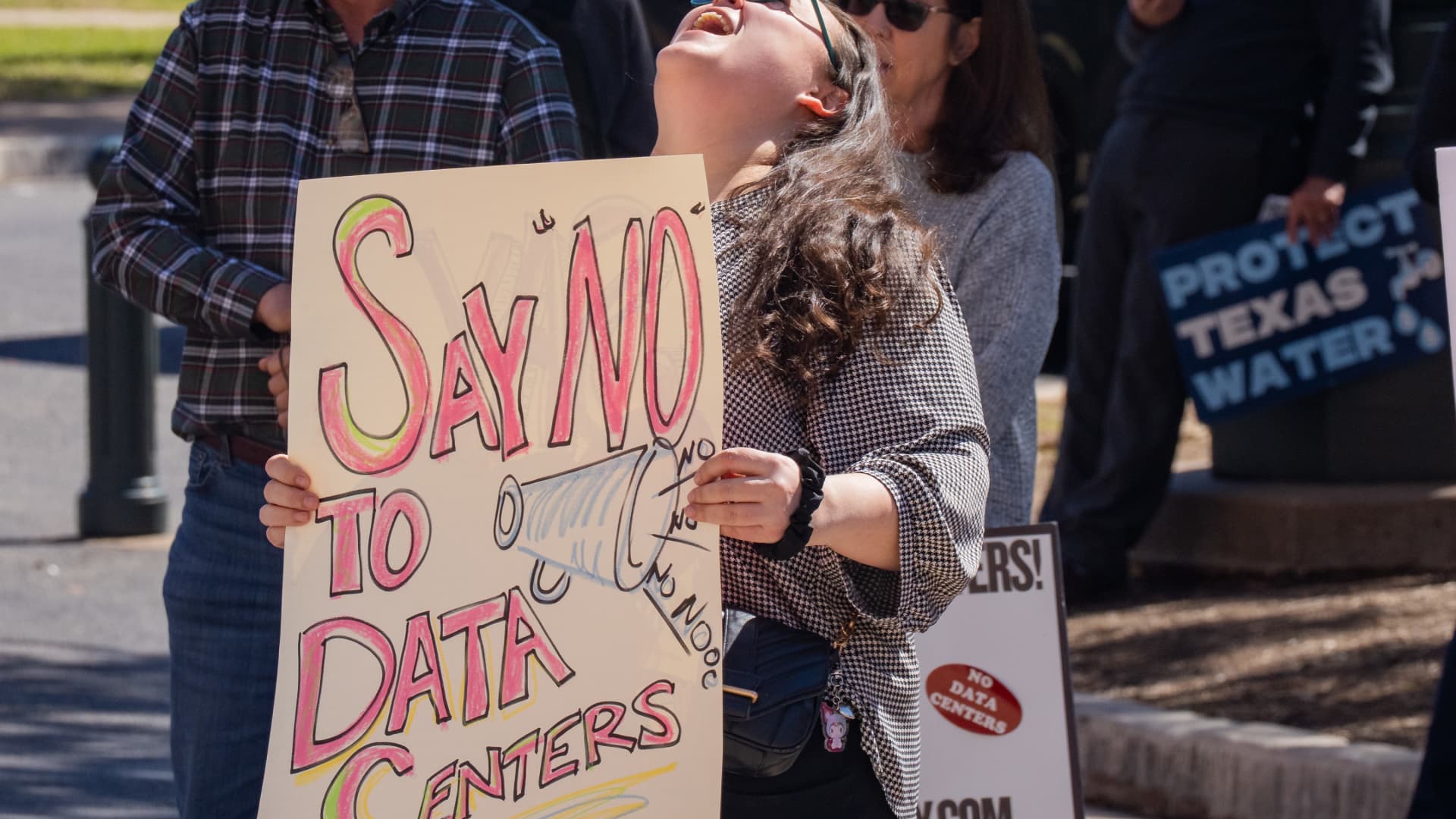
Advocacy groups and community members protest laws surrounding data centers while outside the Texas Capitol in Austin Monday, Feb. 23, 2026.
Austin American-statesman/hearst Newspapers | Hearst Newspapers | Getty Images
The companies racing to build the massive infrastructure needed for the artificial intelligence boom are facing growing backlash over electricity costs, as households and policymakers question whether data centers are driving up power bills.
However, a recent report from SemiAnalysis, a semiconductor research firm, argued that the expansion of data centers is only part of the story, and claimed that market design and policy decisions play a greater role in these energy price increases than AI infrastructure growth alone.
From rural Virginia to the Arizona desert, communities that once welcomed tech investment are now pushing back against data centers amid growing concerns that these facilities — built by so-called AI hyperscalers — are straining local power grids, raising costs for everyone else.
Since 2020, residential electricity prices in the U.S. have risen by more than 36%, from 12.76 cents per kilowatt-hour to 17.44 cents per kilowatt-hour in February 2026, and are expected to hit 19.01 cents per kilowatt-hour by September 2027, according to the latest forecast by the U.S. Energy Information Administration.
“Retail electricity prices have increased faster than the rate of inflation since 2022, and we expect them to continue increasing through 2026,” the EIA said in a March 2025 report before the Iran War.
U.S. President Donald Trump recently also acknowledged the problem for the industry, saying data centers “need some PR help.”
Localized pricing mechanisms
Retail electricity prices in the U.S. reflect the costs of generating, transmitting, and delivering power, along with other factors such as taxes and utility investments to upgrade aging infrastructure.
SemiAnalysis claimed that an obscure market pricing mechanism known as the Base Residual Auction accounted for most of the “runaway” energy prices in the PJM Interconnection area — a regional grid operator serving 13 eastern states and home to data centers from hyperscalers like Google, Anthropic, and Amazon.
Under the mechanism, consumers make payments for expected electricity costs two years in advance, ensuring sufficient power availability during peak demand periods, such as heatwaves or winter storms.
Future energy prices under the mechanism are forecasted prices based on anticipated future demand, calculated through simulations run on proprietary models and data. But with all prediction models, parameters may not always reflect real-world circumstances.
SemiAnalysis argued that PJM’s forecasts often overestimated future demand, particularly as many planned data centers in the area faced construction or assembly delays due to a chronic memory shortage.
The report contrasted PJM with another energy grid overseen by the Electric Reliability Council of Texas, where it said prices have remained relatively stable since 2022, despite the development of data center complexes by hyperscalers such as OpenAI, Anthropic, and Google.
In the U.S., where regulations governing power grids are decentralized across states and utility providers, market design often determines how additional costs are passed on to households.
The EIA also noted regional price disparities in a March 2025 report, saying that regions with high residential electricity prices could see increases above the national average.
“In a constrained capacity market like PJM, prices have increased dramatically as data center demand has increased. However, other markets enable a more fulsome direct cost allocation,” Maeghan Rouch, partner at Bain & Company, told CNBC.
It may also not always be clear exactly what drives upward increases in consumer energy prices, as unrelated investments in local grids, such as grid hardening and modernization, or overall inflation, may also weigh on households, Rouch added.
“Even in the absence of data center investment, we’d still expect some degree of upward pressure on price growth,” Rouch said.
Pledges from hyperscalers
Large technology companies have also worked to assuage concerns about their energy use, with pledges to cover the electricity costs for their projects or to develop alternative energy sources.
In January, Microsoft outlined a five-point plan, including a pledge to cover any additional electricity costs resulting from its data centers, among other community investments. This was followed by a similar commitment by Anthropic in February.
Most recently, President Trump summoned executives from leading AI corporations to the White House to affirm the Ratepayer Protection Pledge, ensuring that expenses incurred by new AI data centers are not passed on to American consumers.
The problem is, the industry’s not making money, so that puts even more pressure on them.
Marc Einstein
Research director, Counterpoint Research
Such commitments could prove particularly important for “drawing support from communities that otherwise might oppose [data center] projects,” according to Chris Howard, head of data centers account management at JLL, especially if data center development were accompanied by alternative investments in local communities, such as jobs or training.
But experts have questioned the legitimacy of such commitments, given that hyperscalers have struggled to turn profits.
“The problem is, the industry’s not making money, so that puts even more pressure on them,” Marc Einstein, research director from Counterpoint Research, said.
Hyperscalers should also clarify their plans to address rising electricity costs, he added. “If they’re quiet about it, that’s going to allow the rumor mill to fly off the handle.”

Tech companies have also committed to meeting data center needs through renewable sources.
Such alternative energy sources will become increasingly important as concerns over energy availability grow due to the growing demand for data centers worldwide, according to JLL’s Howard.
“The average wait time for a grid connection in primary data center markets is already between four to six years, and up to 10 years in cities like Tokyo,” Howard said.
Globally, these energy shortfalls could “create massive opportunities for energy producers, particularly when it comes to renewable energy,” he added.
However, skepticism toward renewable energy commitments within the U.S.’ current administration has raised questions about how far such sustainability pledges will advance in the country, Howard said.
Even so, analysts say it may be in the corporate interests of the AI hyperscalers to deliver on these pledges.
“It would definitely be better PR,” Einstein said.
But public backlash could also prompt regulators to impose new rules on hyperscalers, Einstein added, “which is really not what they want.”
