

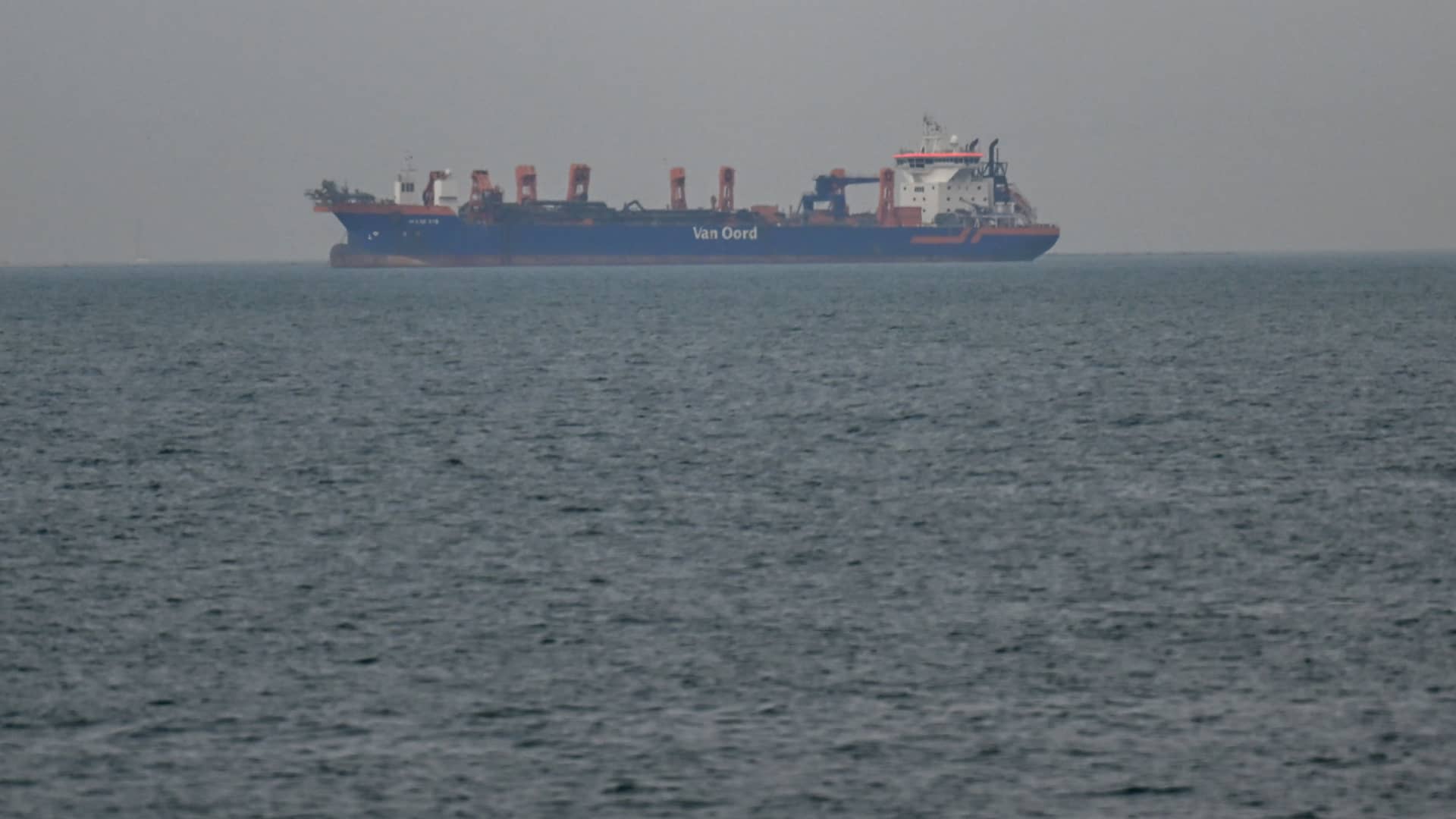
Commercial ships anchor off the coast of the United Arab Emirates due to navigation disruptions in the Strait of Hormuz, Dubai on March 2, 2026.
Anadolu | Getty Images
The closure of the Strait of Hormuz by Iran is sending shockwaves across global energy markets, with Asia expected to face the maximum pain.
A senior commander from Iran’s Revolutionary Guards said Monday that the Strait of Hormuz had been shut and warned that any vessel attempting to transit the waterway would be targeted, Iranian media reported.
Located between Oman and Iran, the Strait functions as a vital artery for global oil trade. Roughly 13 million barrels per day passed through it in 2025, representing about 31% of all seaborne crude flows, according to energy consulting firm Kpler.
A prolonged closure of the Strait would likely lead to a further surge in oil prices, with some analysts seeing oil crossing $100 per barrel. Global benchmark Brent was last up 2.6% at around $80 per barrel —almost 10% higher since the conflict broke out.
About 20% of global liquefied natural gas exports that come from the Gulf are also at risk, primarily those originating from Qatar and shipped via the Strait of Hormuz, according to Kpler. Qatar, one of the world’s largest providers of LNG, halted production on Monday after Iranian drones hit its facilities at Ras Laffan Industrial City and Mesaieed Industrial City.
“In Asia, Thailand, India, Korea and the Philippines are the most vulnerable to higher oil prices, due to their high import dependence, while Malaysia would be a relative beneficiary since it is an energy exporter,” Nomura wrote in a note on Monday.
Here’s how those reliant on Gulf energy and shipments via the Strait of Hormuz stand to be impacted.
South Asia: immediate physical strain
South Asia would face the most acute disruption, particularly when it comes to supplies of LNG, analysts said.
Qatar and the UAE account for 99% of Pakistan’s LNG imports, 72% of Bangladesh’s, and 53% of India’s, according to Kpler data.
With limited storage and procurement flexibility, Pakistan and Bangladesh are especially vulnerable. For one, Bangladesh is already running a significant structural gas deficit. According to the Institute for Energy Economics and Financial Analysis, the country is running a shortfall of more than 1,300 million cubic feet per day.
“Pakistan and Bangladesh have limited storage and procurement flexibility, meaning disruption would likely trigger fast power-sector demand destruction rather than aggressive spot bidding,” Katayama said.
India faces the largest combined exposure in the region. “More than half of its LNG imports are Gulf-linked, and a significant share is Brent-indexed, so a Hormuz-driven crude spike would simultaneously lift oil import costs and LNG contract prices. That creates a dual physical and financial shock,” he said.
Similarly, about 60% of India’s oil imports come from the Middle East, according to UBP. A sustained blockade would therefore amplify both energy import costs and current-account pressures.
China: large exposure but sufficient buffer
A Hormuz closure would test China’s energy security, but stockpiles and alternative supply offer some buffer.
The country is the world’s largest crude oil importer, and purchases over 80% of Iranian oil, according to Kpler.
Around 30% of its LNG imports come from Qatar and the UAE, and roughly 40% of its oil imports pass through Hormuz, UBP estimates.
“China is materially exposed but more flexible,” Kpler’s Katayama said.
According to Kpler, China’s LNG inventories as of end-February stand at 7.6 million tons, providing short-term cover. However, China would need to compete for Atlantic cargoes if the outage persists, tightening the Pacific basin, Katayama added. In which case, the dynamic could intensify price competition across Asia even if Beijing avoids outright shortages.
Saudi Arabia has increased crude loadings in recent weeks, and strategic petroleum reserves held by major consuming nations like China, could provide some temporary cushioning to the market, Rystad Energy said in a note on Sunday.
UBP said that while China is a key net energy importer in the region, it is not necessarily the most vulnerable to potential supply shocks.
Japan and South Korea
The Middle East supplies 75% of Japan’s oil imports and around 70% of Korea’s, according to UBP.
For LNG, their Gulf exposure is lower than South Asia’s. South Korea sources 14% of its LNG from Qatar and the UAE, while Japan sources 6%, Kpler estimates.
Even without outright shortages, price effects could be severe. “Economies with high energy import reliance such as Japan, South Korea, and Taiwan are more exposed to supply shocks,” said Shier lee Lim, lead macro and FX strategist of APAC at payments platform Convera.
Inventories are also limited. Korea holds about 3.5 million tons of LNG and Japan around 4.4 million tons in reserves, enough for roughly two to four weeks of stable demand, according to Kpler.
South Korea’s net oil imports are 2.7% of GDP, with Nomura flagging it amongst the most vulnerable on the current-account front.
Southeast Asia
Across much of Southeast Asia, the first-order hit is cost inflation rather than an immediate shortage, said industry experts.
Spot-reliant LNG buyers would face sharply higher replacement costs as Asia competes with Europe for Atlantic cargoes, said Kpler’s Katayama.
Thailand especially is a standout oil-price loser in Nomura’s framework because the external hit is large and immediate: it has the biggest net oil imports in Asia at 4.7% of GDP, and each 10% oil price rise worsens the current account by around 0.5 percentage point of the country’s GDP.
