(Oil and Gas 360) – Energy Advisors continuing series on Coterra Energy, Devon Energy, Kimmeridge, and Scott Sheffield asks the ultimate question: Can 1+1 ever equal 3 in the M&A world?

Click New Devon, What’s 1+1? to download the report series. Our first report“ The Debate Begins” looked at what a Coterra and Devon merger would look like vs. Coterra becoming a Delaware pure-play by shedding its mature Marcellus and legacy Anadarko. We followed with The Debate Continues which looked at the impact of Kimmeridge’s intent to nominate Scott Sheffield as Coterra Chairman.
Today. In Theory.
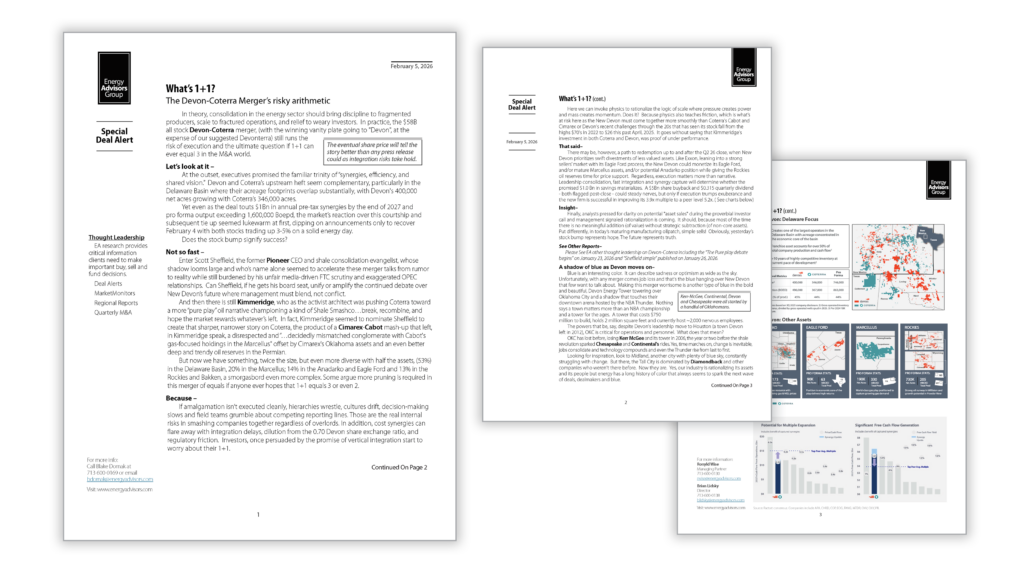
In theory, consolidation in the energy sector should bring discipline to fragmented producers, scale to fractured operations, and relief to weary investors. In practice, the $58B all stock Devon-Coterra merger still runs the risk of execution and the ultimate question if 1+1 can ever equal 3 in the M&A world.
Let’s look at it.
At the outset, executives promised the familiar trinity of “synergies, efficiency, and shared vision.” Devon and Coterra’s upstream heft seem complementary, particularly in the Delaware Basin where their acreage footprints overlap, with Devon’s 400,000 net acres growing with Coterra’s 346,000 acres.
Yet even as the deal touts $1Bn in annual pre-tax synergies by the end of 2027 and pro forma output exceeding 1,600,000 Boepd, the market’s reaction over this courtship and subsequent tie up seemed lukewarm at first, dipping on announcements only to recover February 4 with both stocks trading up 3-5% on a solid energy day.
Does the stock bump signify success?
Not so fast.
Enter Scott Sheffield, the former Pioneer CEO and shale consolidation evangelist, whose shadow looms large and who’s name alone seemed to accelerate these merger talks from rumor to reality. Can Sheffield, if he gets his board seat, unify or amplify the continued debate over New Devon’s future where management must blend, not conflict?
And then there is still Kimmeridge, who as the activist architect was pushing Coterra toward a more “pure play” oil narrative championing a kind of Shale Smashco…break, recombine, and hope the market rewards whatever’s left. Kimmeridge’ seemed to nominate Sheffield to create that sharper, narrower story on Coterra, the product of a Cimarex-Cabot mash-up that left, in Kimmeridge speak, a disrespected and “…decidedly mismatched conglomerate with Cabot’s gas-focused holdings in the Marcellus” offset by Cimarex’s Oklahoma assets and an even better deep and trendy oil reserves in the Permian.
A bigger, more complex portfolio.
But now we have something, twice the size, but even more diverse with half the assets, (53%) in the Delaware Basin, 20% in the Marcellus; 14% in the Anadarko and Eagle Ford and 13% in the Rockies and Bakken, a smorgasbord even more complex. Some argue more pruning is required in this merger of equals if anyone ever hopes that 1+1 equals 3 or even 2.
If amalgamation isn’t executed cleanly, hierarchies wrestle, cultures drift, decision-making slows and field teams grumble about competing reporting lines. Those are the real internal risks in smashing companies together regardless of overlords. In addition, cost synergies can flare away with integration delays, dilution from the 0.70 Devon share exchange ratio, and regulatory friction. Investors, once persuaded by the promise of vertical integration, start to worry about their 1+1.
Physics, momentum…and friction.
We can invoke physics to rationalize the logic of scale where pressure creates power and mass creates momentum. Does it? Because physics also teaches friction, which is what’s at risk here as the New Devon must come together more smoothly than Coterra’s Cabot and Cimarex or Devon’s recent challenges through the 20s that has seen its stock fall from the highs $70’s in 2022 to $26 this past April, 2025.
Path to redemption?
There may be, however, a path to redemption up to and after the Q2 26 close if New Devon prioritizes swift divestments of less valued assets. Like Exxon, leaning into a strong sellers’ market with its Eagle Ford process, the New Devon could monetize its Eagle Ford, and/or mature Marcellus assets, and/or potential Anadarko position while giving the Rockies oil time for price support.
Regardless, execution matters more than narrative. Leadership consolidation, fast integration and synergy capture will determine whether the promised $1.0 Bn in savings materializes. A $5Bn share buyback and $0.315 quarterly dividend both flagged post-close – could steady nerves, but only if execution trumps exuberance and the new firm improves its price/cash flow 3.9x multiple to a peer level 5.2x.
Insight, subtraction creates value.
Analysts pressed for clarity on potential “asset sales” during the proverbial investor call and management signaled rationalization is coming. It should, because most of the time there is no meaningful addition (of value) without strategic subtraction (of non-core assets). Put differently, in today’s maturing manufacturing oilpatch, simple sells! Obviously, yesterday’s stock bump represents hope. The future represents truth.
A shadow of blue as Devon moves on–
Blue is an interesting color. It can describe sadness or optimism as wide as the sky. Unfortunately, with any merger comes job loss and that’s the blue hanging over New Devon that few want to talk about. Making this merger worrisome is another type of blue in the bold and beautiful, Devon Energy Tower towering over Oklahoma City and a shadow that touches their downtown arena hosted by the NBA Thunder. Nothing says a town matters more than an NBA championship and a tower for the ages. A tower that costs $750 million to build, holds 2 million square feet and currently hosts ~2,000 nervous employees.
The powers that be, say, despite Devon’s leadership move to Houston (a town Devon left in 2012), OKC is critical for operations and personnel. What does that mean?
OKC has lost before, losing Kerr McGee and its tower in 2006, the year or two before the shale revolution sparked Chesapeake and Continental’s rides. Yes, time marches on, change is inevitable, jobs consolidate and technology compounds and even the Thunder rise from last to first.
Looking for inspiration, look to Midland, another city with plenty of blue sky, constantly struggling with change. But there, the Tall City is dominated by Diamondback and other companies who weren’t there before. Now they are. Yes, our industry is rationalizing its assets and its people, but energy has a long history of color that always seems to spark the next wave of deals, dealmakers and blue.
About Energy Advisors oilandgas360.com contributor
Energy Advisors is a leading firm in oil and gas transaction advisory services and thought leadership having served the industry for over 35 years. We trace our roots back to PLS Inc which sold its listing service, research, and databases to DrillingInfo in 2018 and rebranded its advisory and marketing arm as Energy Advisors in 2019.
Contacts:
Brian Lidsky
Director of Research
713-600-0138
Blake Dornak
VP, Marketing
713-600-0123
[email protected]
The views expressed in this article are solely those of the author and do not necessarily reflect the opinions of Oil & Gas 360. Please consult with a professional before making any decisions based on the information provided here. The information presented in this article is not intended as financial advice. Contact Energy Advisors for the full report. Please conduct your own research before making any investment decisions.