

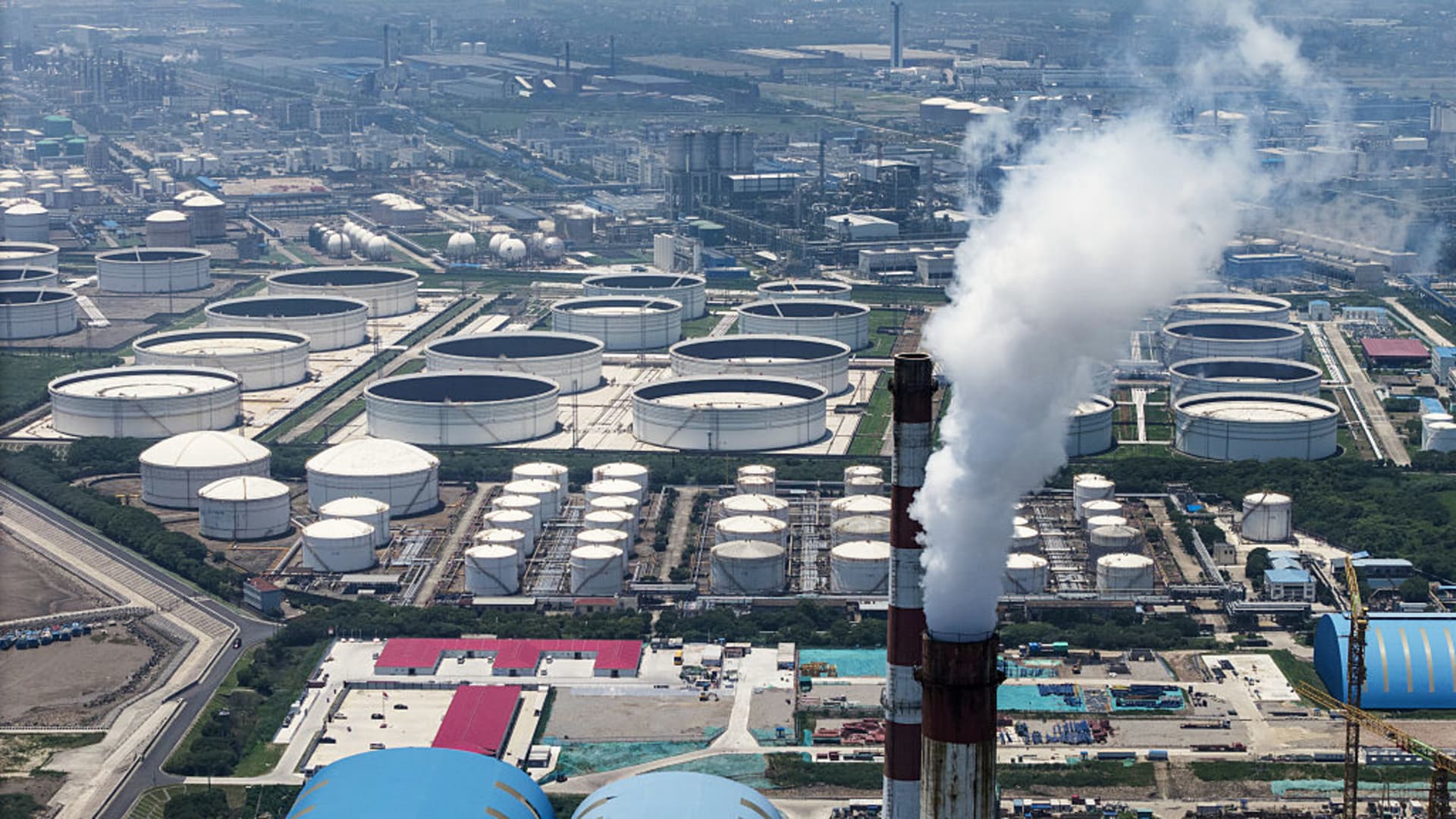
Oil storage tanks at a petrochemical production base on the outskirts of Shanghai, China, on Saturday, June 28, 2025. China buys around 90% of Iran’s oil exports of roughly 1.7 million barrels a day. Source: Bloomberg
Bloomberg | Bloomberg | Getty Images
The U.S. and Israeli strikes on Iran are being debated largely through the familiar lenses of military escalation risk, nuclear deterrence theory, and Middle Eastern geopolitical instability. But the most important strategic consequences may unfold far from the region itself. The country now facing the most consequential near-term economic and strategic test is China, whose dependence on global energy flows makes it immediately vulnerable to disruption even as its long-term planning appears increasingly validated by precisely this kind of geopolitical shock.
In the near term, Beijing faces real exposure. China is the world’s largest importer of crude oil, and a substantial portion of those imports moves through the Strait of Hormuz, one of the most sensitive chokepoints in the global economy. The danger is not limited to a full closure of the waterway. The mere possibility that Hormuz could become contested access territory is enough to drive insurance costs higher, alter tanker routing, and push markets to price scarcity long before physical supply is interrupted. For an economy still managing uneven recovery and fragile domestic demand, higher oil prices quickly translate into rising industrial costs and renewed pressures across the economy.
China’s situation is further complicated by its reliance on discounted Iranian crude acquired under sanctions conditions. Those purchases (along with those from Venezuela) provided Beijing with economic advantages, but they also tethered part of China’s energy security to politically fragile suppliers. Any sustained disruption to Iranian exports forces Chinese refiners into sharper competition for replacement barrels in already constrained markets. In the short term, instability in the Gulf represents genuine economic pain for China rather than strategic opportunity.
The U.S. has taken action in very short order against two of China’s key petro-state partners. Whether it is inadvertent or part of a grand strategic design, China will see it as evidence that despite the quieter rhetorical climate in U.S.-China relations, the U.S. long-term strategy design to limit China’s global competitiveness and capacity has not changed. This could be an agenda item at the end of this month if the Trump visit isn’t postponed.
Beijing has been preparing for this energy shock
Yet this immediate vulnerability, which is real and should not be dismissed, tells only part of the story. The current crisis closely resembles the scenario Chinese policymakers have spent more than a decade preparing for. Beginning in the early 2010s, Beijing reshaped its energy security strategy around a simple assumption: geopolitical shocks, sanctions regimes, and maritime chokepoints would become recurring features of the international system, not periodic bugs.
China responded by diversifying across suppliers, technologies, and energy sources. Oil imports expanded across Russia (particularly after the Russian invasion of Ukraine), the Middle East, Latin America, and Africa while strategic petroleum reserves were built to buffer sudden shocks like the ones that may be on the near-term horizon. At the same time, Beijing accelerated renewable deployment on a scale unmatched globally. The renewables strategy played heavily in the 14th and soon we will see it again in the 15th Five Year Plan.
What many outside observers interpreted primarily as climate policy was equally a national security strategy. Domestically generated energy reduces exposure to unstable suppliers and vulnerable shipping routes. Each incremental expansion of renewable capacity lowers China’s dependence on precisely the geopolitical conditions now driving market anxiety.

The disruption of oil flows from both Iran and Venezuela reinforce why diversification became central to Beijing’s planning. Chinese refiners have repeatedly adjusted to sanctions and supply interruptions by redirecting purchases across multiple partners. The system was never designed to totally eliminate supply shocks but was designed to ensure that no single disruption could paralyze the broader economy. Seen from Beijing, today’s turmoil confirms rather than contradicts long-standing assumptions about global energy insecurity. A diversified energy mix, increasingly supported by domestic renewables, became a survival strategy.
How China can benefit from U.S.-Iran conflict
Ironically, the longer-term implications of the crisis may also present China with new economic opportunities. If Iran eventually emerges from a crushing international sanctions regime and becomes more integrated into global markets, Chinese firms will likely expand their presence rather than retreat in defeat, as many in the U.S. might hope or expect. China’s current investment in Iran operates well under the radar and under legal and financial constraints that limit scale, opportunities, and visibility. A post-sanctions environment would remove many of those barriers and likely supercharge China investments and involvement in Iran’s economy.
Chinese infrastructure firms, energy companies, and financial institutions specialize in precisely the large-scale development projects a reintegrating Iran would require for its recovery. Expanded access to global finance would allow Chinese capital to operate openly rather than cautiously, broadening cooperation beyond oil into transportation, manufacturing, and industrial development, technology, and other critical infrastructure sectors. Contrary to common assumptions, a more open or even more Western-leaning Iran would not necessarily diminish China’s role. It could instead accelerate it.
Western companies anticipating opportunities in a “new” Iran should expect competition similar to what they face from China across emerging markets worldwide. While it is possible that the U.S. seeks to lock China out of Iran and limit or leverage China as it pertains to Iranian oil in the near term, this requires a multi-year calculus if it is to be successful. China will and can adjust and wait Trump out.
This reflects a broader feature of China’s global strategy. Beijing’s influence often grows not through political alignment but through economic persistence, patient capital, rapid scaling, and coordinated action between state institutions and commercial actors. Infrastructure and investment relationships frequently outlast shifts in political orientation. For China, stability and access matter more than ideology.
The paradox here is clear. The same instability likely to produce short-term economic strain for China now simultaneously reinforces the logic behind its long-term planning. For more than fifteen years, Chinese policymakers have assumed the international system would become more volatile and less predictable. Diversification of energy sources, expansion of renewables, and accumulation of strategic reserves were responses to that expectation.
Events in Iran validate that worldview. Short-term disruption reinforces long-term resilience while positioning China for expanded economic opportunity in the future. Iran may dominate today’s headlines, but for Beijing the episode looks less like a crisis than confirmation that preparation for geopolitical uncertainty was not premature. It was necessary.
—By Dewardric McNeal, managing director and senior policy analyst at Longview Global, and a CNBC Contributor

