

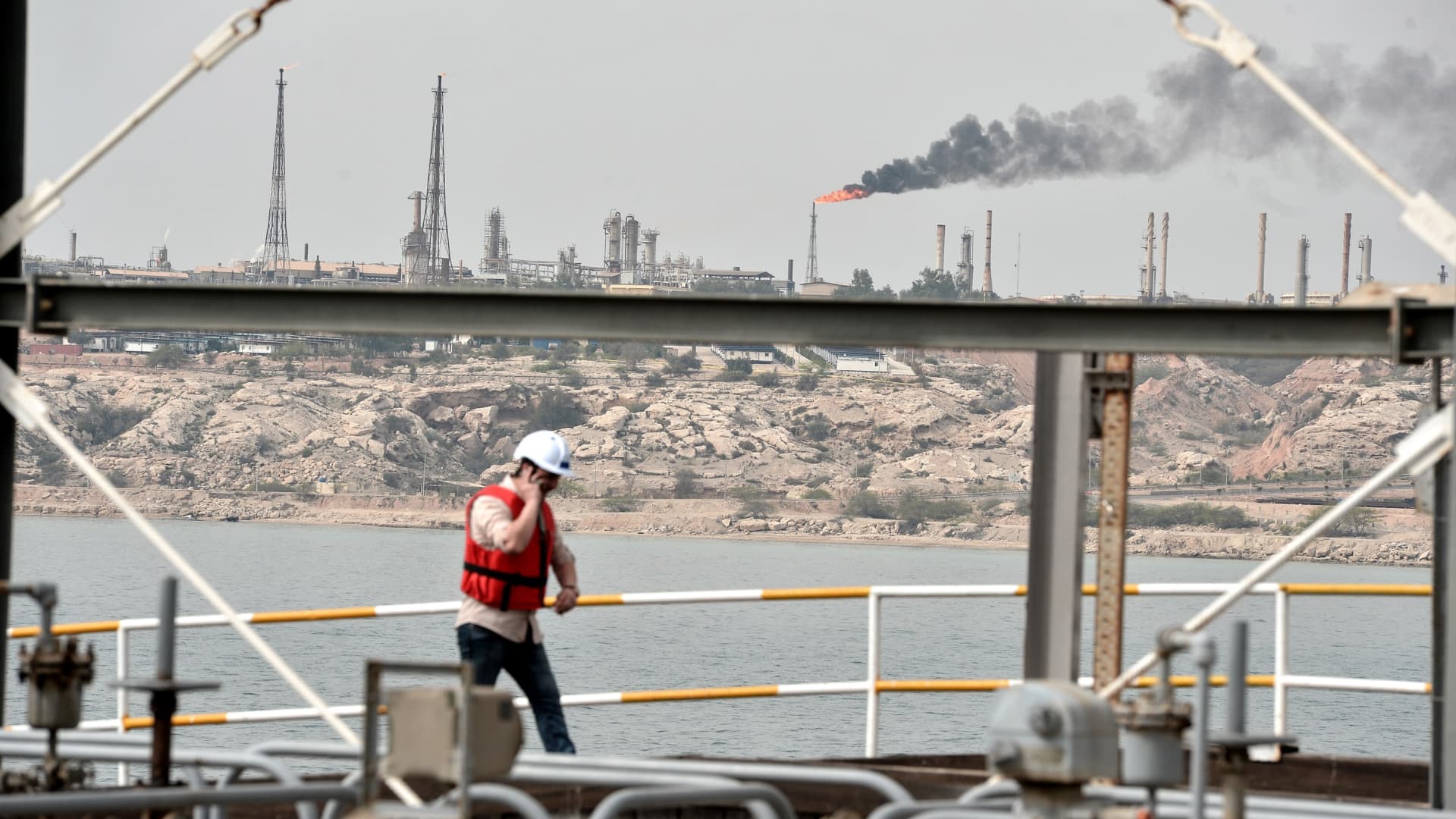
A general view of the Port of Kharg Island Oil Terminal, 25 km from the Iranian coast in the Persian Gulf and 483 km northwest of the Strait of Hormuz, in Iran on March 12, 2017.
Fatemeh Bahrami | Anadolu | Getty Images
President Donald Trump’s order to strike Iranian military assets on Kharg Island has thrust one of Tehran’s most critical oil hubs into the center of the escalating U.S.-Iran conflict.
Trump said the strikes, carried out Friday night, targeted military facilities and spared oil infrastructure. But he warned the United States could attack crude facilities on the island if Iran continues attacks on commercial vessels in the Strait of Hormuz, a key shipping artery for global energy supplies.
“The strike on the military facilities of Kharg was meant to serve as a warning shot to Tehran. If it doesn’t reopen the Strait of Hormuz, the oil infrastructure on the island would be next,” Vandana Hari, founder of Vanda Insights, told CNBC in an email on Monday.
Kharg Island is regarded as one of Iran’s most sensitive economic targets. The five-mile-long coral island, located about 15 miles off the coast of mainland Iran in the northern Persian Gulf, handles roughly 90% of the country’s crude exports. It also has a loading capacity of about 7 million barrels per day, making it a critical gateway for Tehran’s energy revenue.
Iran’s economic lifeline
A direct hit on Iran’s export terminal on the island would instantly shut down most of its 1.5 million barrels per day crude exports, data provided by JPMorgan showed.
“Destruction of its oil infrastructure would take years to rebuild, leaving the country deprived of its most critical source of revenue,” Hari added.
“War-risk insurance premiums will likely remain elevated long after the last missile is fired. And the behavioral response … [will] permanently reprices the supply chain.”
Jeff Currie
Chief Strategy Officer of Energy Pathways, Carlyle
Energy analysts said Washington’s focus on Kharg Island reflects both the island’s strategic importance to Iran and its leverage over global oil markets.
“Iran has other ports, but presumably if the U.S. took control of or destroyed Kharg Island, it would be possible to do the same to the other export facilities,” said Josh Young, chief investment officer at Bison Interests.
Damage to the facility could significantly disrupt exports, though Iran does have some limited alternatives, noted Andy Lipow, president of Lipow Oil Associates.
Lipow noted that Iran could use its Goreh-to-Jask pipeline, which can bypass both Kharg Island and the Strait of Hormuz, carrying roughly 1.5 million barrels per day.

Even so, analysts cautioned that attacks on Kharg Island would still represent a major escalation.
“[Tehran] would escalate by attacking more energy infrastructure in the region, for instance, Abqaiq in Saudi Arabia,” said Edward Fishman, senior fellow at the Council on Foreign Relations, referring to the kingdom’s massive oil processing facility.
Jeff Currie of Carlyle said the conflict is accelerating a structural shift in how energy supply chains are priced.
Damaged infrastructure at Kharg Island cannot be repaired under fire, the former Goldman Sachs commodities chief wrote in a note.
“War-risk insurance premiums will likely remain elevated long after the last missile is fired. And the behavioral response — hoarding, contract renegotiations, the scramble for alternative suppliers — permanently reprices the supply chain,” he added.
Currie said the world is moving toward a new energy paradigm in which security risks are embedded in commodity prices.
Crude prices topped $100 per barrel on Monday. Brent prices, the international benchmark, were up 0.88% to $104 per barrel as of 9:48 p.m. ET.
“Every commodity that must transit a chokepoint will likely carry a security premium,” Currie wrote.
For oil markets, that means the threat to Kharg Island may matter almost as much as an actual strike.
— CNBC’s Sam Meredith contributed to this report.
