

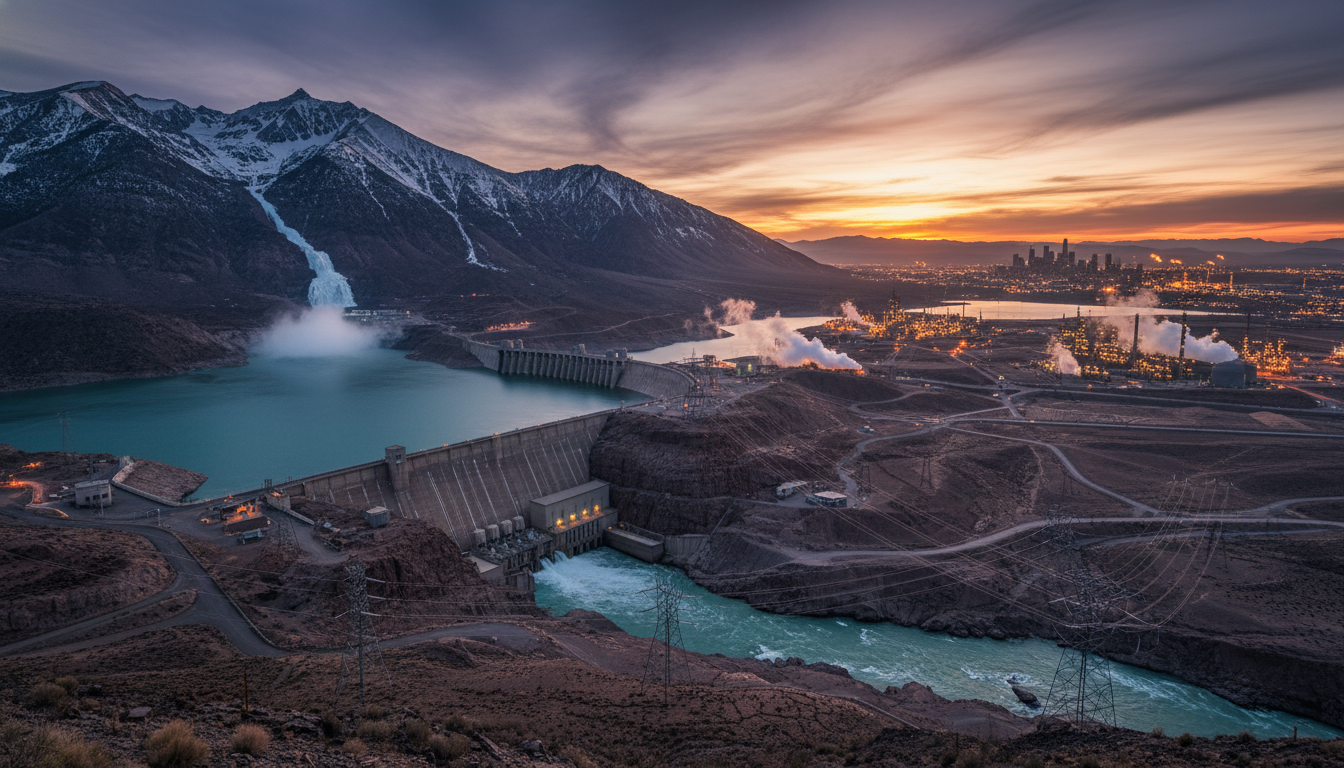
Western US Snowpack Crisis: A Looming Threat to Energy Markets and Regional Investment
Grim reports from recent snow surveys across the American West paint a deeply concerning picture for investors, as historically warm winter conditions and an scorching March have left critical snowpacks at unprecedented low levels. This severe water deficit signals substantial ripple effects across crucial economic sectors, particularly impacting energy markets, agricultural production, and regional stability. For those eyeing investments in Western states, understanding the immediate and long-term implications of this water scarcity becomes paramount.
Experts warn that despite any temporary moderation in temperatures, the rapid melt-off experienced over the past month has plunged key water basins into uncharted territory ahead of the dry seasons. While some forecasts suggest potential for late-season snowfall, climatologists largely dismiss these as insufficient to reverse the current trajectory. Dr. Russ Schumacher, a Colorado State University climatologist, emphasizes the severity, stating, “This year is on a whole other level,” highlighting how current data significantly underperforms historical lows, raising profound concerns for water managers and investors alike.
Snowpacks function as nature’s vital water reservoirs, dictating the volume of water available for human consumption, agriculture, and hydroelectric power generation throughout the summer months. Measurements conducted during the week of April 1st serve as critical indicators, forecasting the peak water availability for vital reservoirs, rivers, and the parched landscapes across the region. Beyond merely the volume of snow, the “Snow Water Equivalent” (SWE) – a measure of the moisture frozen within the snowpack that will eventually melt into natural and man-made systems – registers at exceptionally low levels, underscoring the severity of the impending water crisis.
Critical Shortfalls Across Major Basins Signal Investment Risks
The numbers are stark. California’s Sierra Nevada recorded a mere 4.9 inches of SWE as of Monday, preceding the state’s official April 1st survey. This represents a shocking 18% of its historical average. More critically, the Colorado River headwaters, a basin supporting over 40 million individuals across multiple states, 5.5 million acres of agricultural land, 30 tribal nations, and parts of Mexico, held just over 4 inches of SWE, a meager 24% of its average. This figure stands as less than half of what was previously considered a record low for the region, amplifying pressure on an already over-allocated system and directly impacting the energy grid reliant on its hydroelectric output.
The crisis extends broadly across the Intermountain West and Southwest. Data from the US Department of Agriculture (USDA) reveals alarmingly low averages compared to the 1991-2020 baseline. The Great Basin reports only 16% of its average SWE, while the Lower Colorado region, encompassing significant portions of Arizona and Nevada, registers an abysmal 10%. The Rio Grande basin, covering parts of New Mexico, Texas, and Colorado, shows an even more dramatic shortfall at just 8% of its average. Schumacher warns, “This year has the potential of being way worse than any of the years we have analogues for in the past,” a troubling prospect for energy demand, agricultural commodity prices, and regional economic stability.
A March Catastrophe, Not a Miracle, Accelerates Energy Challenges
Federal analysts confirmed a pervasive “snow drought” across virtually every major river basin in the West as March began, despite near-normal precipitation levels. An update on March 8th revealed 91% of stations reported below-median SWE. Hopes for a “March miracle” – a significant cold storm to replenish snowpacks – were dashed by an unprecedented heatwave. This blistering warmth shattered over 1,500 monthly high-temperature records and tied hundreds more, transforming the landscape and accelerating melt-off at an alarming pace.
Climatologist Daniel Swain described the event as “likely among the most statistically anomalous extreme heat events ever observed in the American South-west.” He emphasized that the “record-shattering March heat will likely be the decimation of the water year 2025-26 snowpack across nearly all of the American west,” a critical consideration for long-term investment strategies. This rapid melt complicates water capture efforts, reducing the potential for refilling reservoirs and directly impacting hydroelectric power generation capabilities. Andy Reising, manager of California DWR’s Snow Surveys and Water Supply Forecasting Unit, notes that this season exemplifies future trends: “winters with more rain and less snow and stretches of hot and dry conditions,” requiring energy infrastructure adaptation.
Reservoir Levels Threaten Hydroelectric Output and Grid Stability
While California’s reservoirs currently stand near or above historic averages due to earlier robust rains, the rapid snowmelt presents challenges for capturing this water, particularly given already high reservoir levels. The situation in the Colorado River Basin appears even more precarious for energy production. Lake Mead and Lake Powell, which collectively hold about 90% of the Colorado River’s storage, stood at just 25% and 33% full respectively as of March 29th. With minimal inflow expected from the diminished snowpack, these vital reservoirs face acute risk.
Officials are already relocating infrastructure, such as floating marinas on Lake Powell, in anticipation of rapidly receding water levels. Experts warn that Lake Powell could soon drop to its lowest levels since its creation in the 1960s. The dire prospect of “deadpool” – where water levels are insufficient to pass through dams, generate hydroelectric power, or be distributed downriver – poses a catastrophic threat. Such a scenario would severely strain the regional power grid, forcing a greater reliance on thermal generation (natural gas, coal) and potentially spiking energy costs, creating both risks and opportunities for fossil fuel investors.
The Colorado River’s century-long overdraft, exacerbated by rising temperatures and decreased precipitation, intensifies pressure on water-dependent sectors, including energy-intensive industries and agriculture. Seven states remain deadlocked on allocation agreements, leaving crucial resources in limbo. This uncertainty drives immediate action: Salt Lake City, Utah, targets a 10-million-gallon water cut, limiting city facility use by 10%. Colorado imposes lawn watering restrictions, and Wyoming residents face potential outdoor irrigation limits as early as May. Farmers and ranchers across the West grapple with reduced water allocations, forcing difficult operational and investment decisions that will impact agricultural output and associated energy demand.
Wildfire Threat: Direct Hazards for Energy Infrastructure and Increased Demand
The accelerated snowmelt carries profound consequences beyond water supply and agriculture, setting the stage for a significantly heightened and extended wildfire season. Dr. Joel Lisonbee from the Cooperative Institute for Research at the University of Colorado Boulder warns, “Unless there’s a major change in the weather patterns and we somehow pull out some sort of miracle springtime precipitation, we’re looking at an extended fire season.” Landscapes that typically remain blanketed by snow for longer periods will dry out rapidly, becoming highly susceptible to ignition weeks or even months earlier than average. This “rapid drying of the vegetation” creates ideal conditions for fire proliferation.
The threat is already materializing; dozens of large, destructive fires have erupted across the Intermountain West and High Plains, fueled by extreme heat and low moisture. Over 1.5 million acres have already burned this year across the U.S., more than double the 10-year average. For the energy sector, this poses direct physical risks to critical infrastructure such as oil and gas pipelines, electrical transmission lines, and even refinery operations located in or near fire-prone areas. Furthermore, an extended fire season drives increased energy demand for firefighting efforts, including air tankers and ground equipment, potentially straining local fuel supplies and distribution networks.
While this year stands out, climatologists like Dr. Abby Frazier of Clark University underscore that the climate crisis is driving long-term warming trends, ensuring a hotter and drier West. She notes a rise in “compound events,” where hazards like heat and drought overlap or occur in quick succession, amplifying dangers. This “one-two punch” from heat and drought will significantly increase wildfire risks, impacting economic activity and infrastructure stability. Investors must account for these escalating climate risks when evaluating energy assets and opportunities in the Western United States, prioritizing companies demonstrating robust adaptation and mitigation strategies to safeguard against these increasingly “catastrophic” changes.
