

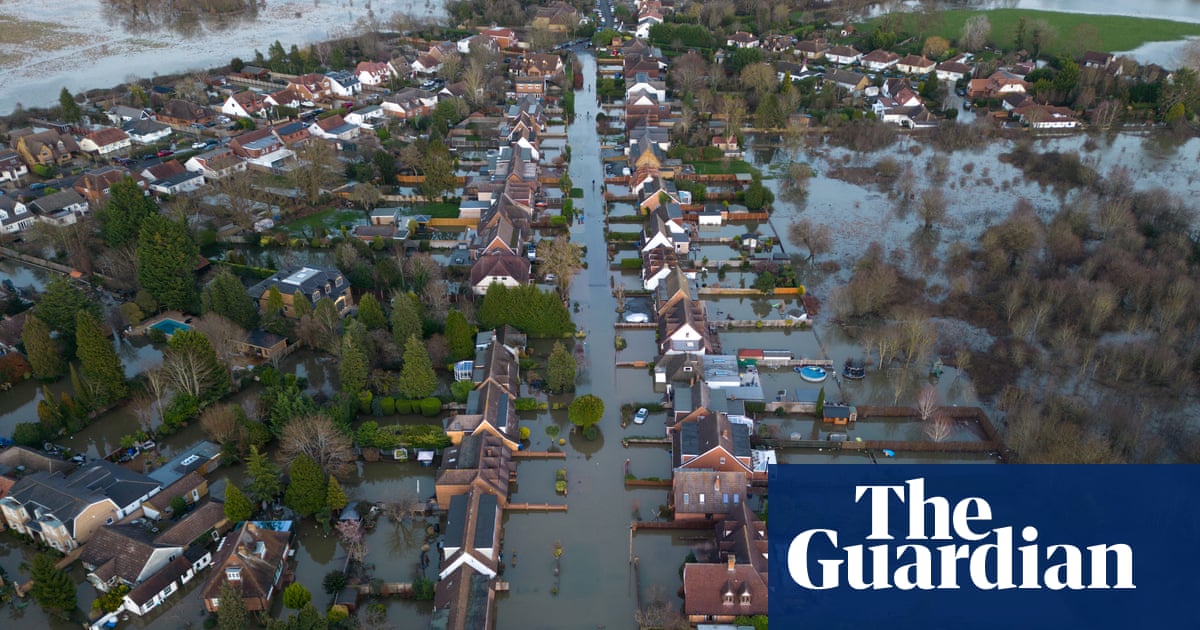
Good morning. For years, whenever I read about parts of Britain being wrecked by flooding, it always felt like something distant – because until your house is flooded, it’s hard to imagine it happening, isn’t it? Not any more.
According to a Guardian investigation, millions more homes across England, Scotland and Wales are at risk of devastating floods. In England alone, the number of properties exposed to flooding is expected to rise by more than a quarter, from 6.3m to 8m. The story gets worse for those in high-risk areas for flash flooding – which is harder to predict and protect against – where the frequency could surge by up to 66% by 2050. The picture is so bleak that, startlingly, some towns may one day have to be abandoned altogether.
This time, however, the warnings are not coming from environmental campaigners but from leaders in the insurance industry, who are sounding the alarm about extreme weather events driven by the climate crisis. They warn that large swathes of housing and commercial property in densely populated areas are among the most vulnerable to devastating flooding.
To dig into the investigation’s findings and explore what communities and the government must now do, I spoke to Matthew Taylor, an environment correspondent for the Guardian. That’s after the headlines.
Five big stories
Israel-Gaza war | The fragile ceasefire in Gaza faced its first test on Tuesday when Israel said the flow of aid into the devastated Palestinian territory would be cut by half and the crucial Rafah border crossing with Egypt would not open as planned, blaming Hamas for delays in the return of bodies of hostages.
UK child abuse inquiry | Keir Starmer’s national grooming gangs inquiry has stalled amid wrangles over its remit and difficulties in finding a senior legal figure willing to become its chair, the Guardian has been told.
Economics | The global economy has shown “unexpected resilience” to Donald Trump’s tariffs, but the full impact is yet to be felt, the IMF has warned. The forecast for economic growth in the UK has also been modestly increased, from 1.2% to 1.3% this year – though slightly downgraded next year, also to 1.3%.
Madagascar | Andry Rajoelina, the president of Madagascar, has said he fled the country in fear for his life after a military rebellion but did not announce his resignation in a speech broadcast on social media. They were Rajoelina’s first public comments since the a military unit called Capsat turned against his government in an apparent coup.
Music | D’Angelo, the Grammy-winning R&B singer who helped pioneer the sound of neo-soul, has died after a struggle with pancreatic cancer. He was 51.
In depth: ‘It is absolutely a sign that the climate crisis is here and escalating’
Every constituency in Great Britain is expected to face greater flood risk in the years ahead, according to a study by the insurer Aviva. The company analysed every parliamentary constituency in England, Scotland and Wales to gauge vulnerability to flooding, and shared its findings with the Guardian.
In England, 69% of constituencies are likely to see more than a 25% increase in the number of properties at risk by the middle of the century. In Wales and Scotland, every area is projected to experience a similar rise, with many expected to be hit even harder.
The threat is particularly acute in densely populated regions such as London, Manchester and parts of north-east England. In Bermondsey and Old Southwark in London, and Boston and Skegness in Lincolnshire, about 90% of homes could be at risk from river and coastal flooding by 2050 – that is the highest proportions anywhere in the country.
“We environment reporters often write about NGOs and campaigners and climate scientists calling for different things, which is great and important. But I was getting wind from a few conversations that the insurance industry was also really concerned about this issue and theirs is a different calculation,” Matthew Taylor told me.
He pointed to a quote from Jason Storah, chief executive for UK & Ireland general insurance at Aviva, in his piece to illustrate his point. “He says ‘we’re not in this because we’re climate campaigners or trying to burnish our credentials or because we have a political agenda. This is a hard-headed calculation, we’re looking at the numbers’. And I thought that might have some purchase with a different group of people,” Matthew said.
When he and fellow Guardian reporter Helena Horton started making calls to leaders in the industry, it quickly became apparent how widespread the concern was. “It is absolutely a sign that the climate crisis is here and escalating in the UK.”
Will towns be abandoned?
What stood out the most to me in this investigation was a quote from Emma Boyd, the former chair of the Environment Agency, who said it may be too expensive to build the flood protection needed to save some areas.
Helena has a fascinating story on what that looks like: in flood-prone Worcestershire, insurers have abandoned the picturesque town of Tenbury Wells, and business owners and residents now fear one more flood could bankrupt the town.
“At the moment, there’s this joint government and industry scheme that will protect individual properties, but commercial properties are public buildings and not protected,” said Matthew. “The reality is that some areas at some point will just become too prohibitively expensive to protect and then get flooded too much for them to get insurance – and that is pretty stark.”
This scheme, called Flood Re, is due to end in 2039, when climate-related flooding is projected to be more severe.
What should the government do?
For its part, the government says it has drawn up long-term plans to strengthen London’s flood defences over the next century, alongside wider efforts to improve protection across the country, including greater use of natural flood management.
On Tuesday, floods minister Emma Hardy announced a £10.5bn investment to protect 900,000 properties in England, alongside new measures designed to speed up the delivery of these defences – which is great, but what I want to know from Matthew is whether it’s all going to be enough.
“They are starting to think more holistically about how we manage the changing environment, but it will mean a fairly dramatic change in priorities for planning and development,” said Matthew.
But the government’s drive for growth and building 1.5m extra homes by the end of this parliament has raised fears that essential nature and climate considerations will be cast aside. “Within that drive for planning reform, there needs to be an absolute recognition that we need to protect new properties and communities, to make sure [those developments] are all compliant with a changing climate,” he added.
What can people do?
I joke to Matthew that I often describe his patch as the “apocalypse beat.” He was gracious enough to laugh – but I asked whether sometimes things feel hopeless as an environment correspondent. For years, campaigners and experts have warned that something terrible was coming our way. It’s clear now, from the growing flood risks to record-breaking heatwaves, that the future has arrived. Add to that the fact that just this month, the Conservative party leader, Kemi Badenoch, vowed to take the UK out of net zero commitments that her party once heralded, and that Reform UK, which continues to lead in the polls, has aggressively attacked climate policies across the board and I wonder: doesn’t he feel frightened?
Matthew says we don’t have time to be frightened. And we already have all the answers and the technologies we need to address the crisis – we just need the political will. It is important that people feel they have agency, too. He pointed to a recent piece written by Helena outlining how individuals can better defend their homes against flooding. It includes practical steps from sealing doorways togetting rid of your paving (and convincing your neighbours to do the same). And, perhaps most importantly, lobbying the government for better protection.
“I do find hope in reporting on the positive things going on at a community and a campaigning level; that when people see an injustice, they come together and make a difference. That, combined with the inescapable truth that the climate crisis is here and that tackling it can improve everyone’s lives, has to be the rallying point for real transformative action.”
Now, who is ready to pull up those pavement slabs?
Our morning email breaks down the key stories of the day, telling you what’s happening and why it matters
Privacy Notice: Newsletters may contain information about charities, online ads, and content funded by outside parties. If you do not have an account, we will create a guest account for you on theguardian.com to send you this newsletter. You can complete full registration at any time. For more information about how we use your data see our Privacy Policy. We use Google reCaptcha to protect our website and the Google Privacy Policy and Terms of Service apply.
after newsletter promotion
What else we’ve been reading
Narcissism is one of those terms that gets thrown around as a vague insult – but it refers to something much more specific and complex than mere egotism. Lucy Knight’s feature is a nuanced portrait of a complicated condition. Archie
The world will have sighed with relief at the news of a ceasefire in Gaza. The question now on everyone’s mind is simple to ask – what happens next? – but far harder to answer. This beautifully written piece by my colleague Chris Osuh on what Britain owes Palestine is one of the few things I’ve read in the past few days that’s offered some clarity. Aamna
ConservativeHome’s Henry Hill has an interesting look at a party members’ survey that suggests Kemi Badenoch did enough at party conference to secure her position for now – but that it may be a delay rather than a reprieve. Archie
More than 15 years after the explosion of the Arab spring, protesters are back out in Morocco. The demonstrations are being led by generation Z, who speak defiantly about their cause in this brilliant piece, showing courage despite protesters being killed and widespread arrests. Aamna
After D’Angelo’s death at 51, Alexis Petridis writes that while his catalogue was sparse, it was also “perfect”. His debut album, Brown Sugar, “was resolutely not a mere homage but a product of its era, the work of an artist who cared as much about hip-hop as he did about Black music’s history”. Archie
Sport
Football | Thomas Tuchel laughed off the mockery from the fans and hailed his side for achieving something special after England qualified for the World Cup finals tournament with a 5‑0 win against Latvia in Riga. Harry Kane scored twice, including once from the penalty spot.
Tennis | Emma Raducanu again struggled physically in a first-round exit at the Ningbo Open to China’s Zhu Lin, raising questions over the rest of her season. The result was her third straight defeat.
Ashes cricket | Stuart Broad has said that England will face “probably the worst Australian team since 2010” on tour this winter.
The front pages
“Tensions high as Israel cuts aid to Gaza in row over hostage remains” says the Guardian while the Times has “Hamas kills its enemies on ceasefire Gaza streets”. “Bessent slams China’s trade warfare” – that’s the Financial Times while the Mirror says “Boris DID harm our kids” which is about schooling during Covid. The Mail announces that “Labour isn’t working (again)” citing inflation, jobs and wages figures. Similar in the Express: “Reeves blow as prices rise and growth stalls”. The i paper reports “UK pension set to climb by 4.8% as triple lock helps buffer over-65s from inflation”. The Telegraph runs with “Mahmood: UK has lost control of its borders”. Main story in the Metro is “Hotel worker ‘stabbed by migrant 23 times’”.
Today in Focus
Inside the mystery of the collapsed Chinese spy trial
Questions mount over collapse of trial of teacher and parliamentary researcher accused of spying for China. Dan Sabbagh reports
Cartoon of the day | Ben Jennings
The Upside
A bit of good news to remind you that the world’s not all bad
Praia, the capital of Cape Verde, is normally a laid-back sort of place. But on Monday night, crowds flooded to the Estádio da Várzea stadium to celebrate a moment that was swiftly compared to the most significant in the country’s footballing history: a 3-0 win over Eswatini. With that result, the island nation of less than 600,000 people became the second-smallest country ever to qualify for the World Cup.
The side’s success, which comes 50 years after independence, owes a great deal to members of the large Cape Verdean diaspora, often referred to as the 11th island of the archipelago: 14 of the 25 players called up for the last two qualifying matches are dual nationals. Dailon Rocha Livramento, who was born in the Netherlands, was the team’s top scorer. “Being able to repay the efforts of our grandparents and parents, who emigrated to give us a better future, sometimes even working two jobs at the same time, is the least we can do,” he said.
Pleas for a national holiday were denied – but the $10.5m the FCF stands to earn from reaching the World Cup group stage will make a huge difference to the football federation’s finances. Perhaps more important is the sense of national pride. “Independence Day and 13 January 1991 – when the first multiparty elections were held – are the two symbolic dates that have united our people,” said José Maria Silva, the national director of state protocol. “This World Cup qualification can already be considered the third defining moment of our nation.”
Sign up here for a weekly roundup of The Upside, sent to you every Sunday
Bored at work?
And finally, the Guardian’s puzzles are here to keep you entertained throughout the day. Until tomorrow.
