

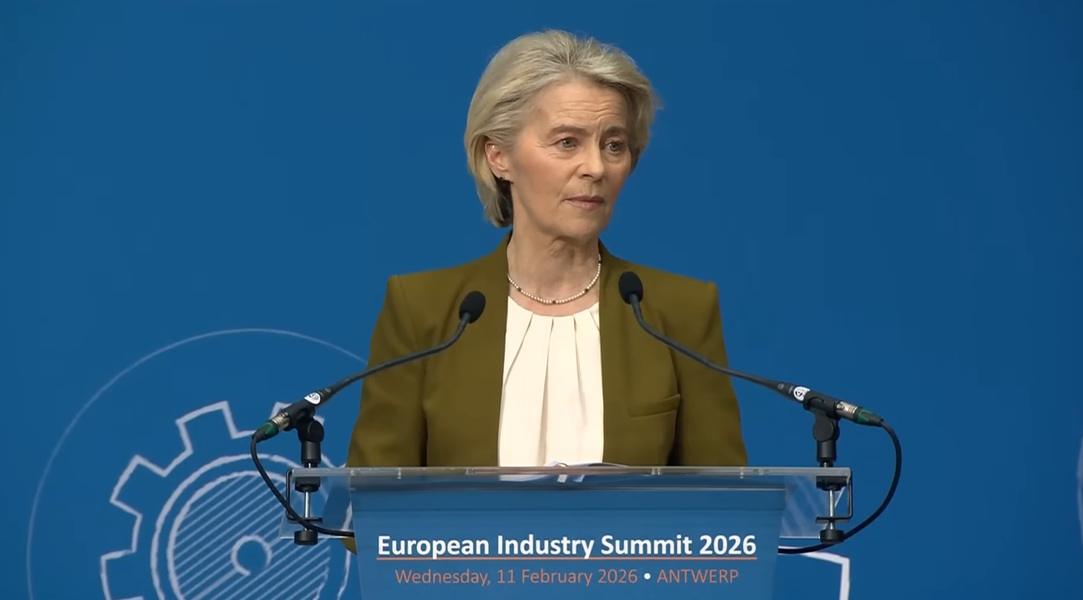
European Commission President Ursula von der Leyen defended the EU’s carbon pricing mechanism at an industry conference on Wednesday, noting the system’s progress on decarbonizing industry, and calling on member stated to dramatically increase their reinvestment of revenues from the system back into industrial innovation, to help address concerns from emissions intensive sectors over the impact of the program.
Von der Leyen noted that while 100% of revenues generated from the EU’s Emissions Trading System (ETS) are reinvested in industrial innovation at the European level, less than 5% is reinvested in industrial decarbonization at the national level, and said that this will be a focus area of upcoming reform of the ETS planned for later this year.
Established in 2005, the ETS puts a price on carbon emissions for key greenhouse gas (GHG) intensive sectors, including electricity and heat generation, oil refineries, steel, cement, paper, chemicals, and commercial aviation, among others. In 2023, the EU adopted an “ETS2” plan to expand the ETS, including extending the carbon pricing system to new sectors, including fuel used for road transport and for heating buildings. Initially planned for 2027, ETS2 is expected to be delayed until 2028, as part of an agreement between the EU Parliament and member states on a new 2040 European climate target.
The EU Commission’s President’s comments come amidst growing criticism from industry and some member states about the impact of the ETS on industrial competitiveness, citing concerns ranging from the high cost and unpredictability of carbon pricing, and carbon leakage, a situation in which companies move production of emissions intensive goods to countries with less stringent environmental and climate policies.
In her defense of the ETS, von der Leyen cited the success of the carbon pricing system in achieving the EU’s climate goals, noting that emissions have dropped by 39% since the establishment of the ETS, alongside 71% economic growth in sectors covered by the ETS, stating that “this shows that decarbonisation and competitiveness can go hand in hand.”
Noting the major gap between the rechanneling of ETS funds back into industries between the EU and member states, von der Leyen called on EU countries to “step up and match our level of support.”
Von der Leyen added:
“Channelling more ETS revenues back to industry will therefore be a core focus of the upcoming reform of the Emissions Trading System this summer. Because these resources come from the industry and they must be reinvested in the industry itself, where the money comes from.”
