

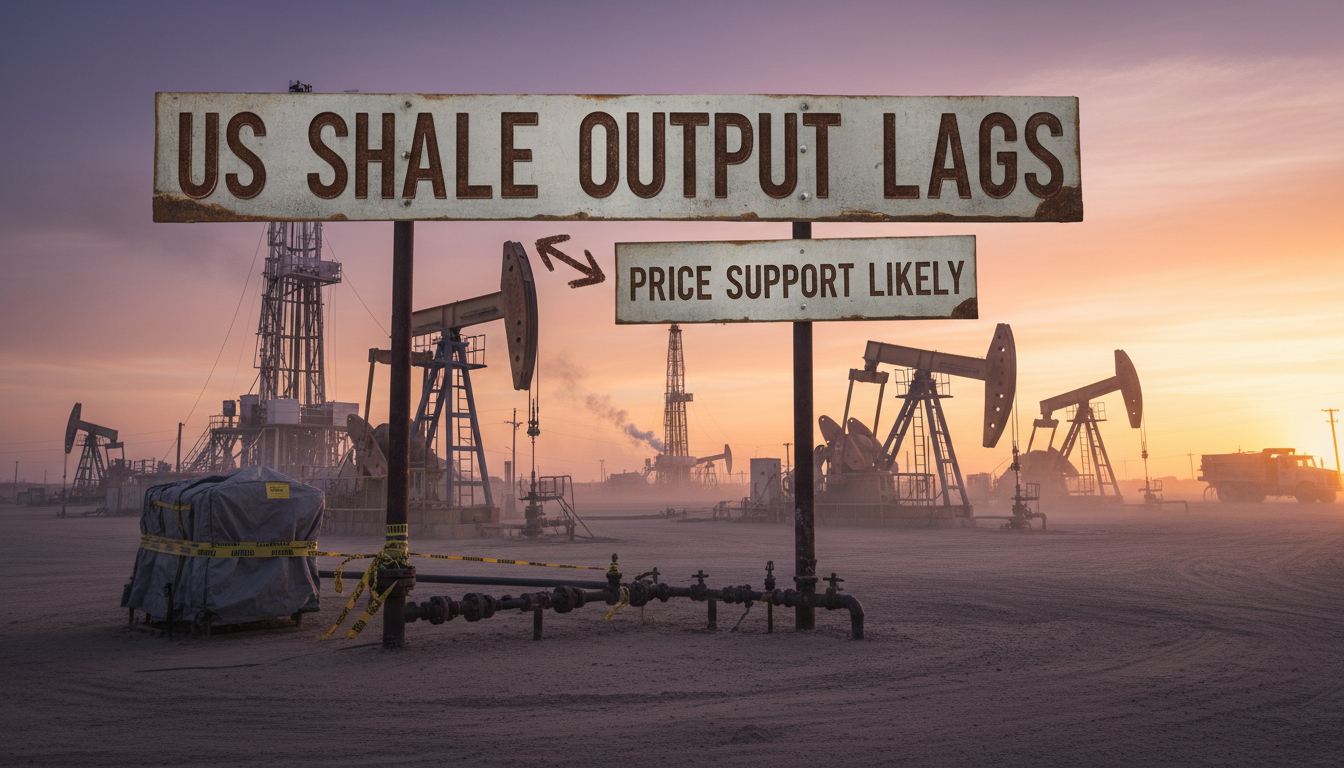
As West Texas Intermediate (WTI) crude benchmarks recently climbed above $90 per barrel, a compelling paradox dominates the U.S. shale landscape: a market demanding more supply, yet producers remain largely hesitant to accelerate output. This strategic restraint, driven by a confluence of financial discipline and operational constraints, presents a nuanced picture for energy investors monitoring the trajectory of American oil production.
Industry analysis indicates U.S. shale operators are not poised for a swift production ramp-up despite robust commodity prices. This measured response stems from two primary factors: a deeply ingrained strategic caution regarding price volatility and a notably depleted inventory of drilled, uncompleted (DUC) wells available for rapid activation.
Capital Discipline Reigns Amidst Price Volatility
Publicly traded U.S. shale producers have demonstrably prioritized capital discipline in recent years, a strategy that continues to anchor their current investment decisions. Analysts point out that most E&P budgets were set against a more challenging WTI price environment, typically in the $55-$60 per barrel range. Consequently, the current surge past $90 per barrel is viewed cautiously as a potentially short-lived phenomenon. This skepticism is reinforced by the WTI futures curve, which exhibits steep backwardation, signaling an expectation for lower prices in the future.
Rather than immediately reallocating capital to boost drilling, many producers are capitalizing on current high prices to lock in future revenues through hedging strategies. Unless these elevated price levels persist for several months, a significant overhaul of existing capital expenditure plans, which prioritize shareholder returns and balance sheet strength over aggressive growth, remains unlikely.
The DUC Well Constraint: A Bottleneck to Rapid Supply
A critical operational impediment to a quick production increase is the limited availability of DUC wells. During periods of lower prices in 2025, producers strategically drew down their DUC inventories. This allowed them to maintain output and fulfill shareholder payout commitments without incurring substantial new capital expenditures. The consequence, however, is a much smaller backlog of wells that can be quickly brought online. Even if operators suddenly became willing to pursue accelerated growth, their immediate capacity to increase production is severely hampered by this DUC depletion.
Projections suggest that an aggressive drawdown of remaining excess DUCs could potentially add approximately 111,000 barrels per day (bpd) of supply from these wells within the coming months. However, achieving this accelerated pace is deemed improbable, as it would necessitate a coordinated strategic effort across numerous operators. Realistically, some private E&P companies, with different financial structures and objectives, may seize the opportunity presented by high prices to complete DUCs. In contrast, many larger public companies and supermajors are likely to remain wary of further depleting their productive capacity, preferring a more sustainable development pace.
Exploring Production Scenarios and Upside Potential
Industry experts have modeled various scenarios to assess how U.S. oil production might respond to sustained high prices. In a scenario where operators react to consistently strong prices by materially increasing their rig count — envisioning 46 additional rigs deployed in Lower 48 oil plays over the next five months — production could grow by 196,000 bpd from exit-2025 to exit-2026. This would represent a notable 280,000 bpd increase in December 2026 compared to a pre-event baseline outlook.
A more theoretical “maximum case” scenario, considered extremely unlikely, envisions a significant and aggressive ramp-up effort across the Lower 48. This would involve activating approximately 60 rigs within three months, coupled with improved operational cycle times. Under such conditions, exit-to-exit growth for 2026 could reach 279,000 bpd in the Permian Basin and 101,000 bpd in other regions. This translates to a substantial 464,000 bpd upside by December 2026 from earlier production forecasts, with the potential for 500,000 bpd upside by the end of 2027. However, the operational hurdles and capital commitment required for this scale of acceleration make it a less probable outcome for oil and gas investors to bank on.
E&P Financial Strategies: Hedging and Balance Sheet Resilience
Operators are expected to adopt a similar disciplined approach to rig additions. Rather than immediate DUC drawdowns or rig deployments, the current focus is on reinforcing financial positions. Companies are actively exploring hedging opportunities for late 2026 into 2027, particularly if they anticipate a future moderation in prices. Initial market intelligence suggests a strong interest among operators in bolstering their hedge books.
It is important to note, however, that many E&P companies had previously constructed their 2026 hedge portfolios with downside protection in mind. With only about one-third of their production typically hedged at lower floor and ceiling prices, a significant portion of their output remains exposed to spot prices, allowing them to fully benefit from the current market strength. Private E&Ps, often operating with tighter budgets targeting near-breakeven economics, might be among the first to add an additional rig or frac crew. They stand to gain significantly from second-half 2026 prices, which, even if they recede from $90-$100, would still exceed their initial planning assumptions.
Financial analysis indicates that cash reserves on the balance sheets of pure-play shale E&Ps decreased by over $4 billion from year-end 2024 to year-end 2025, largely due to capital deployed to maintain investor payouts. This context suggests producers will not rush additional capital expenditure in response to higher prices. Instead, they will likely utilize the current period of $100-range oil prices to rebuild their cash reserves and strengthen their balance sheets before committing to new investment cycles.
EIA’s Outlook: Long-Term Growth Prospects
While the immediate response from producers remains muted, the U.S. Energy Information Administration (EIA) provides a broader, more optimistic view on future U.S. crude oil production in its latest Short-Term Energy Outlook (STEO). The EIA explicitly links higher crude oil prices to increased U.S. output in its forecast, with the effects becoming more pronounced in the longer term due to the time lag between investment decisions and first oil.
The March STEO projects total U.S. crude oil production, including lease condensate, to average 13.61 million bpd in 2026 and 13.83 million bpd in 2027. This represents an upward revision from its February STEO, which forecast 13.60 million bpd for 2026 and 13.32 million bpd for 2027. For the Lower 48 states, excluding the Gulf of Mexico, the EIA expects production to reach 11.17 million bpd in 2026 and further increase to 11.50 million bpd in 2027, also an increase from its prior estimates.
The EIA attributes this anticipated growth to several factors, including sustained higher prices supporting increased drilling activity across key basins. Crucially, expanded pipeline capacity in the prolific Permian region is expected to facilitate the market access of associated natural gas, thereby providing further support for oil-directed operations. The Permian region’s crude oil production forecast has seen a 6% increase in 2027, underscoring its pivotal role in future U.S. supply growth. The agency notes that the impact of elevated prices on production will be more significant in 2027 than in 2026, with output climbing from 13.4 million bpd in September 2026 to 13.8 million bpd in 2027.
Investor Takeaways
For investors, the current energy market presents a dichotomy. While spot prices are highly attractive, U.S. shale producers are demonstrating remarkable restraint, prioritizing financial health and shareholder returns over aggressive, potentially unsustainable growth. The limited DUC inventory acts as a near-term ceiling on rapid supply increases, reinforcing the strategic caution observed across the industry. Although theoretical upside exists for production, the most probable scenario involves a gradual, disciplined expansion, heavily influenced by longer-term price stability and continued infrastructure development, particularly in the Permian Basin. Monitoring hedging activity and balance sheet movements will be key for understanding future capital deployment decisions in this evolving oil and gas investment landscape.
