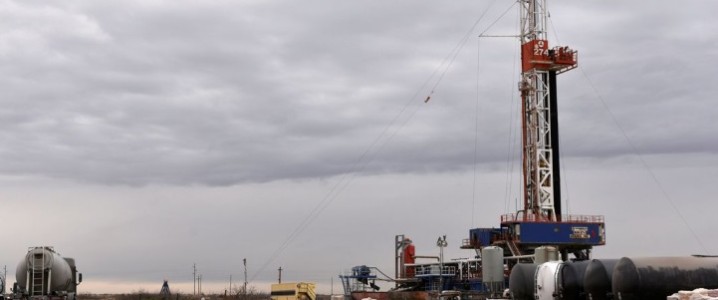
The notion that the United States can effortlessly ramp up oil production to counter global supply disruptions, such as new sanctions on Russian crude, often sounds compelling in political discourse. However, a deeper dive into the operational realities of the American oil patch reveals a more nuanced, and frankly, challenging picture. While the U.S. remains a formidable force, currently pumping approximately 13.2 million barrels per day, with nearly half originating from the prolific Permian Basin, the industry is not positioned for a rapid, significant surge. Operators are navigating a complex landscape of price volatility, investor demands for capital discipline, and structural constraints that collectively temper any immediate ambitions for stepping on the gas. For investors eyeing the energy sector, understanding these underlying dynamics is crucial to assessing the true flexibility and responsiveness of US oil output.
The Economic Squeeze: Dissecting Producer Reluctance Amidst Volatile Prices
The primary hurdle for US oil producers lies squarely in the economics of new drilling. The latest industry surveys indicate that the average breakeven price for new wells in the Permian Basin hovers around $64 a barrel. This figure is a critical benchmark against which exploration and production (E&P) companies evaluate new projects. As of today, Brent crude trades at $90.38, reflecting a significant daily downturn of 9.07%, while WTI crude stands at $82.59, also down 9.41%. This immediate price weakness, coupled with a broader 14-day trend seeing Brent fall from $112.78 to $91.87, injects considerable uncertainty into investment decisions. While current prices technically remain above the $64 breakeven, the sharp daily and recent declines underscore a volatile environment where sustained profitability for new ventures is far from guaranteed. This volatility directly impacts the Baker Hughes rig count, which has fallen to 415 active oil rigs across the U.S., a decrease of seven in just the past week. The Permian, the nation’s engine of growth, saw its rig count drop by three, reaching its lowest level since 2021. This decline in drilling activity is a clear indicator that operators are exercising caution, reluctant to commit fresh capital without greater price stability and more attractive margins.
Investor Outlook: Balancing Returns and Growth in a Shifting Landscape
Investors are keenly focused on the future trajectory of crude oil prices and the strategic responses of major producers. Our proprietary reader intent data shows significant interest in questions like, “What do you predict the price of oil per barrel will be by end of 2026?” and “What are OPEC+ current production quotas?” These inquiries highlight a collective concern over market stability and the forces shaping future supply. E&P companies, particularly those publicly traded, face immense pressure from Wall Street to prioritize capital returns over aggressive production growth. Shareholders demand dividends and share buybacks, a stark contrast to the pre-2020 era of “growth at all costs.” This shift in investor sentiment means that even if crude prices temporarily surge, companies are less likely to reinvest extensively in new drilling. Instead, they will use higher revenues to bolster balance sheets or reward shareholders. This disciplined approach, while beneficial for investor returns, inherently limits the industry’s capacity for rapid output expansion. The potential for OPEC+ decisions to influence global supply, and thus prices, looms large, directly impacting the investment calculus for US operators considering future capital deployment.
Navigating Future Volatility: Key Calendar Events on the Horizon
The coming weeks are packed with critical events that will undoubtedly shape the near-term outlook for oil markets and influence US producer behavior. On April 18th and 19th, the OPEC+ Joint Ministerial Monitoring Committee (JMMC) and the Full Ministerial Meeting will convene. These meetings are pivotal as members review market conditions and potentially adjust production quotas. Any unexpected shifts in OPEC+ policy could send ripples through global crude prices, either providing a much-needed boost for US producers or adding further downward pressure. Domestically, the API Weekly Crude Inventory reports on April 21st and 28th, followed by the EIA Weekly Petroleum Status Reports on April 22nd and 29th, will offer crucial insights into current supply-demand balances within the U.S. Significant inventory builds could signal weakening demand or oversupply, while draws might suggest the opposite. Finally, the Baker Hughes Rig Count on April 24th and May 1st will provide immediate feedback on drilling activity. If these reports continue to show declining or stagnant rig counts, it will further confirm the industry’s cautious stance, making any political calls for a rapid increase in US oil output increasingly challenging to realize.
The Path Forward: Unlocking US Production Potential Beyond Price Signals
While the economic calculus and investor mandates are significant, the ability of US producers to “step it up” also depends on a broader ecosystem of infrastructure, labor, and regulatory frameworks. Even with an estimated 44 billion barrels of proved oil reserves, transforming this underground potential into above-ground barrels is a complex undertaking. It requires robust pipeline networks, sufficient skilled labor, timely permitting processes, and access to capital that views the long-term risk-reward as favorable. The current environment, characterized by capital discipline and a focus on efficiency, means that incremental production gains are more likely to come from optimizing existing wells and infrastructure rather than a widespread drilling spree. For US oil output to genuinely surge in response to external pressures, a sustained period of higher, less volatile crude prices would be necessary, alongside a supportive regulatory environment that streamlines development. Absent these conditions, the industry will continue its measured approach, delivering modest growth while prioritizing shareholder returns, leaving any significant supply gap to be filled by other market forces.


