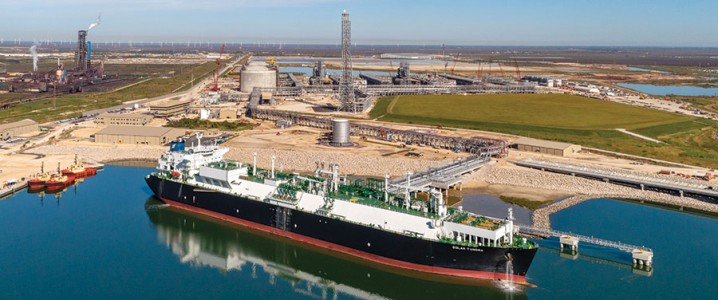
The European Union’s recent commitment of a substantial $750 billion framework for energy purchases over the next three years, heavily weighted towards liquefied natural gas, has sent ripples through the U.S. LNG export sector. This strategic move, designed to bolster Europe’s energy security, has been a clear catalyst for companies like Cheniere Energy and Venture Global, whose stock prices saw notable increases. Yet, a closer examination reveals a nuanced market response: while long-term demand certainty buoys exporters, the immediate landscape for upstream natural gas producers and spot commodity prices remains challenging, characterized by oversupply and softening seasonal demand. This divergence highlights a critical disconnect investors must navigate between the promise of future export volumes and the realities of current market fundamentals.
The EU’s LNG Lifeline: A Two-Speed Market Response
The announcement of the EU’s multi-billion-dollar energy purchasing framework has undeniably injected renewed optimism into U.S. LNG export infrastructure plays. Cheniere Energy, a foundational name in American LNG exports, saw its shares rise by approximately 1.7% to $229.23, having initially popped around 4% before some profit-taking later in the session. Similarly, Venture Global, an agile developer with significant operational and pipeline projects like Plaquemine LNG and Port Arthur, experienced an even more robust surge, trading up 4.53% at $15.22. These gains underscore investor confidence that long-term, multi-year supply contracts stemming from the EU’s pledge will translate directly into increased export volumes and revenue for these downstream-focused entities. They are the direct beneficiaries of softened demand uncertainty and the market’s favored beneficiaries of this massive deal.
However, the enthusiasm is not universal across the natural gas value chain. Upstream producers, primarily exposed to commodity price fluctuations, experienced a different trajectory. EQT Corp, a major U.S. natural gas producer without significant downstream exposure, saw its stock decline by 1.7% to $51.32. This reflects a persistent disconnect, reinforced by the August Henry Hub natural gas futures contract, which dipped approximately 2% to around $3.09 per MMBtu. The underlying issue for upstream players remains a supply-heavy environment in the U.S., where rising production, coupled with weaker immediate consumption due to mild summer weather, continues to weigh on spot prices. The long-term EU commitment, while significant, does not immediately alleviate these near-term pressures on raw commodity prices.
Crude’s Plunge: A Broader Headwind for Energy Investors
Adding another layer of complexity to the energy investment landscape is the recent significant downturn in crude oil prices, a factor keenly observed by investors seeking clarity on broader market direction. As of today, Brent Crude trades at $90.38 per barrel, marking a sharp 9.07% decline in a single trading day, with its range spanning from $86.08 to $98.97. WTI Crude mirrors this weakness, sitting at $82.59, down 9.41%, within a day range of $78.97 to $90.34. This aggressive price correction is not an isolated incident; our proprietary data pipelines show that Brent has trended down by $20.91, or 18.5%, from $112.78 on March 30th to $91.87 just yesterday. The price of gasoline has also followed suit, currently at $2.93, a 5.18% drop today.
This substantial retreat in crude prices, which has seen benchmarks shed nearly a fifth of their value in less than three weeks, casts a long shadow over the entire energy sector, including natural gas. Investors, many of whom are asking about the predicted price of oil per barrel by the end of 2026, are clearly concerned about the durability of commodity strength. While the LNG export story is distinct, a broadly bearish sentiment in crude can dampen enthusiasm for all energy-related assets, potentially limiting upside even for well-positioned LNG exporters. The current volatility suggests that the energy market is grappling with more than just specific commodity supply-demand balances; broader macroeconomic concerns and geopolitical shifts are clearly at play.
Navigating Near-Term Dynamics: Inventory, Production, and OPEC+ Signals
Looking ahead, the next two weeks are packed with critical events that will further shape market sentiment and provide crucial data points for investors. Our proprietary event calendar highlights several key releases that will impact both the natural gas and crude markets. The API Weekly Crude Inventory report on Tuesday, April 21st, followed by the EIA Weekly Petroleum Status Report on Wednesday, April 22nd, will offer fresh insights into U.S. crude and product stockpiles. These reports, repeated the following week, are vital for assessing the supply overhang that has contributed to the recent crude price weakness. Any unexpected build or draw could either exacerbate or alleviate current market pressures.
For natural gas, the weekly Baker Hughes Rig Count, scheduled for Friday, April 24th, and again on May 1st, will be closely watched. This data provides a real-time pulse on U.S. drilling activity and future production trends, directly informing the “rising production” narrative that currently pressures Henry Hub futures. A sustained increase in gas-directed rigs could reinforce the oversupply concerns, even as long-term export demand grows. Furthermore, the upcoming OPEC+ Joint Ministerial Monitoring Committee (JMMC) meeting on April 18th, followed by the Full Ministerial Meeting on April 19th, is paramount. With crude prices plummeting, investors are keenly focused on what OPEC+ will do regarding current production quotas – a frequent question among our readers. Any indication of a production cut could provide a floor for crude, potentially stabilizing the broader energy complex and indirectly supporting investor confidence across the board. Conversely, inaction could signal further downside risk.
Investor Focus: Bridging the Long-Term Promise with Short-Term Pressures
Our proprietary reader intent data reveals a clear focus among investors on the future trajectory of oil prices and the influence of major players like OPEC+. Questions range from specific company performance to macro predictions such as what the price of oil per barrel will be by the end of 2026. This underscores a market grappling with uncertainty, seeking clear signals amidst volatility.
For U.S. LNG, this means investors must carefully weigh the significant long-term demand pledge from the EU against the immediate realities of the commodity market. While the $750 billion figure anchors confidence, analysts have cautioned that it may be more aspirational than assured, requiring rapid expansion of U.S. export infrastructure to fully materialize. This translates into execution risk for even the most favored beneficiaries. Companies like Cheniere and Venture Global are well-positioned to capitalize, but their performance will also be influenced by capital expenditure cycles, regulatory approvals, and the broader sentiment in an energy sector currently contending with a steep decline in crude prices. The task for investors is to discern which players are best equipped to bridge the gap between aspirational long-term contracts and the challenging, supply-heavy dynamics of the near-term natural gas market, all while navigating a volatile crude backdrop.


