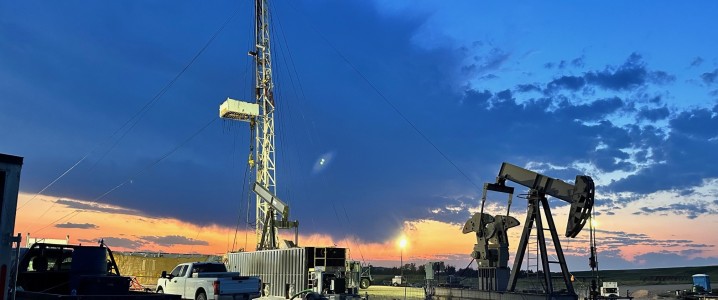
The latest drilling activity data from the United States signals a clear response from producers to prevailing market conditions. The total number of active oil and gas rigs in the US fell to 547 this week, a notable 39-rig decline compared to this time last year. This contraction in drilling, particularly in key oil-producing regions, presents a nuanced picture for energy investors. While U.S. crude oil production recently hit its highest point this year at 13.629 million barrels per day, the slowing pace of new well completions and the ongoing rig count reduction suggest that future supply growth may face headwinds. Understanding this dynamic requires a deep dive into current market prices, upcoming geopolitical and inventory events, and the pressing questions on investors’ minds.
US Drilling Activity Retreats Amid Price Pressures
The recent Baker Hughes rig count data underscores a cautious approach from American drillers. The total U.S. rig count now stands at 547, marking a significant year-over-year decrease of 39 rigs. Specifically, active oil rigs declined to 418, a substantial 63 fewer than a year ago, illustrating producers’ sensitivity to crude price signals. While gas rigs saw a slight increase of 2, reaching 120 and standing 19 above last year’s level, this does not offset the broader trend of reduced drilling for crude.
Regionally, the Permian Basin, a cornerstone of U.S. shale production, saw its rig count dip by 1 to 250, a stark 54 rigs below year-ago levels. Similarly, the Eagle Ford Basin recorded a drop of 1 rig, now at 44, which is 5 fewer than this time last year. This reduction in active drilling is further corroborated by the Primary Vision Frac Spread Count, which remained unchanged at 179 for the week ending October 3rd, after four weeks of gains. This figure is just 17 crews above its four-year low, indicating that even well completion activity is struggling to gain significant momentum. Despite these cuts in drilling and completion, the EIA reported U.S. crude oil production reaching 13.629 million bpd, up from 13.505 million bpd, highlighting the persistent efficiency gains and legacy production even as new activity slows. However, investors must consider whether this efficiency can indefinitely offset sustained declines in new drilling.
Crude Prices Plunge, Forcing Strategic Shifts
The backdrop to this reduced drilling activity is a significantly weaker crude oil market. As of today, Brent Crude trades at $90.38 per barrel, down a sharp 9.07% within a day’s range of $86.08 to $98.97. Similarly, WTI Crude has fallen to $82.59 per barrel, experiencing a 9.41% decline, with its daily range between $78.97 and $90.34. This severe daily downturn extends a broader trend for the global benchmark; Brent has plummeted from $112.78 on March 30th to its current $90.38, representing a staggering 19.9% loss in just over two weeks.
Such rapid and substantial price depreciation directly impacts the economic viability of new drilling projects. While U.S. producers have historically demonstrated resilience, sustained periods of lower prices compel capital expenditure reductions and a re-evaluation of expansion plans. This explains the paradoxical situation where current production remains high due to past investments and efficiency, but forward-looking indicators like rig counts are trending down. The downstream impact is also visible, with gasoline prices currently at $2.93, down 5.18% today, suggesting softening demand or ample supply in refined products. For investors, this volatility underscores the heightened risk in the energy sector and the need for careful positioning.
OPEC+ Decisions Loom Large for 2026 Price Outlook
A central question on many investors’ minds, as reflected in our reader intent data, revolves around “what do you predict the price of oil per barrel will be by end of 2026?” and “What are OPEC+ current production quotas?”. These questions are inextricably linked, especially given the current price weakness. The upcoming OPEC+ meetings are critical determinants for the near and medium-term oil market trajectory. On April 19th, 2026, the OPEC+ Joint Ministerial Monitoring Committee (JMMC) will convene, followed by the full OPEC+ Ministerial Meeting on April 20th.
These gatherings will be pivotal. With Brent having shed nearly 20% in the last fortnight, pressure will be mounting on the alliance to address market stability. Will OPEC+ maintain its existing production cuts, which have been instrumental in supporting prices, or will they consider deepening them to counteract the recent price slide? Conversely, any indication of an easing of quotas could exacerbate the bearish sentiment and push prices lower. Investors should closely monitor the rhetoric and any official statements emerging from these meetings, as they will significantly influence supply expectations and, consequently, our collective outlook for oil prices through the remainder of 2026 and beyond. A firm commitment to supply discipline could provide a floor for prices, while a more lenient stance could signal further downside risk.
Tracking Inventory and Future Rig Activity for Market Clarity
Beyond OPEC+, market participants will be keenly watching a series of upcoming U.S. data releases for further insights into supply and demand dynamics. The API Weekly Crude Inventory report on April 21st, followed by the official EIA Weekly Petroleum Status Report on April 22nd, will offer crucial updates on U.S. crude stockpiles. These reports are vital for assessing the effectiveness of current production levels against domestic demand and import/export flows. High inventory builds could signal oversupply, reinforcing bearish sentiment, while drawdowns might suggest a tightening market.
Furthermore, the next Baker Hughes Rig Count reports on April 24th and May 1st will provide immediate follow-up on the trends observed this week. Investors will be looking for confirmation of sustained drilling cuts or any signs of a rebound, which would indicate a shift in producer confidence. The interplay between U.S. drilling activity, production volumes, and inventory levels will be critical in shaping market sentiment. With global oil markets currently grappling with significant price volatility, these weekly data points, combined with OPEC+’s strategic decisions, will offer the necessary clarity for investors to navigate the evolving supply landscape and make informed decisions in the oil and gas sector.