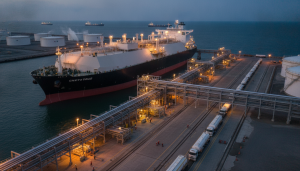
The global energy landscape continues its dynamic churn, demanding keen investor attention to both geopolitical shifts and market fundamentals. A recent temporary authorization by the U.S. Treasury, allowing the purchase of Russian crude products already at sea, underscores the delicate balance policymakers attempt to strike between maintaining market stability and upholding sanctions. This “narrowly tailored, short-term measure,” as described by Treasury Secretary Scott Bessent on April 11, 2026, applies exclusively to oil loaded onto ships on or before that date, with purchases permitted until April 11, 2026, at 12:01 a.m. Eastern time. While seemingly a minor adjustment, this move carries significant implications for supply chain fluidity, price volatility, and the broader outlook for oil and gas investments, especially as geopolitical tensions persist and global demand metrics evolve.
U.S. Intervention: A Calculated Play for Market Stability
The U.S. Treasury’s decision to temporarily greenlight the purchase of specific Russian oil cargoes is a direct response to prevailing energy market pressures, signaling a proactive stance to prevent potential supply disruptions and mitigate price spikes. This exemption is not an easing of sanctions in principle but rather a tactical maneuver to clear a logistical bottleneck for oil already in transit. As of today, Brent Crude trades at $92.85 per barrel, reflecting a slight dip of 0.42% within a day range of $92.57-$94.21, while WTI Crude stands at $89.39, down 0.31%. Gasoline prices are also feeling the pressure, currently at $3.11, down 0.64%. These figures highlight a market under constant tension, where even minor supply-side adjustments can have outsized psychological impacts. The Treasury’s intent is clear: to ensure these “stranded” barrels reach their destinations, thereby adding immediate supply to an already tight market and preventing an artificial scarcity that could further inflate prices. For investors, this short-term measure offers a brief window of supply certainty, but it simultaneously draws attention to the underlying fragilities that necessitate such interventions.
Navigating Geopolitical Crosscurrents and Price Trends
The context surrounding the U.S. authorization extends far beyond simple logistics. Geopolitical tensions, particularly those impacting crucial transit choke points like the Strait of Hormuz, continue to cast a long shadow over global energy markets. The U.S. move, while focused on specific Russian cargoes, cannot be decoupled from the broader narrative of managing energy security amidst ongoing conflicts and international sanctions regimes. Investors have witnessed significant volatility recently; our proprietary data shows Brent crude prices have declined by $7.07, or 7%, from $101.16 on April 1, 2026, to $94.09 on April 21, 2026. This downward trend, even with the current day’s slight dip, suggests that while immediate supply concerns might be addressed by the U.S. action, the overarching geopolitical risk premium and demand uncertainties are powerful counterforces. The temporary authorization might prevent an immediate upward shock, but it doesn’t fundamentally alter the high-risk environment that has driven prices through a volatile range in recent weeks. Investors must continue to weigh the potential for further disruptions against the global supply response and demand elasticity.
Investor Outlook: What Lies Ahead for Crude and Equities
A key question on many investors’ minds, echoed in our proprietary reader intent data (“Is WTI going up or down?” and “What will the price of oil per barrel be by end of 2026?”), revolves around future price trajectory and the performance of energy equities like Repsol. While the U.S. Treasury’s temporary measure provides short-term clarity for a specific segment of Russian oil, the broader market outlook remains complex. Forward-looking analysis is crucial, and several upcoming calendar events will provide critical data points. The EIA Weekly Petroleum Status Report, scheduled for April 22, April 29, and May 6, will offer fresh insights into U.S. crude inventories, refining activity, and demand indicators. These reports are pivotal for gauging the health of the largest consuming market. Furthermore, the Baker Hughes Rig Count on April 24 and May 1 will shed light on North American drilling activity, a bellwether for future supply. Perhaps most significantly, the EIA Short-Term Energy Outlook on May 2 will provide updated forecasts for global supply, demand, and prices through 2027, offering a comprehensive view that will heavily influence investor sentiment. For those asking about WTI’s direction or oil’s year-end price, these reports, combined with ongoing geopolitical developments, will be the primary drivers determining market moves and the subsequent performance of upstream and integrated oil and gas companies.
Strategic Implications Beyond the Short Term
While the U.S. Treasury’s authorization is explicitly “short-term,” its existence speaks volumes about the current state of global energy markets and the strategic challenges policymakers face. It highlights the inherent difficulty in fully isolating a major producer like Russia from global supply chains without significant repercussions for energy consumers worldwide. For oil and gas investors, this implies a continued need for vigilance regarding the interplay between sanctions policy, geopolitical events, and market fundamentals. The April 11 deadline for these specific purchases means that the market will quickly revert to previous supply constraints for Russian oil, unless further, similar measures are enacted. This situation underscores the fragile nature of market stability and the constant potential for policy shifts to introduce new variables. Companies with diversified supply chains and robust trading arms may be better positioned to navigate such temporary market interventions. Investors should consider the long-term implications for global oil flows, the evolving role of non-OPEC+ supply, and the potential for increased volatility as these geopolitical and economic forces continue to converge and diverge, shaping the future of energy investments.