In the timeless week between Christmas and the new year, two Spanish men in their early 50s – friends since childhood, popular around town – went to a restaurant and did not come home.
Francisco Zea Bravo, a maths teacher active in a book club and rock band, and Antonio Morales Serrano, the owner of a popular cafe and ice-cream parlour, had gone to eat with friends in Málaga on Saturday 27 December. But as the pair drove back to Alhaurín el Grande that night, heavy rains turned the usually tranquil Fahala River into what the mayor would later call an “uncontrollable torrent”. Police found their van overturned the next day. Their bodies followed after an agonising search.
“We are used to some floods. Not many,” said Conchi Navarro, the headteacher of Los Montecillos secondary school, whom Zea Bravo was supposed to succeed upon her retirement at the end of the school year. “But since December, these borrasca [low-pressure storms] have come one after the other.”
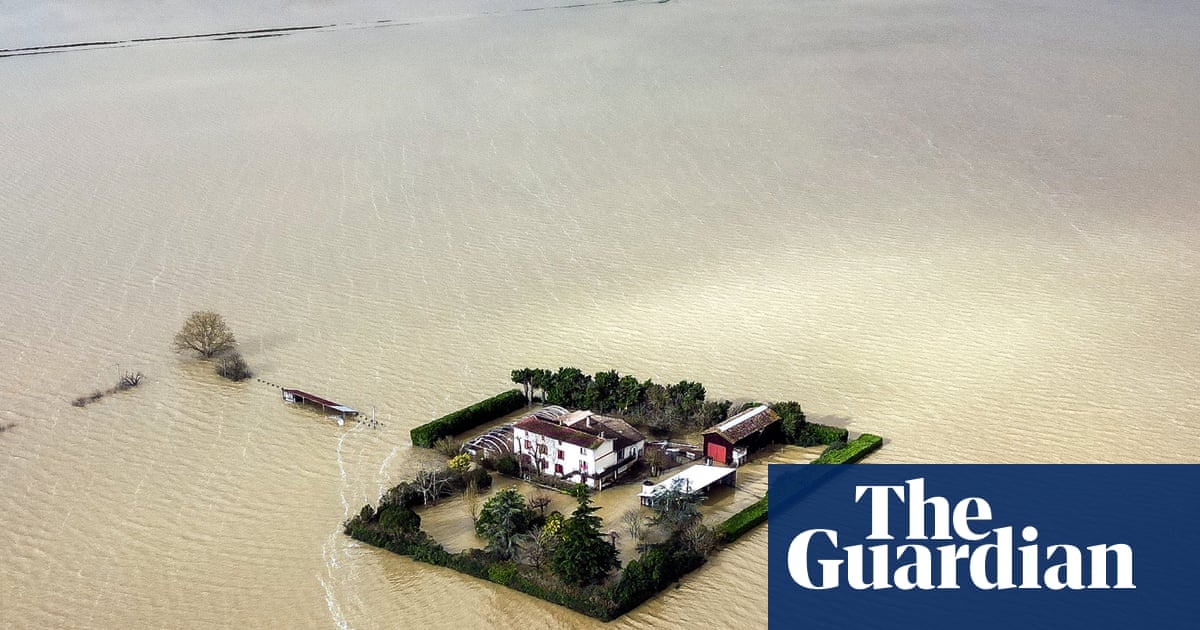
The quiet fallout of a broken climate – a book club short of one member, a rock band without a bassist, a cafe that lacks a pastry chef – has been echoing around western Europe for weeks. The back-to-back storms that battered Spain have killed at least 16 people in neighbouring Portugal. Soils across France have reached unprecedented levels of saturation, with weather forecasters issuing flood alerts that demand “absolute vigilance”. Parts of the UK have broken records for the number of days without a break in the rain.
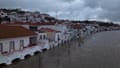
This is Europe’s new reality: under water in winter, withered in summer. Yet even as the weather extremes worsen, the voices of denial have grown louder and more influential.
“We’re moving toward self-destruction of the planet,” said Navarro, adding that at the age of 60 she had witnessed the effects of climate change first-hand. “It’s not something ‘they’ told me, it’s something I’ve seen. How can anybody say this is an invention?”
The answer, particularly in the US, is with breathtaking ease. The president, Donald Trump, has ramped up his attacks on climate policy in recent weeks – quitting the Paris agreement again and repealing a finding that underpins pollution controls – while going global with his “drill, baby, drill” policy. Chris Wright, the US energy secretary and former fracking executive, has pressured Europe to roll back methane standards and sustainability rules that could threaten American exports of liquefied natural gas. On Wednesday, he urged spreadsheet-wranglers at the International Energy Agency to “drop the climate” from its models.
Even in Europe, where polls show citizens overwhelmingly accept climate science and support stopping planet-heating pollution, a quiet but deadly form of denial has emerged.
Far-right parties have gained ground across the continent, even as they make fighting climate policy – aided by the Heartland Institute, a US thinktank funded by fossil fuels – their second priority after immigration. Centrist leaders, alarmed by their success and anxious to placate polluting industries, are rolling back green rules with a vigour that has surprised even some lobbyists. This month, ahead of a meeting in Antwerp between the European Commission president, Ursula von der Leyen, and business leaders, the EU’s carbon price – the cornerstone of its pollution-cutting efforts – found itself in the crosshairs of the powerful chemical industry.
All the while, evacuation alerts are lighting up phones and rivers are bursting their banks as new storms form before the waters from the last have receded. Alice, Benjamin and Claudia were the storms named by meteorologists that started the season in southern Europe in October and November. David, Emilia and Francis led to a wet December. In January, five storms struck in quick succession – Goretti, Harry, Ingrid, Joseph and Kristin – while in February there were just as many – Leonardo, Martha, Nils, Oriana and Pedro – in the first two weeks. The season is one storm shy of the record 17 that hit in the 2023-24 season, with forecasters having reached the second half of the alphabet in far less time.
The storms lashing the Iberian peninsula and the relentless rains in the UK are the result of a southward shift in the jet stream, a conveyor belt of fast-moving air, which has coincided with high pressure over northern Europe and blocked weather systems in place. Global heating amplifies the damage as warm air can hold more moisture. As water pounds sodden soils that have not had time to dry out, the risk of floods increases exponentially.
Scientists complain that European governments are in denial about the scale of the threat. Christophe Cassou, a climate scientist and research director at the French National Centre for Scientific Research, said the flooding in France was unprecedented in terms of area and the result of record cumulative rainfall since the start of the year.
“What is surprising is that the authorities are surprised by such an outcome,” he said. “We are not experiencing the worst possible scenario, but simply a probable one, entirely within the range of what can be expected from climate simulations.”
In Spain, the consequences of such negligence are fresh in people’s minds. On 29 October 2024, Empar Puchades listened to a lunchtime press conference in which the president of Valencia said the storm sitting over the region would soon move on. Puchades still felt troubled. The 70-year-old former healthcare worker looked up the rainfall on official meteorological platforms. Worried about the volume of water and conscious that she lived on flat farmland in a highly urbanised region, she spoke to a friend in a higher-up village who told her an “unimaginable flood” was coming.
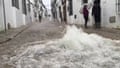
Puchades dutifully warned her neighbours and asked her middle son not to work the night shift, but he told her he had to relieve a colleague, and set out early instead. “If my son had left at his usual time, he would have been caught in the full force of the water,” she said.
The floods that evening killed 229 people in Valencia. The disaster sparked public fury at authorities, who delayed sending alerts, and hammered home the harm that fossil fuel pollution is causing rich countries. Global heating increased rain intensity by 21%, a study in Nature Communications found on Tuesday, and expanded the area under 180mm of rain by 55%.
The night the floods struck, Puchades grabbed the dog, went upstairs, and opened the shutters to see a tongue of water – “not very high, with a lot of debris, making a very strange noise and with an unrecognisable smell” – approaching her home. It came slowly at first, and then quickly. “I will always say that what struck me was how fast it was.”
Spain’s lack of preparedness echoes Germany’s three years earlier, when rains made worse by climate breakdown killed 134 people in the Ahr valley after botched warnings. The disasters are among many examples that have led the EU’s scientific advisers to decry Europe’s efforts to adapt to a hotter planet as “insufficient, largely incremental [and] often coming too late”. In a report on Tuesday, they told officials to prepare for a world 2.8-3.3C hotter than preindustrial levels by 2100 – double the level of global heating that world leaders promised to aim for when they signed the Paris agreement in 2015 – and to stress-test hotter scenarios.
Maarten van Aalst, a member of the European Scientific Advisory Board on Climate Change and head of the Dutch meteorological agency, said climate risks would rise rapidly in such a scenario but that Europe still had a choice about how to navigate those risks.
“Even with the much milder but quite significant warming that we’ve seen so far, we’re already seeing extreme events that surprise us and that kill people when they possibly shouldn’t have if we had anticipated better,” he said. “I hope we will not get to 3C … but there’s a significant chance that the world at large will not meet its targets.”
Temperatures are creeping closer to the 1.5C threshold. The world has warmed by about 1.4C since preindustrial levels and few experts see the goal as still being within reach. As losses mount, climate scientists warn that “every fraction of a degree” of warming still matters.
Navarro, who used to turn to Zea Bravo for reassurance when the busy school became too demanding, said she would remember his chatty character and calming presence. The school held a memorial for him in early January once term restarted, which she said left students silent and motionless. After the “terrible” first two weeks since the floods, they had begun to recover, she added.
“Now we will wait for the fires in summer.”