

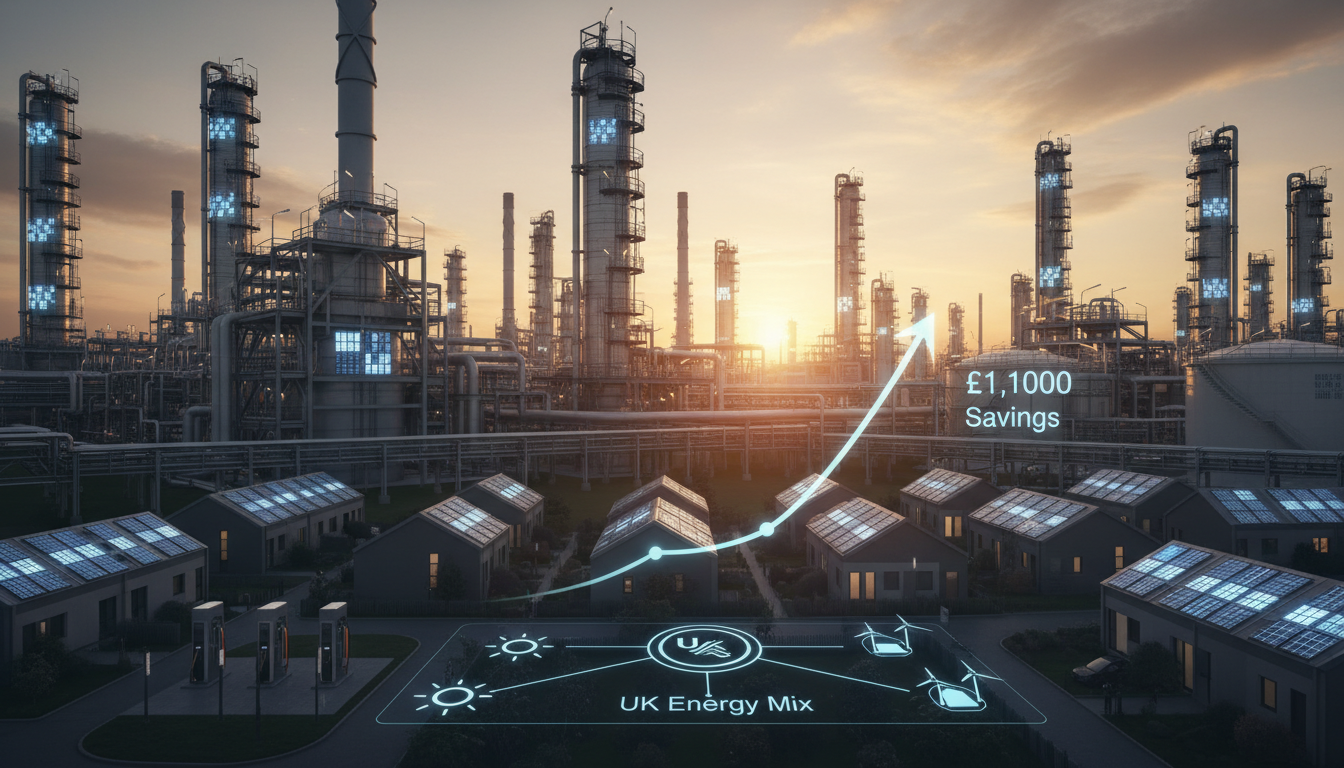
UK Households Set for Significant Returns from Micro-Solar Investments
The United Kingdom’s energy landscape is witnessing a burgeoning opportunity for homeowners and investors alike, as independent financial assessments project substantial long-term savings from the adoption of plug-in solar panels. A typical UK household stands to realize an impressive £1,100 in net savings over the projected 15-year operational lifespan of these compact renewable energy systems.
In a strategic move to bolster national energy security amid prevailing global uncertainties, the UK government unveiled a comprehensive package of clean energy initiatives on March 15. A cornerstone of this policy push is the imminent introduction of “plug-in” solar technology to the mass market, with availability anticipated within months across major retail channels. This development signifies a notable pivot towards democratized, decentralized power generation.
Detailed financial modeling reveals that these plug-in solar solutions are engineered to generate approximately 400 kilowatt hours (kWh) of electricity annually. This output is sufficient to fulfill roughly 15% of a typical household’s yearly electricity requirements, translating directly into tangible bill reductions. Projections indicate annual savings of around £110 on electricity costs. Given an average upfront investment of approximately £500 for an 800-watt (W) system, this robust financial performance facilitates an attractive payback period of just five years. Considering the systems’ anticipated 15-year operational life, the cumulative net financial benefit underscores their compelling value proposition.
The Rise of Plug-in Photovoltaics: A Market Overview
Unlike traditional, larger-scale rooftop solar installations, plug-in solar systems offer unparalleled ease of deployment and flexibility. Typically comprising one to two panels, these units can be effortlessly installed in diverse outdoor environments, from apartment balconies to garden spaces. Their key innovation lies in their direct plug-and-play functionality, connecting straight into standard home electrical sockets without the necessity for complex, costly additional wiring. This seamless integration immediately reduces reliance on grid electricity, directly impacting consumer expenditure.
The market for plug-in solar is not merely nascent; it is rapidly maturing in several European nations and beyond. Germany, a vanguard in renewable energy adoption, has already seen official registrations for these systems exceed 1 million, with unofficial estimates suggesting actual deployments could be as high as 4 million units. Similar growth trajectories are evident in France, Spain, the Netherlands, and the United States, indicating a strong international appetite for accessible solar solutions.
In the UK, the government’s announcement signals a concerted effort to accelerate adoption. Retailers, including major supermarket chains like Lidl and Sainsbury’s, are expected to stock these units within months. Market demand is already demonstrating significant strength, with leading providers reporting sold-out inventory for popular plug-in solar products, highlighting a ready and eager consumer base.
To facilitate widespread adoption, regulatory frameworks are also evolving. The government has committed to collaborating with relevant industry bodies to update electrical regulations, ensuring safe and efficient integration of plug-in solar. Prospective users, however, are prudently advised by organizations like the Institution of Engineering and Technology (IET) to arrange for a professional wiring inspection prior to installation, safeguarding both investment and safety.
Investment Metrics: Analyzing Costs, Benefits, and Energy Security
To provide a clear financial outlook, a detailed cost-benefit assessment was conducted for an 800-watt (W) installation, modeled on a typical two-to-three-bedroom London home. While specific outcomes will inherently vary based on geographic location and precise system setup, these approximate figures offer a robust benchmark for potential investors and homeowners.
Under optimal conditions—panels oriented south-facing and tilted at approximately 40 degrees—such a system in London could generate an impressive 820 kWh annually, operating at an estimated load factor of 12%, according to established European photovoltaic databases. However, real-world deployments frequently encounter sub-optimal conditions, such as vertical balcony placements, less-than-ideal orientations, or shading, which can diminish output.
Industry reports from leading trade organizations indicate that these real-world factors can lead to a 30-60% reduction from optimal generation. For the purpose of this analysis, a conservative 45% reduction was applied. Assuming households efficiently utilize 90% of the generated power—a common efficiency rate for such installations—the system would still contribute a substantial 400 kWh of electricity each year, fulfilling 15% of an average household’s demand. Maximizing this capture rate often involves strategic appliance usage, such as running washing machines or dishwashers during peak daylight hours.
The financial impact is clear: these 400 kWh of annual self-generation translate into an estimated £110 in annual electricity bill savings. This calculation assumes a stable unit electricity cost of 27p/kWh, consistent with market predictions for mid-2026. At this rate, the initial £500 investment is recovered within five years, paving the way for pure profit over the remaining decade of the system’s operational life, accumulating to a total net saving of £1,100.
Furthermore, the volatility inherent in energy markets presents an even more compelling case. Should electricity prices experience prolonged surges, mirroring the peaks observed during the 2022 gas price crisis where rates reached 34p/kWh, annual savings could escalate to approximately £140. Such a scenario would further compress the payback period, enhancing the investment’s attractiveness. As the market for plug-in modules expands and competition intensifies, a downward pressure on upfront costs is also anticipated, which would further improve these financial metrics.
Broader Market Impact and Energy Independence
Scaling up, if 3 million UK households—a figure comparable to current deployment levels in Germany—were to adopt plug-in solar, this collective effort would yield approximately 1.2 terawatt hours (TWh) of electricity annually. While this represents less than 1% of the UK’s total electricity demand, its aggregate economic and strategic value is profound. This level of adoption would collectively save UK households over £330 million and, crucially for energy security, displace an equivalent of roughly two large tankers’ worth of imported liquefied natural gas (LNG) each year.
Beyond the direct financial returns, plug-in solar offers a vital pathway to greater energy independence and widespread participation in the clean energy transition. A significant segment of the UK population—renters, who constitute roughly one-third of households—traditionally face formidable barriers to engaging with home-based clean energy solutions like rooftop solar or heat pumps due to property ownership constraints. Plug-in solar systems circumvent these hurdles, empowering a broader demographic to actively contribute to and benefit from domestic renewable energy generation. This accessibility broadens the market for distributed energy resources, fostering a more resilient and equitable energy ecosystem for the future.
