

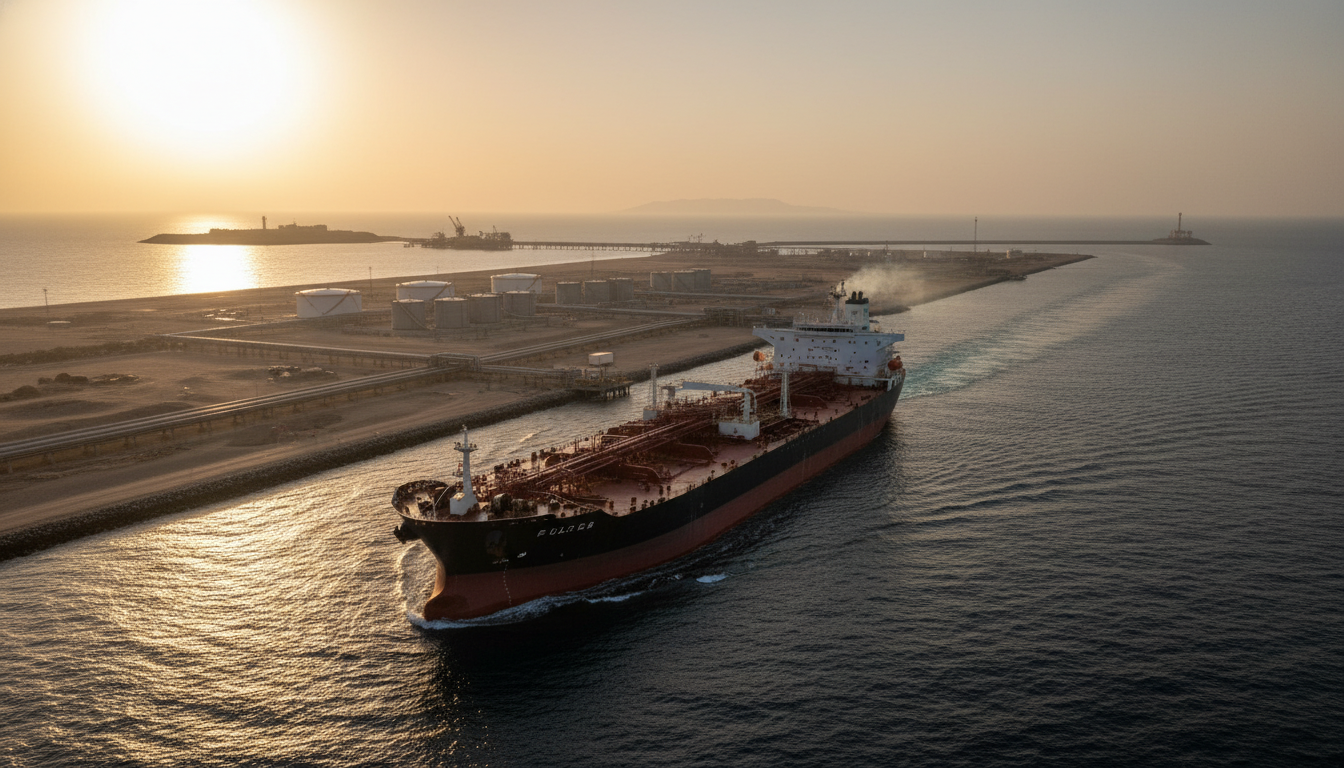
UAE Unleashes Fujairah Crude Exports as Hormuz Bypass Fortifies Global Supply
Investors in the global energy markets are closely monitoring a significant operational resurgence in the United Arab Emirates, where crude oil exports from the strategic port of Fujairah have surged. This critical facility is demonstrating its pivotal role as a bypass for the Strait of Hormuz, successfully restoring loading capabilities following recent Iranian drone strikes. This rapid return to full, or near-full, operational status underscores the UAE’s commitment to maintaining stable crude flows amidst escalating regional tensions, providing a crucial bulwark against potential supply disruptions.
New data reveals a robust uptick in crude loadings from Fujairah, averaging approximately 1.9 million barrels per day (MMbpd) during the critical period of March 20-24. This represents an impressive increase of roughly 57% when compared to what is referred to as the 2025 average, highlighting a rapid and substantial recovery in export capacity. This surge in volumes directly follows the successful partial restart of key export infrastructure managed by the Abu Dhabi National Oil Company (ADNOC), which had faced temporary shutdowns in the wake of targeted attacks earlier in the month. For oil and gas investors, this rapid recovery signals strong operational resilience and an effective mitigation strategy against geopolitical risks in a volatile region.
Fujairah’s Indispensable Role Amidst Regional Volatility
With the Strait of Hormuz effectively experiencing closures to significant tanker traffic due to heightened security risks, Fujairah’s strategic importance has never been more pronounced. Alongside Saudi Arabia’s Yanbu terminal on the Red Sea, Fujairah has solidified its position as an indispensable conduit for maintaining the uninterrupted flow of Gulf oil to international markets. The Habshan-Fujairah pipeline, which links ADNOC’s prolific onshore fields directly to the Fujairah export terminal, is now operating at near maximum capacity. This vital infrastructure ensures that crude exports can continue unimpeded, effectively circumventing the logistical and security challenges posed by disruptions within the Persian Gulf itself. Market analysts are keenly observing how this operational flexibility will influence crude price stability and global energy security discussions.
However, market participants must remain cognizant of the persistent vulnerabilities facing Fujairah. Located approximately 80 miles from the Strait of Hormuz, the port remains within striking distance of regional threats. In recent weeks, the facility has endured multiple attacks, resulting in damage to critical infrastructure, including storage tanks, pumping systems, and fuel-loading apparatus. While crude export systems have largely resumed full operations, certain segments of the refined products network continue to experience downtime, necessitating the rerouting of some loading activities to alternative facilities. This ongoing risk profile adds a layer of complexity for investors assessing long-term stability and operational efficiency in the region.
Navigating Operational Challenges and Market Transparency
Further complicating the operational landscape and market transparency are persistent signal interferences across the region. These disruptions significantly hinder real-time vessel tracking, making it increasingly challenging for analysts and investors to accurately verify actual export volumes. This lack of granular, immediate data can introduce uncertainty into market assessments, potentially impacting trading decisions and risk premiums associated with regional crude flows. Energy sector investors are advised to factor in this information asymmetry when evaluating market positions and supply chain reliability in the Arabian Gulf.
Despite these inherent challenges and the ongoing threat landscape, Fujairah’s pivotal role as a strategic bypass route has proven instrumental in averting a much deeper global supply shock. The Strait of Hormuz typically handles a staggering 15 MMbpd of crude oil, representing a significant portion of the world’s daily consumption. Without the crucial alternative export corridors provided by Fujairah and Yanbu, the profound loss of these flows would have precipitated a far greater and more severe impact on global oil markets, likely triggering unprecedented price spikes and threatening worldwide economic stability. The operational resilience demonstrated by the UAE, channeled through Fujairah, therefore serves as a critical stabilising force in an otherwise unpredictable global energy environment.
Investor Outlook: Strategic Resilience in a Volatile Market
For investors focused on the oil and gas sector, Fujairah’s resurgence underscores the strategic value of diversified export infrastructure and the operational agility of key national oil companies like ADNOC. While geopolitical risks in the Middle East remain elevated, the ability to rapidly restore and sustain crude exports through alternative routes offers a vital layer of protection against major supply disruptions. This strengthens the investment case for entities with robust infrastructure and contingency plans, signaling a commitment to reliable supply even under duress. The ongoing developments in Fujairah will undoubtedly remain a focal point for assessing energy security and market resilience in the coming months, influencing strategic investment decisions across the global petroleum landscape.
