

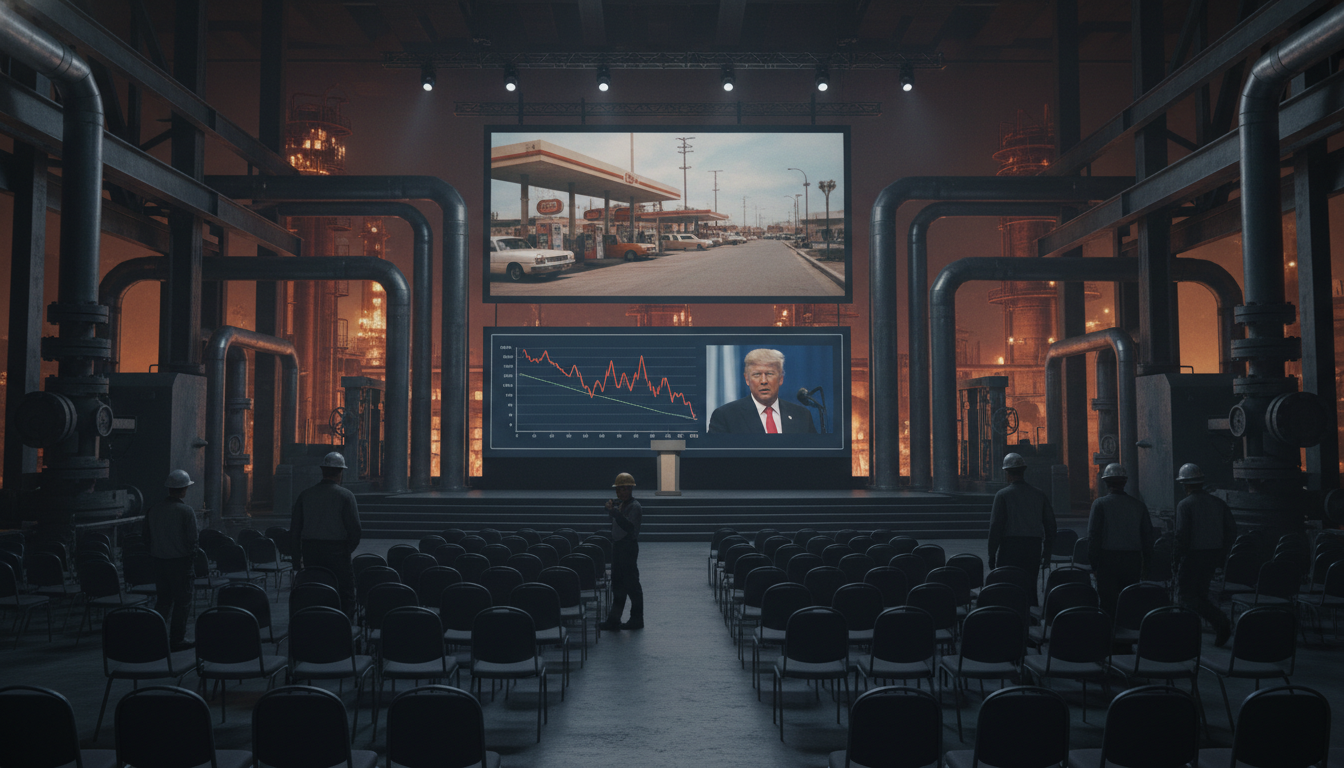
Geopolitical Tensions Ignite Energy Markets: A Deeper Dive for Investors
As global attention fixates on the escalating geopolitical landscape, the current administration’s public pronouncements often project an image of strategic triumph. However, astute investors recognize the inherent risks: the conflict’s economic fallout for the global economy, and particularly for the United States, could intensify significantly before any resolution. History teaches us that such energy-driven crises can cast long shadows, shaping presidential legacies and redefining economic paradigms for decades.
Indeed, a look back to the 1970s reveals a recurring pattern where U.S. presidencies grappled with energy shortages and rampant inflation. These periods left an indelible mark on the collective economic psyche. As one seasoned presidential historian and former head of the U.S. Energy Information Administration observed, the “oil shock of the ’70s was deeply embedded in our memory,” leaving a profound impact. Current market dynamics suggest we may be experiencing a similar, jarring jolt to the system.
The immediate repercussions are already evident across the energy complex. Retail gasoline prices for consumers have climbed above $4 per gallon on average, a threshold not breached since the onset of the latest conflict. This surge directly tracks the sharp rise in benchmark crude prices. Brent crude, a global bellwether, has soared by an estimated 27% since the hostilities commenced, pushing past the $100 per barrel mark. A significant contributor to this market anxiety is the vital Strait of Hormuz, a maritime chokepoint off Iran’s southern coast through which an estimated 20% of the world’s oil transits daily. Threats and reported attacks in the region have led to commercial shippers and oil tankers idling, directly impacting global supply chains.
Yet, the consumer pain at the pump may represent merely a fraction of the broader economic pressures building globally. The United Kingdom, for instance, anticipates receiving its final scheduled shipment of jet fuel for the foreseeable future this week. Worldwide, jet fuel prices have escalated by an staggering 96%, according to data compiled by Platts and the International Air Transport Association. Further illustrating this widespread market dislocation, futures contracts for liquid natural gas (LNG) in key Asian markets like Japan and South Korea have jumped by 43%, as reported by FactSet.
While the United States possesses greater domestic energy production capabilities, distinguishing it from Asian and European nations that rely heavily on direct Middle Eastern imports, the interconnected nature of global commodity markets ensures that disruptions reverberate everywhere. Analysts are increasingly voicing concerns that global oil prices could well surpass the historic peak of nearly $150 per barrel witnessed in July 2008 during the Great Recession, signaling profound inflationary pressures ahead.
To date, the world has partially cushioned the blow by leveraging existing energy supplies already in transit when the conflict began just over a month ago. Emergency releases from strategic petroleum reserves have also provided some temporary relief. However, these reserves are finite, and the world is rapidly depleting them. The International Energy Agency’s Executive Director, Fatih Birol, recently underscored the gravity of the situation, stating that “even with the modest estimates we have now, the loss of oil in April will be twice the loss of oil in March,” indicating a rapidly deteriorating supply outlook.
Global Responses and Energy Conservation Mandates
In response to this looming energy crisis, governments worldwide are actively pursuing measures to encourage conservation. The IEA tracks these initiatives, noting that 26 different governments have implemented steps ranging from Pakistan lowering its national speed limit to other demand-side management strategies. Such actions reflect a growing acknowledgment of the severity of the supply squeeze.
Domestically, the U.S. administration has focused on incentivizing market forces to boost supply, but has notably refrained from issuing calls for Americans to conserve energy. This reluctance is steeped in political precedent, harkening back to President Jimmy Carter’s efforts during the 1979 crisis, which coincided with the Iranian Revolution. Ronald Reagan effectively leveraged Carter’s appeals for consumer belt-tightening into a potent political weapon, securing the presidency the following year. Furthermore, the current administration has spent considerable time advocating for restrictions on the development and subsidies for renewable energy initiatives, presenting a complex policy landscape for investors to navigate. This political dynamic suggests a shift in national priorities, with one historian noting, “We’ve lost our ability to ask the American public to sacrifice,” a sentiment with significant implications for how future energy shocks might be managed.
Historical Precedent: Energy Shocks and Economic Recessions
Prior to the Carter era, a bipartisan consensus often supported calls for shared national sacrifice during times of crisis. President Richard Nixon, a Republican, proposed a national speed limit of 55 miles per hour following the Arab Oil Embargo of 1973. This measure was enacted into law the subsequent year, but even before its formal adoption, Nixon’s appeals for reduced speeds resonated with the public. “We still had a little bit of the World War II mentality,” Hakes recalled, highlighting a period where civic duty and collective action were more readily embraced.
However, the energy crises of the 1970s fundamentally altered this mindset. Both Nixon and Carter struggled to contain rising prices, leading to rampant inflation. Carter’s appointment of Paul Volcker as Federal Reserve chair ultimately tamed inflation, but only through aggressively raising interest rates, which triggered a severe recession and record-high mortgage rates. Carter, consequently, failed to secure re-election.
The failures to effectively address these energy crises significantly eroded public trust in governmental efficacy. As Princeton University historian Meg Jacobs articulated, “If the Vietnam war and Watergate scandal taught Americans that their presidents lied, the energy crisis showed them that their government didn’t work.” This diminished faith in institutions permanently reshaped Americans’ expectations of government’s role and capabilities.
Navigating Future Volatility
Today’s political climate presents a distinct challenge. The current President’s political platform has often emphasized a singular ability to resolve national issues, stating, “Nobody knows the system better than me, which is why I alone can fix it.” This highly centralized approach to executive power means that if the worst-case scenarios regarding energy supply disruptions and economic downturns materialize, the administration will face immense pressure to address them effectively, with limited avenues to deflect responsibility.
While the most dire predictions may not come to pass, and the global economy could demonstrate resilience, much like it did following the initial shock of previous geopolitical events, the potential for prolonged instability remains. For investors, this environment necessitates a vigilant assessment of geopolitical risks, energy supply fundamentals, and governmental policy responses. The current tensions highlight the critical importance of understanding energy market dynamics and their profound impact on broader economic stability and long-term investment strategies.
