

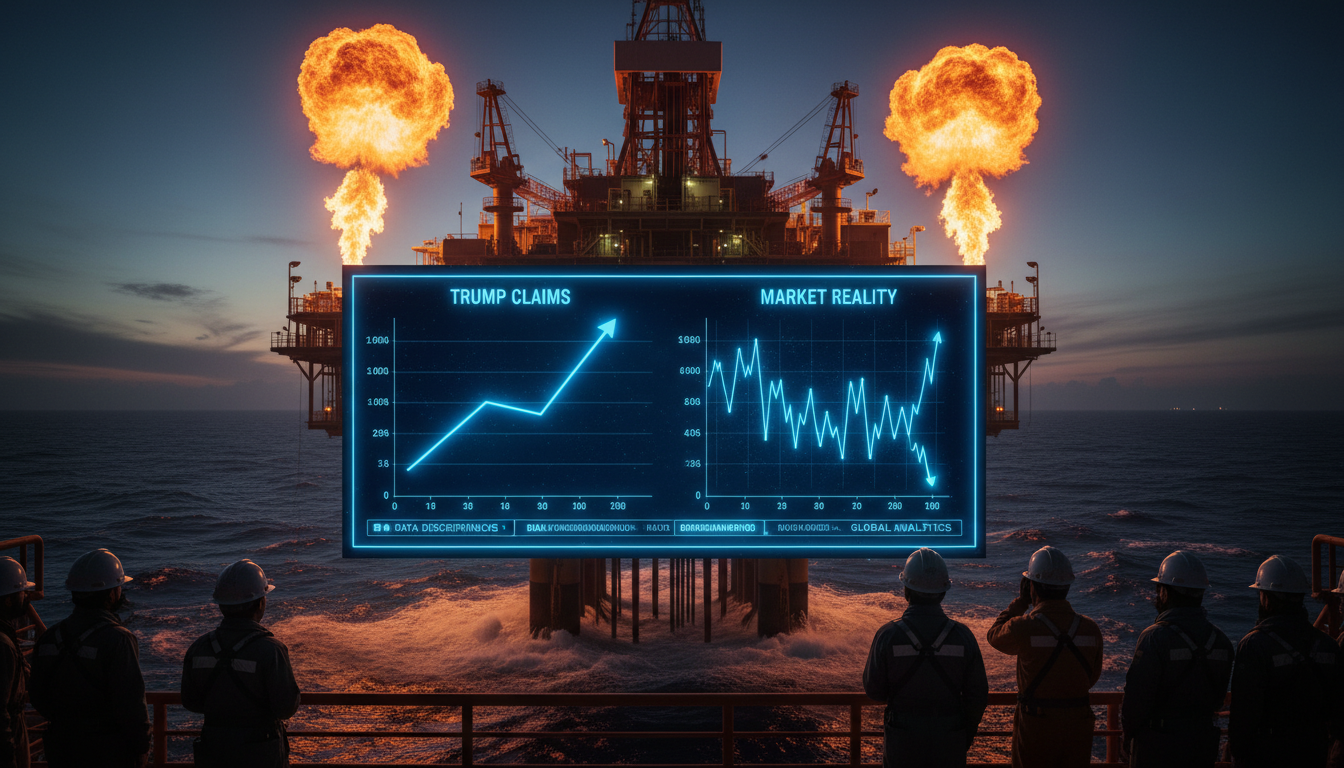
Energy investors are closely scrutinizing recent statements regarding the U.S. economy and geopolitical shifts in the Middle East, particularly concerning Iran. These declarations come amidst a backdrop of surging gasoline prices and persistent inflationary pressures, factors that directly impact the financial outlook for the global oil and gas sector. Evaluating these claims against verifiable economic and geopolitical data is crucial for informed investment decisions in today’s volatile energy markets.
Inflation’s Persistent Grip on Energy Markets
A recent assertion that the U.S. economy, once perceived as struggling, has transformed into the world’s most robust with “no inflation” warrants a closer look from an investor’s perspective. While the U.S. economy has indeed demonstrated resilience, the claim of zero inflation does not align with current economic indicators. In 2024, the American gross domestic product (GDP), adjusted for inflation, expanded by a significant 2.8%. This growth outpaced most affluent nations globally, except for Spain, and followed healthy expansion rates from 2021 through 2023. However, growth did see a deceleration to 2.1% in the past year, partially influenced by a 43-day federal government shutdown.
More importantly for energy investors, inflation remains a tangible economic force. The Labor Department’s Consumer Price Index (CPI) registered a 2.4% increase in February compared to the previous year. This figure, still above the Federal Reserve’s 2% target, highlights ongoing cost pressures. For oil and gas companies, persistent inflation can elevate operational expenses, from labor and equipment to transportation, directly impacting profitability margins. Investors must account for these inflationary headwinds when projecting future earnings and evaluating the real return on their energy investments.
Iran’s Shifting Geopolitical Landscape and Oil Supply Risk
The geopolitical dynamics in Iran are of paramount concern to the global oil market. Recent statements suggesting that “regime change has occurred” due to the demise of “original leaders” and that a “less radical and much more reasonable” group now holds power require critical analysis. The reality on the ground indicates a far more complex and potentially volatile situation for oil supply and regional stability.
Following an Israeli airstrike on February 28th, which resulted in the death of Supreme Leader Ayatollah Ali Khamenei, his son, Mojtaba, widely considered an even harder-line figure, was installed as the new supreme leader. This succession has not heralded a moderation in governance but rather a solidification of power for Iran’s paramilitary Revolutionary Guard, which has gained further influence during the month-long conflict. Iran’s civilian leadership, largely unaffected by the war, openly admits to having limited command and control over the Guard’s actions. This dynamic means that even if a perceived “change” in leadership structure occurred, the practical implications for Iran’s foreign policy, its approach to sanctions, and its potential for disrupting global oil flows remain highly uncertain and carry significant geopolitical risk for oil and gas investors. Both international leaders have signaled a desire for the Iranian populace to rise up and reclaim their government, a call that has not materialized, underscoring the resilience of the current regime’s internal control.
Internal Stability and Iran’s Oil Production Outlook
The extent of internal unrest within Iran, particularly claims about protester deaths, is a grim indicator of domestic stability. A recent assertion claimed that “45,000 of their own people who were protesting in Iran” were killed. However, this figure far exceeds verified reports. The U.S.-based Human Rights Activists News Agency, a reliable source for monitoring Iranian demonstrations, confirmed over 7,000 deaths in nationwide protests that peaked in January. While acknowledging that thousands more may have perished due to communication restrictions, the agency also reported over 53,000 arrests. The Iranian government, notorious for downplaying casualty figures, offered its own toll of 3,117 deaths on January 21st. The stark discrepancy in these figures highlights the opacity of the situation and the challenge in accurately assessing the depth of internal dissent.
For energy investors, these reports, regardless of the precise numbers, signal persistent internal instability. A nation’s internal turmoil can translate into disruptions in oil production, export capabilities, or heightened regional tensions, all of which directly impact global oil prices and investor confidence in Middle Eastern assets. Monitoring these human rights reports offers valuable insights into the underlying political risks associated with a major OPEC producer like Iran.
The Global Nature of Oil and U.S. Energy Independence
The narrative of the United States being “totally independent of the Middle East” and no longer needing its oil, while appealing domestically, fails to account for the fundamental nature of the global oil market. It is true that the U.S. has achieved remarkable success in boosting domestic oil production, emerging as the world’s leading producer. In 2025, only 8.5% of U.S. oil imports originated from the Persian Gulf, a significantly reduced reliance compared to past decades.
However, energy market analysis consistently demonstrates that oil is a globally traded commodity. Its price is determined on international exchanges, meaning any significant disruption in supply, regardless of location, reverberates across the entire market. As University of Chicago energy analyst Sam Ori aptly stated before recent political addresses, “a disruption anywhere affects the price everywhere.” This economic reality is evident in current market movements: the benchmark U.S. crude oil price has climbed over 50% since the onset of the Iran war, and the average price for a U.S. gallon of gasoline surpassed $4 this week. These figures clearly illustrate that despite increased domestic production, U.S. consumers and the broader economy remain deeply sensitive to geopolitical events in major oil-producing regions like the Middle East. Investors must always factor global geopolitical risk into their energy portfolio strategies.
Scrutinizing Investment Figures
Claims of “record-setting investments coming into the United States, over $18 trillion,” are significant for investors tracking capital flows and economic growth. However, verifiable evidence supporting this colossal figure has not been presented. This sum appears to be a substantial overestimation when compared against established financial reporting and even the White House’s own published data. The administration’s website, for instance, cites a lower figure of $10.5 trillion, which notably encompasses investment commitments made during the previous administration as well.
Further complicating these claims, a study published in January raised considerable doubts regarding the materialization of over $5 trillion in investment commitments made last year by key U.S. trading partners. The study questioned both the likelihood of these funds being deployed and their specific allocation if they were. For investors in the energy sector, accurate reporting on domestic and foreign direct investment is critical for assessing future demand, infrastructure development, and overall economic health. Overstated figures can lead to misjudgments in capital allocation and distorted views of market opportunities and risks.
Understanding Past Financial Transactions with Iran
Historical financial transactions with Iran are often subject to misinterpretation, as highlighted by the persistent claim that a previous administration “gave them $1.7 billion in cash.” While it is true that the U.S. Treasury remitted approximately this amount to Iran, it was not a gratuitous payment or foreign aid. This sum represented a settlement for money owed to Iran since the 1970s.
Specifically, Iran had paid the U.S. $400 million for military equipment that was never delivered following the overthrow of the Iranian government and the subsequent rupture of diplomatic ties. After the 2015 agreement aimed at constraining Iran’s nuclear development, the U.S. and Iran announced a resolution to this long-standing financial dispute. This entailed the U.S. repaying the $400 million principal in cash, along with approximately $1.3 billion in accrued interest. Understanding this distinction between a historical debt repayment and a direct ‘gift’ is crucial for investors attempting to dissect the financial and political history influencing U.S.-Iran relations, especially as these dynamics continue to shape sanctions regimes and Iran’s potential role in global oil supply.
