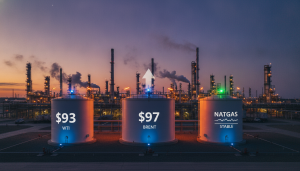
The global oil market stands at a critical juncture, facing the potential for significant disruption from impending policy shifts. While headlines might suggest a well-supplied market, our proprietary data and deep analysis reveal a delicate balance easily tipped by external shocks. The prospect of substantial U.S. tariffs on Russian oil, specifically a proposed 500% levy, could fundamentally re-route global crude flows, creating immediate arbitrage opportunities and injecting a fresh wave of volatility. For energy investors, understanding the underlying fragilities and the market’s current positioning is paramount as we navigate this complex landscape.
The Looming Tariff Threat and Supply Chain Stress
The imposition of a punitive 500% tariff on Russian oil would effectively render its export to nations implementing such a measure uneconomical, necessitating a rapid shift in global demand towards non-Russian barrels. This dramatic rerouting would not only create immediate price dislocations but also exacerbate existing fragilities in the global supply chain. Consider the ripple effects: a significant portion of refined products, particularly from major processing hubs like India, rely heavily on Russian feedstock. A disruption here could destabilize product markets, driving up prices for gasoline and diesel globally, which are already showing sensitivity, with gasoline trading at $3.00, down a modest 0.33% today but within a tight daily range of $2.93-$3.03.
Compounding this potential supply shock are the ongoing challenges in maritime logistics. With 183 Russian-affiliated tankers now facing blacklisting, freight rates for voyages to Asia have already surged by 50%. This forces Russia to increasingly rely on older, less-insured vessels and engage in more risky ship-to-ship transfers. Such operational shifts introduce significant supply chain risk, increasing the probability of delays, accidents, and further tightening of available crude. The market’s superficial oversupply narrative, driven by recent inventory builds, masks this underlying vulnerability. While global supply growth has outpaced demand growth by approximately 2.1 million barrels per day (mb/d) versus 700-720 thousand barrels per day (kb/d), these inventory additions since February offer a false sense of security against geopolitical shocks of this magnitude.
OPEC+’s Balancing Act and U.S. Shale’s Constraints
In the face of potential Russian supply reductions, the market’s ability to respond quickly hinges on the flexibility of other major producers. While U.S. shale has demonstrated remarkable resilience, currently pumping at a record 13.4 mb/d, its capacity for rapid acceleration is not limitless. Production economics, with breakeven costs in the $62-$64 per barrel range, coupled with escalating input costs, are tempering the pace of new drilling. Furthermore, existing tariffs on steel and other essential equipment are adding an estimated $3-$5 per barrel to production economics, further reducing the speed at which U.S. producers can meaningfully respond to a sudden price spike. This structural inflexibility means the burden of market stabilization largely falls on OPEC+.
Over 80% of the world’s accessible OPEC+ spare capacity is concentrated within the Middle East, primarily in Saudi Arabia and the UAE. Both nations depend on the Strait of Hormuz, a persistent geopolitical flashpoint, for their exports. Any disruption to this vital chokepoint, especially during a period of heightened supply stress, would have severe global implications. Investors will be keenly watching the upcoming OPEC+ Joint Ministerial Monitoring Committee (JMMC) meeting on April 18th, followed by the full Ministerial Meeting on April 20th. These gatherings, highlighted in our proprietary economic calendar, represent critical junctures where producers will assess the market balance and potentially signal their collective response to any significant Russian supply curtailment. Their decisions will be pivotal in shaping the crude price trajectory for the remainder of the quarter, a key concern for many of our readers asking for a base-case Brent forecast.
Market Positioning Reflects Mounting Volatility Expectations
Our proprietary reader intent data indicates a strong investor focus this week on forward Brent price forecasts and strategies to navigate market volatility. This sentiment is clearly mirrored in current trading patterns. We’re observing a distinct shift away from outright directional bets towards strategies designed to capitalize on increased price swings. For example, February $75 Brent call options, which traded at a mere $0.43 previously, have recently surged to nearly $2.00, while $80 Brent calls are now commanding a premium of $5.29. This significant increase in call option pricing signals growing conviction among traders regarding the potential for upward price movement and a corresponding surge in volatility.
Further supporting this outlook, ICE Brent net long positions saw a substantial jump of 55,630 lots last week, reaching a total of 222,347 lots. This accumulation of long exposure underscores a robust belief in potential supply disruptions pushing prices higher. Currently, Brent Crude trades at $94.93, showing a flat movement today but within a daily range of $91-$96.89. This follows a notable downward trend from $102.22 on March 25th to $93.22 on April 14th, representing a $9, or 8.8%, decline over 14 days. This recent dip, however, may be viewed by some as an attractive entry point, particularly with technical analysis indicating Brent faces resistance in the $80-$82 range. A sustained breakout above this level, especially in response to geopolitical headlines, could easily trigger algorithmic buying and trend-following flows, propelling prices higher and validating the current options market positioning.
Navigating a Bullish Outlook with a Volatility Premium
Given the confluence of geopolitical risk, a fragile market balance, and shifting investor sentiment, the market outlook remains bullish, albeit with a significant volatility premium. The potential implementation of robust tariffs on Russian oil by the U.S. could serve as a major inflection point for crude markets. Should this policy effectively remove a substantial volume of Russian barrels from global circulation, investors should prepare for a sustained run towards the $80-$85 per barrel range, with further upside potential depending on the severity and duration of the disruption.
In this environment of elevated policy risk and headline sensitivity, a defensive hedging strategy remains the most prudent approach. Investors should favor call options, strategic spreads, and producer collars over outright long positions, which offer exposure to upside while managing downside risk. Closely monitoring key indicators will be crucial for timing and strategy adjustments. Pay particular attention to updates on sanctioned tanker lists, global freight rates, and the evolving buying patterns of major importers like China and India, especially how their “tea-pot” refineries adapt. These metrics will provide the earliest signals of how aggressively markets will react to any new supply-side shock.