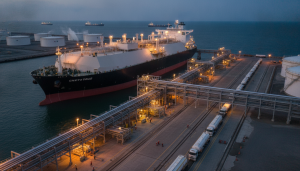
The global energy landscape is once again gripped by uncertainty following candid remarks from President Donald Trump, who on Monday, May 20, 2026, expressed profound disinterest in the potential collapse of peace negotiations with Iran. Speaking to CNBC, the President’s statements have sent ripples through oil markets, with investors closely scrutinizing the geopolitical implications for crude supplies and prices. His comments arrive amidst reports of escalating tensions, including threats by Tehran to “completely block” the strategically vital Strait of Hormuz.
Geopolitical Tensions Reshape Energy Market Outlook
President Trump’s dismissive stance on the protracted diplomatic efforts with Iran signals a potentially significant shift in U.S. policy, or at the very least, a hardening of rhetoric that could dramatically influence oil market dynamics. Asked about intelligence indicating a cessation of communication from Iranian negotiators and the severe threat to the Strait of Hormuz—a critical chokepoint for global oil shipments—the President unequivocally stated, “I don’t care if they’re over, honestly.” He further elaborated, “I really don’t care. I couldn’t care less,” adding that he found the ongoing discussions to be “very boring.”
This assertive position emerges against a backdrop of heightened regional instability, specifically Israel’s ongoing military operations in Lebanon. The potential for the conflict to broaden, coupled with Iran’s reported reaction, casts a long shadow over the stability of Middle Eastern oil flows. President Trump confirmed he intended to discuss the situation directly with Israeli Prime Minister Benjamin Netanyahu, with Reuters later reporting that the two leaders had indeed spoken via phone on Monday afternoon.
For investors, the Strait of Hormuz represents an existential artery for global oil trade. Blocking this waterway would immediately trigger a substantial supply shock, with dire consequences for crude prices and global economic stability. Trump’s apparent indifference to the negotiation’s fate, therefore, introduces an additional layer of geopolitical risk that must be meticulously factored into energy investment strategies.
The Oil Price Paradox: Trump’s Optimism vs. Market Realities
Despite the palpable increase in geopolitical risk, President Trump conveyed an surprising degree of confidence regarding the future trajectory of oil prices. He asserted, “I think the oil will be dropping like a rock in the very near, you know, the very near distance.” This statement directly contrasts with immediate market reactions, which saw crude benchmarks spike following the initial reports of Iran’s threats to the Strait of Hormuz earlier in the day.
The disconnect between the President’s forecast and the market’s immediate response highlights the complex interplay of political rhetoric, perceived risk, and fundamental supply-demand dynamics. While strategic petroleum reserves and potential increases in output from other major producers could theoretically mitigate some shocks, the blocking of a passage through which approximately one-fifth of the world’s oil transits daily would undoubtedly lead to severe price volatility and upward pressure in the short to medium term. Investors are left to reconcile the President’s optimistic outlook with the very real and immediate threats to global crude supply lines.
Public Tolerance for Higher Fuel Costs: A Nuclear Imperative?
Further adding to the complexity, President Trump suggested that the American public would be willing to absorb higher gasoline prices if the alternative were Iran developing nuclear weapons. “Once you explain that this is all about Iran having a nuclear weapon, people are willing to pay a little bit more,” he stated. This argument frames potential domestic economic discomfort as a necessary sacrifice for national security, specifically the non-proliferation agenda.
Historically, elevated fuel prices often lead to public dissatisfaction and can impact consumer spending, a crucial driver of economic growth. Should a scenario unfold where geopolitical tensions in the Persian Gulf escalate significantly, leading to sustained high crude oil and gasoline prices, the economic ramifications could extend far beyond the energy sector. Industries reliant on transportation and consumer discretionary spending would likely face headwinds, influencing corporate earnings and broader market sentiment.
Despite his assertion about public willingness to pay more, Trump reiterated his belief that prices at the pump would “drop very quickly.” This seemingly contradictory stance leaves investors pondering the administration’s true expectation for energy costs in the face of ongoing international crises and its implications for both energy policy and economic planning.
Investor Outlook: Navigating Uncertainty in the Persian Gulf
For discerning investors in the oil and gas sector, President Trump’s latest remarks underscore a period of heightened uncertainty and potential volatility. His open disdain for ongoing negotiations, coupled with significant threats emanating from Tehran and military actions in the Levant, means geopolitical risk premiums are likely to remain elevated, offering both challenges and opportunities.
Companies with significant exposure to Middle Eastern crude production or transportation, particularly those with a heavy reliance on the Strait of Hormuz, face increased scrutiny. Conversely, firms positioned in less geopolitically sensitive regions or those with robust balance sheets capable of weathering price swings might present defensive plays. Furthermore, the renewed focus on energy security could accelerate investments in alternative supply routes or non-OPEC production, creating new avenues for growth.
As diplomatic channels falter and military tensions simmer, the market will intently watch for concrete actions from all parties involved. Investors must remain agile, continuously assessing the evolving geopolitical landscape and its immediate and long-term implications for global energy supply, demand, and pricing structures. The prospect of sustained instability in a region critical to the world’s oil supply demands a cautious yet opportunistic approach to portfolio management in the coming weeks and months.