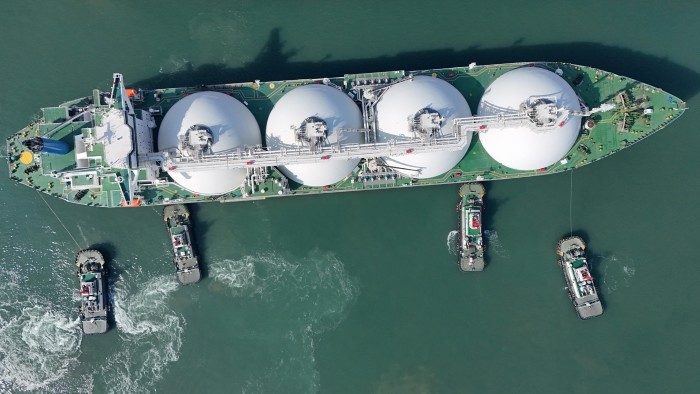
America’s rapidly expanding liquefied natural gas (LNG) export industry, a critical pillar of its “energy dominance” strategy, now confronts significant policy-induced headwinds. Industry leaders are issuing stark warnings that recently unveiled federal trade regulations, intended to enforce the use of American transport vessels, are simply impractical and threaten to severely disrupt a vital export market valued at $34 billion annually.
U.S. Trade Policy Collides with LNG Logistics
On April 17, the U.S. Trade Representative (USTR) unveiled new directives designed to exert pressure on China regarding perceived unfair trade practices, while simultaneously aiming to bolster domestic shipbuilding capabilities. The core mechanism involves implementing levies on Chinese-built ships that dock at U.S. ports. This move seeks to incentivize the utilization of American-flagged and constructed vessels for transporting U.S. goods, a mandate that critically includes liquefied natural gas.
While the broader objectives of rebalancing trade relationships and stimulating American manufacturing resonate across various sectors, the practical ramifications for the global LNG industry are igniting widespread concern among exporters. This sector, inherently reliant on a diverse international fleet of foreign-built carriers, anticipates a dramatic escalation in operational costs should these new rules be rigorously enforced. Such an impending cost surge could significantly erode the competitive advantage U.S. LNG producers currently enjoy in fiercely contested global energy markets, directly impacting investor returns and market share.
An Unworkable Reality for LNG Exporters
Despite some prior concessions, including a three-year delay in implementation specifically for the LNG sector and a phased 22-year timeline for the complete transition to U.S.-built and flagged vessels, industry stakeholders maintain that the new requirements remain fundamentally unachievable. The American Petroleum Institute (API) has formally communicated to both the Secretaries of Energy and Interior that compliance with these mandates is simply not feasible under current market and infrastructure conditions. A critical reality underscores this predicament: there are presently no U.S.-built vessels capable of shipping LNG, and domestic shipyards lack the surplus capacity to construct the necessary carriers by the stipulated 2029 deadline.
This stark logistical reality presents a formidable challenge for investors and market participants. The inability to meet these strict maritime demands could severely compromise America’s capacity to sustain its leading position within the global LNG industry, thereby jeopardizing its strategic aspirations as a global energy superpower. Furthermore, energy sector leaders express profound concern that such aggressive trade instruments could establish a perilous precedent, potentially empowering future administrations to arbitrarily suspend export licenses. This introduces an immense layer of regulatory uncertainty, a significant risk factor for the long-term, capital-intensive energy projects that define the oil and gas landscape.
Economic Fallout and Geopolitical Stakes
The financial consequences of these policies extend far beyond the immediate operational costs for LNG shippers. Investors must consider the potential for U.S. LNG to become less attractive on the international market, leading to reduced export volumes and diminished profitability for producers. This scenario would not only impact companies directly involved in liquefaction and export but also ripple through the upstream sector, affecting gas producers who rely on export markets to balance domestic supply and demand. The very capital investments made to expand liquefaction capacity, which have driven the U.S. to the forefront of global LNG supply, could see their returns significantly challenged.
Moreover, the geopolitical implications are substantial. Should U.S. LNG exports face impediments, global energy security could be impacted, particularly for allies in Europe and Asia who have come to rely on American gas as a stable and diverse energy source. This policy, while aiming to bolster domestic industry, risks undermining the strategic objective of providing energy independence and stability on a global scale. The long-term contracts and international partnerships integral to the LNG trade are built on predictability and reliability, factors directly threatened by unforeseen shifts in maritime trade policy.
Beyond LNG: Broader Energy Market Implications
The ramifications of these maritime trade tariffs are not confined solely to the LNG sector. Prominent industry groups are also actively advocating for the exemption of other critical energy commodities, including crude oil and refined petroleum products such as gasoline and liquefied petroleum gas (LPG), from these impending maritime tariffs. Their argument is clear and compelling: imposing such fees would inevitably disrupt meticulously balanced global supply chains that have evolved over decades to efficiently deliver energy resources worldwide. Any impediment to the free movement of these vital commodities risks increasing transportation costs, which would ultimately translate to higher prices at the pump for consumers and increased operating expenses for industries reliant on these fuels.
The complexity of global energy shipping, involving specialized vessels, intricate routing, and tight scheduling, means that sudden, broad-reaching tariff implementations can create bottlenecks and inefficiencies across the entire value chain. For investors monitoring the oil and gas markets, this represents a significant variable that could influence commodity prices, refining margins, and the overall competitiveness of U.S. energy exports. Maintaining fluidity in these supply chains is paramount for the stability of global energy markets and for the continued profitability of U.S. energy companies operating on an international stage.
Investor Outlook: Navigating Regulatory Uncertainty
For investors in the oil and gas sector, these new trade policies introduce a substantial layer of regulatory uncertainty that warrants careful consideration. The potential for increased operational costs, diminished market competitiveness, and the broader risk of policy-driven export disruptions demand a proactive assessment of investment portfolios. Companies with significant exposure to LNG exports or those heavily reliant on global maritime shipping for crude and refined products may face particular challenges in the coming years.
Moving forward, clarity from policymakers will be crucial. The industry needs viable pathways to comply or, alternatively, well-defined exemptions that acknowledge the unique logistical realities of the global energy trade. Until such clarity emerges, the immediate outlook for U.S. energy exports, especially LNG, will be characterized by heightened risk and potential volatility. Savvy investors will closely monitor legislative developments, industry lobbying efforts, and the practical implementation of these rules to gauge their true impact on the lucrative, yet increasingly complex, landscape of U.S. energy exports.