

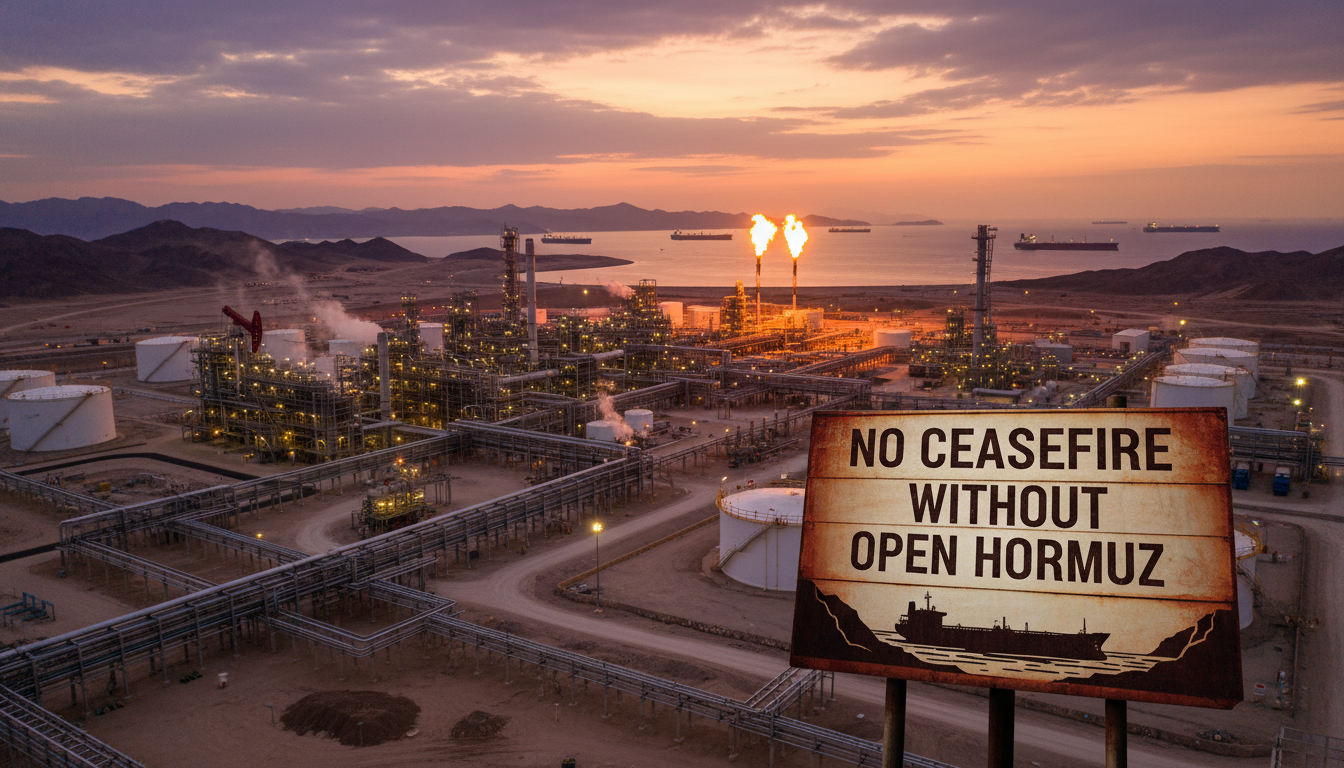
The global energy market finds itself on edge following President Donald Trump’s definitive declaration linking any cessation of US attacks on Iran directly to the complete and unhindered reopening of the Strait of Hormuz. This uncompromising stance injects fresh volatility into an already precarious geopolitical landscape, leaving investors grappling with profound uncertainty over the conflict’s duration and its far-reaching implications for crude oil, natural gas, and broader commodity flows.
US President Trump’s Shifting Rhetoric and Iran’s Overture
President Trump’s latest remarks underscore a complex and at times contradictory approach to the month-long conflict. On Wednesday, he acknowledged a request for a ceasefire from Iran’s newly installed presidential figure, Masoud Pezeshkian, who signaled a “necessary will” to conclude hostilities, provided certain guarantees were met. However, Trump immediately countered this overture with an unambiguous threat: “We will consider when Hormuz Strait is open, free, and clear. Until then, we are blasting Iran into oblivion.”
This aggressive posture stands in stark contrast to previous statements made just days prior, where the US leader hinted at a potential, swift withdrawal from the conflict, irrespective of a ceasefire or a deal concerning the vital shipping lane. Speaking to reporters at the White House, Trump asserted, “We’ll leave because there’s no reason for us to do this.” Furthermore, Reuters quoted him on the same day suggesting the US would be out of Iran “pretty quickly.” This pattern of vacillation, threatening military escalation one moment and signaling imminent de-escalation the next, has characterized the administration’s public messaging, making it challenging for market participants to gauge future actions.
Hormuz: The World’s Critical Energy Chokepoint Remains Shut
The strategic Strait of Hormuz, a conduit for approximately one-fifth of the world’s crude oil and liquefied natural gas (LNG) exports, remains effectively closed after a month of hostilities. This blockade has not only throttled global energy supplies but also disrupted the transport of essential commodities, including fertilizers, thereby impacting international trade and supply chains far beyond the energy sector. The continued closure represents a significant risk premium embedded into current commodity prices.
The direct impact of the ongoing conflict was dramatically highlighted this week, with Israel, Bahrain, Kuwait, and the United Arab Emirates all reporting overnight attacks. Most notably, QatarEnergy confirmed that a fuel oil tanker was struck in Qatari waters, a stark reminder of the persistent threat to maritime security in the region and the potential for severe disruptions to global shipping. While Iran’s Foreign Minister Abbas Araghchi acknowledged direct contact with US Special Envoy Steve Witkoff, he adamantly stated to Al Jazeera that such engagement “does not mean that we are in negotiations,” underscoring Tehran’s hardened stance.
Market Volatility and Investor Implications
The unpredictable nature of the conflict has translated directly into significant market fluctuations. Early in the week, global stocks and bonds experienced a rally as investors interpreted President Trump’s comments as a potential sign of the crisis nearing an end. This optimism briefly pushed crude oil prices below $100 a barrel for the first time in over a week. However, these declines were quickly pared, and prices rebounded, reflecting the persistent geopolitical risk. Oil prices now sit approximately 40% higher than their pre-war levels, indicating a substantial risk premium that continues to weigh on the global economy.
The gravity of the situation was echoed by JPMorgan Chase & Co. CEO Jamie Dimon, who emphasized the paramount importance of a decisive resolution to the Iranian threat. Speaking on Fox & Friends, Dimon asserted, “It’s much more important that this be successfully completed, than what the market does,” warning that anything less would leave the world economy perpetually vulnerable to severe shocks. Investors are keenly aware that sustained instability in the Middle East could trigger further inflationary pressures and dampen global economic growth.
Military Buildup, Diplomatic Stalemate, and International Response
Despite President Trump’s rhetoric hinting at a swift exit, the military reality on the ground continues to point towards a readiness for escalation. The US military is actively amassing assets in the region, including ground troops, with a third US aircraft carrier strike group reportedly having departed Virginia for the Middle East this week. This deployment signals a robust capacity for sustained operations, even as the administration publicly explores diplomatic avenues.
Meanwhile, Tehran maintains a defiant posture. Iran’s Foreign Minister Araghchi declared his country’s readiness for any confrontation with American forces, expressing “zero trust” in Washington and low expectations for any substantive outcome from talks. This diplomatic impasse, coupled with ongoing hostilities – including Iran firing missiles across the Middle East while Israel and the US continue their fifth week of bombardment – highlights the deep chasm between the two sides.
Internationally, there’s a growing consensus on the need to reopen Hormuz, yet a reluctance to be drawn into direct military conflict. UK Prime Minister Keir Starmer announced that Britain would coordinate a diplomatic push alongside a coalition of 35 nations to devise a plan for the Strait’s reopening, explicitly stating his country’s desire not to be “dragged” into the military dimension. The United Arab Emirates also expressed support for international efforts to safeguard regional maritime security, reflecting a shared regional concern over the economic impact of the blockade.
Humanitarian Toll and Political Ramifications
The human cost of the conflict remains stark. Government organizations and the US-based Human Rights Activists News Agency report approximately 4,950 fatalities so far, with nearly three-quarters occurring within Iran. A parallel conflict in Lebanon, involving Israel and Iran-allied Hezbollah, has claimed over 1,200 lives. Israeli Defense Minister Israel Katz outlined plans to occupy parts of southern Lebanon, indicating that some 600,000 displaced residents would not be permitted to return until the security of Israel’s northern communities is guaranteed.
Domestically, the ongoing conflict and its economic fallout pose significant political challenges for the US administration. With average pump prices climbing above $4 a gallon, the energy crisis threatens to inflict substantial political pain on the Republican party ahead of what is anticipated to be a difficult midterm election year. A source familiar with President Trump’s thinking suggests he recognizes the current situation is unsustainable, adding another layer of complexity to the calculus of future actions. Investors should closely monitor President Trump’s scheduled national address on Wednesday night for any crucial updates on the evolving situation, as any shift could immediately reverberate across global energy markets.
