

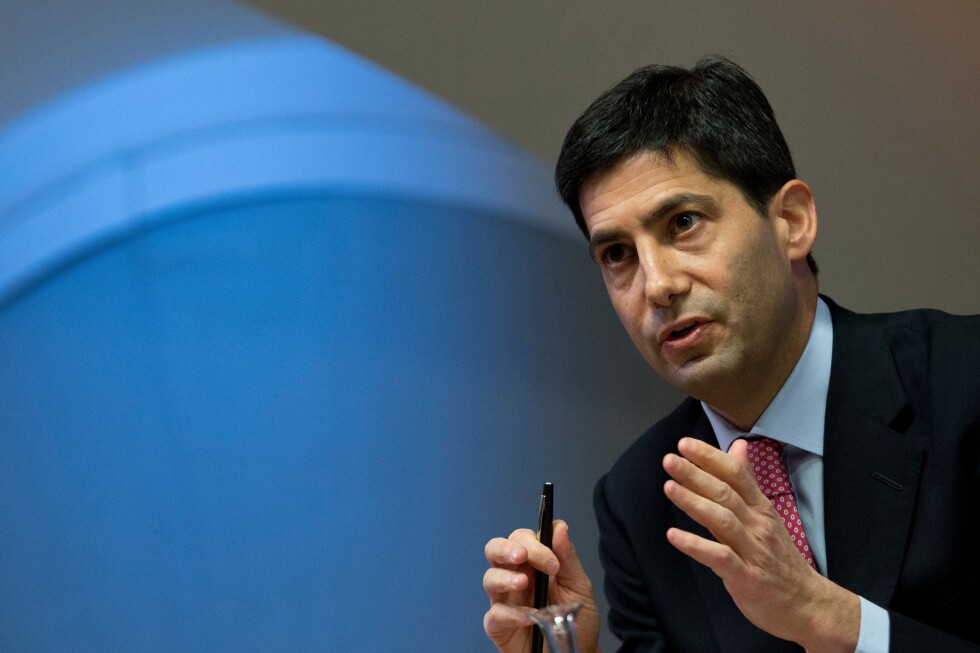
WASHINGTON (AP) — President Donald Trump said Friday that he will nominate former Federal Reserve official Kevin Warsh to be the next chair of the Fed, a pick likely to result in sharp changes to the powerful agency that could bring it closer to the White House and reduce its longtime independence from day-to-day politics.
Warsh would replace current chair Jerome Powell when his term expires in May. Trump chose Powell to lead the Fed in 2017 but this year has relentlessly assailed him for not cutting interest rates quickly enough.
“I have known Kevin for a long period of time, and have no doubt that he will go down as one of the GREAT Fed Chairmen, maybe the best,” Trump posted on his Truth Social site. “On top of everything else, he is ‘central casting,’ and he will never let you down.”
The appointment, which requires Senate confirmation, amounts to a return trip for Warsh, 55, who was a member of the Fed’s board from 2006 to 2011. He was the youngest governor in history when he was appointed at age 35. He is currently a fellow at the right-leaning Hoover Institution and a lecturer at the Stanford Graduate School of Business.
In some ways, Warsh is an unlikely choice for the Republican president because he has long been a hawk in Fed parlance, or someone who typically supports higher interest rates to control inflation. Trump has said the Fed’s key rate should be as low as 1%, far below its current level of about 3.6%, a stance few economists endorse.
During his time as governor, Warsh objected to some of the low-interest rate policies that the Fed pursued during and after the 2008-09 Great Recession. He also often expressed concern at that time that inflation would soon accelerate, even though it remained at rock-bottom levels for many years after that recession ended.
But more recently, however, in speeches and opinion columns, Warsh has said he supports lower rates.
Controlling the Fed
Warsh’s appointment would be a major step toward Trump asserting more control over the Fed, one of the few remaining independent federal agencies. While all presidents influence Fed policy through appointments, Trump’s rhetorical attacks on the central bank have raised concerns about its status as an independent institution.
The announcement comes after an extended and unusually public search that underscored the importance of the decision to Trump and the potential impact it could have on the economy. The chair of the Federal Reserve is one of the most powerful economic officials in the world, tasked with combating inflation in the United States while also supporting maximum employment. The Fed is also the nation’s top banking regulator.
The Fed’s rate decisions, over time, influence borrowing costs throughout the economy, including for mortgages, car loans and credit cards.
For now, Warsh would fill a seat on the Fed’s governing board that was temporarily occupied by Stephen Miran, a White House adviser who Trump appointed in September. Once on the board, Trump could then elevate Warsh to the chair position when Powell’s term ends in May.
Trump’s economic policies
Since Trump’s reelection, Warsh has expressed support for the president’s economic policies, despite a history as a more conventional, pro-free trade Republican.
In a January 2025 column in The Wall Street Journal, Warsh wrote that “the Trump administration’s strong deregulatory policies, if implemented, would be disinflationary. Cutbacks in government spending — inspired by the Department of Government Efficiency — would also materially reduce inflationary pressures.” Lower inflation would allow the Fed to deliver the rate cuts the president wants.
Since his first term, Trump has broken with several decades of precedent under which presidents have avoided publicly calling for rate cuts, out of respect for the Fed’s status as an independent agency.
Trump has also sought to exert more control over the Fed. In August he tried to fire Lisa Cook, one of seven governors on the Fed’s board, in an effort to secure a majority of the board. He has appointed three other members, including two in his first term.
Cook, however, sued to keep her job, and the Supreme Court, in a hearing last week, appeared inclined to let her keep her job while her suit is resolved.
Economic research has found that independent central banks have better track records of controlling inflation. Elected officials, like Trump, often demand lower interest rates to juice growth and hiring, which can fuel higher prices.
Trump had said he would appoint a Fed chair who will cut interest rates, which he says will reduce the borrowing costs of the federal government’s huge $38 trillion debt pile. Trump also wants lower rates to boost moribund home sales, which have been held back partly by higher mortgage costs. Yet the Fed doesn’t directly set longer-term interest rates for things like home and car purchases.
Potential challenges and pushback
If confirmed by the Senate, Warsh would face challenges in pushing interest rates much lower. The chair is just one member of the Fed’s 19-person rate-setting committee, with 12 of those officials voting on each rate decision. The committee is already split between those worried about persistent inflation, who’d like to keep rates unchanged, and those who think that recent upticks in unemployment point to a stumbling economy that needs lower interest rates to bolster hiring.
Financial markets could also push back. If the Fed cuts its short-term rate too aggressively and is seen as doing so for political reasons, then Wall Street investors could sell Treasury bonds out of fear that inflation would rise. Such sales would push up longer-term interest rates, including mortgage rates, and backfire on Warsh.
Trump considered appointing Warsh as Fed chair during his first term, though ultimately he went with Powell. Warsh’s father-in-law is Ronald Lauder, heir to the Estee Lauder cosmetics fortune and a longtime donor and confidant of Trump’s.
Who is Warsh?
Prior to serving on the Fed’s board in 2006, Warsh was an economic aide in George W. Bush’s Republican administration and was an investment banker at Morgan Stanley.
Warsh worked closely with then-Chair Ben Bernanke in 2008-09 during the central bank’s efforts to combat the financial crisis and the Great Recession. Bernanke later wrote in his memoirs that Warsh was “one of my closest advisers and confidants” and added that his “political and markets savvy and many contacts on Wall Street would prove invaluable.”
Warsh, however, raised concerns in 2008, as the economy tumbled into a deep recession, that further interest rate cuts by the Fed could spur inflation. Yet even after the Fed cut its rate to nearly zero, inflation stayed low.
And he objected in meetings in 2011 to the Fed’s decision to purchase $600 billion of Treasury bonds, an effort to lower long-term interest rates, though he ultimately voted in favor of the decision at Bernanke’s behest.
In recent months, Warsh has become much more critical of the Fed, calling for “regime change” and assailing Powell for engaging on issues like climate change and diversity, equity and inclusion, which Warsh said are outside the Fed’s mandate.
His more critical approach suggests that if he does ascend to the position of chair, it would amount to a sharp transition at the Fed.
In a July interview on CNBC, Warsh said Fed policy “has been broken for quite a long time.”
“The central bank that sits there today is radically different than the central bank I joined in 2006,” he added. By allowing inflation to surge in 2021-22, the Fed “brought about the greatest mistake in macroeconomic policy in 45 years, that divided the country.”
___
Follow the AP’s coverage of the Federal Reserve System at https://apnews.com/hub/federal-reserve-system.
