

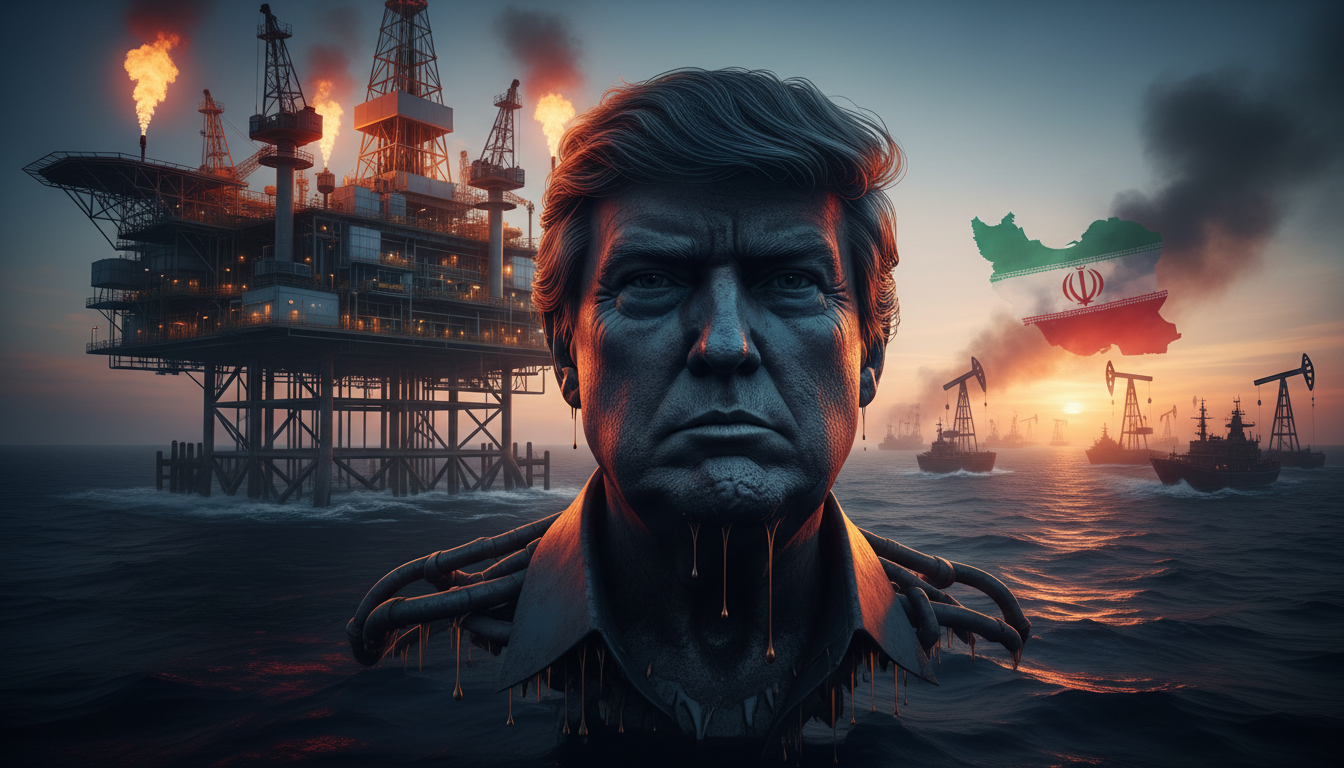
Geopolitical Tensions and Oil Markets: The High Stakes of Iran’s Crude Exports
Recent pronouncements regarding the seizure of Iran’s oil resources have sent ripples through global energy markets, forcing investors to re-evaluate geopolitical risk premiums. Former President Donald Trump reiterated his long-held ambition to “take the oil in Iran,” specifically targeting a critical export hub, a stance observers characterize as a profound disregard for international legal frameworks and an embrace of what some term “fossil-fuel imperialism.”
This assertive rhetoric comes amidst ongoing conflict, casting a shadow over any prospects for immediate de-escalation. While an initial statement from the former president on Tuesday suggested the conflict could conclude within weeks, briefly sparking optimism and a stock market surge, the reality on the ground remains volatile. Iran has firmly indicated that any cessation of hostilities requires robust guarantees against future aggression. Indeed, the war continues to manifest in tangible disruptions, exemplified by an Iranian assault on a fully loaded crude oil tanker anchored at Dubai port earlier this week.
Moreover, the former president escalated his threats on Monday, stating that a failure to “immediately” reopen the strategically vital Strait of Hormuz or achieve a peace agreement “shortly” would provoke a devastating US response. This threat explicitly included “blowing up and completely obliterating” Iran’s energy infrastructure, encompassing crucial facilities like Kharg Island, its electric generating plants, and operational oilwells. With Iran having effectively blockaded the Strait of Hormuz to most commercial shipping since late February, the stakes for global oil supply could not be higher.
The Doctrine of Resource Seizure: A Recurring Theme
The notion of seizing Iranian oil is not new territory for the former president. During a Sunday interview with the Financial Times, he candidly expressed his preference: “To be honest with you, my favorite thing is to take the oil in Iran,” dismissing dissenting voices as “stupid people.” This viewpoint, described by energy lawyer and resident fellow Amir Handjani of the Quincy Institute for Responsible Statecraft as “completely discredit[ing]” the stated rationales for military engagement, appears to confirm long-held suspicions among analysts regarding the pursuit of natural resources.
Handjani highlighted that such statements undermine legitimate strategic objectives, making any military intervention appear solely as a resource grab. This aligns with a pattern observed over decades; as early as 1988, during an interview with the Guardian’s Polly Toynbee while promoting “The Art of the Deal,” Trump expressed a desire to be “harsh on Iran” and explicitly stated, “I’d do a number on Kharg Island. I’d go in and take it.”
The focus on seizing foreign oil resources extends beyond Iran. During his initial presidential campaign, Trump advocated for the US to seize Iraq’s oil to “reimburse” the costs of the conflict, a notion Handjani called “asinine” given the circumstances of the invasion. Upon entering the White House, he similarly suggested US rights to Syrian oil, even proposing Exxon Mobil lead efforts to manage those resources. More recently, late last year, amid intensified pressure on Venezuelan President Nicolás Maduro, he floated the idea of treating seized Venezuelan oil as a US asset, musing, “Maybe we will sell it, maybe we will keep it, maybe we’ll use it in the strategic reserves.”
From an international law perspective, such actions are unequivocally illegal. Handjani emphasized there exists “no legal framework for going to war to take the natural resources of sovereign countries.” Investors must recognize that any such unilateral action would breach fundamental tenets of international law, inviting widespread condemnation and potentially severe global repercussions.
Kharg Island: Iran’s Vital Export Artery and a Potential Flashpoint
At the heart of these discussions lies Kharg Island, a crucial five-mile strip responsible for facilitating an astounding 90% of Iran’s crude oil exports. The logistical and military challenges involved in actually seizing or launching a full-scale assault on this strategic asset are immense. Experts warn that Iranian missile capabilities have already rendered some US bases in the region inoperable, suggesting any direct intervention would face formidable resistance. Marines attempting to parachute into the area would likely encounter intense, heavy fire, escalating the conflict significantly.
The ripple effects of such a move would be catastrophic for global energy markets. Handjani predicted that if the US were to take 90% of Iran’s oil exports offline, Tehran’s retaliatory response would likely be to “level all of the export terminals and oil-producing facilities in the Arab countries, in the Persian Gulf.” In this scenario, the prospect of global crude oil prices soaring to “easily $200 or $300 a barrel” becomes a tangible risk, as vast volumes of global oil and gas supply would be disrupted for years. This would usher in a “brave new world” with “unthinkable ramifications,” a prospect investors must seriously consider given the unpredictable nature of current geopolitical dynamics.
Market Instability, Profits, and the Energy Transition
The escalating conflict has already exacted a terrible human toll, with thousands of lives lost and the largest-ever disruption to global energy supplies now underway. While ordinary citizens grapple with the devastating impact of war and soaring fuel prices, major fossil fuel companies are experiencing substantial windfall profits. Patrick Bigger, co-director of the Transition Security Project, observed that the prolonged elevation of oil prices directly benefits oil majors, many of whom have contributed significantly to political campaigns.
This volatile environment is concurrently being leveraged as justification to expand domestic drilling operations within the United States. Regardless of the feasibility or success of seizing Iranian oil, the current profitability of extraction almost guarantees an increase in the exploitation of existing oil resources. This intensified extraction, however, risks locking the global economy into a more carbon-intensive future, thereby complicating efforts to transition away from fossil fuels and achieve climate objectives. Bigger noted that the former president appears to harbor “no real concern with the future,” instead driven by a deep-seated belief in “fossil-fuel imperialism.”
This perspective views fossil fuels as a cornerstone of national industrial strategy, asserting that “whoever controls the oil controls the world.” Such a philosophy, Bigger concluded, suggests a willingness to employ “extremely hostile tools to blow up the international order to get what he wants.” For investors, these statements underscore a significant and persistent source of geopolitical risk that could profoundly reshape global energy markets for years to come. Understanding these underlying ideological drivers is crucial for navigating the inherent volatility in oil and gas investments.
