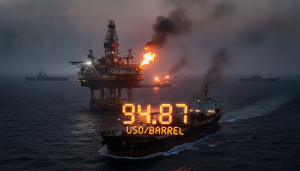
The global oil and gas markets remain on edge as conflicting signals emerge from high-stakes negotiations between the United States and Iran aimed at de-escalating regional tensions and, critically for energy investors, restoring unimpeded passage through the Strait of Hormuz. Despite earlier reports from Iranian state media hinting at a breakthrough, U.S. President Donald Trump has decisively pushed back, underscoring continued dissatisfaction with the diplomatic progress.
On Wednesday, President Trump articulated Washington’s stance from the White House, stating, “They want very much to make a deal. So far, they haven’t gotten there. We’re not satisfied with it.” He added a cryptic note, suggesting, “Maybe we have to go back and finish it,” leaving open the possibility of further action should talks falter. These comments directly contradicted a report circulated by Iranian state television claiming a draft interim agreement could normalize commercial shipping through the vital maritime artery within a month of its implementation.
The White House swiftly dismissed the Iranian claims, labeling the purported memorandum of understanding as “a complete fabrication.” This sharp divergence in narratives highlights the deeply entrenched distrust and the fragile nature of ongoing discussions, which have become central to assessing geopolitical risk premiums in global oil and liquefied natural gas (LNG) markets. Months of sporadic conflict and heightened security concerns have severely disrupted shipping, prompting significant volatility for energy commodity traders.
The Critical Chokepoint: Strait of Hormuz Implications
For investors focused on the energy sector, the status of the Strait of Hormuz is paramount. This narrow waterway serves as a strategic chokepoint, through which an estimated one-fifth of the world’s total oil consumption and a substantial portion of global LNG trade flows daily. Its continued restriction since an escalation in hostilities earlier this year has injected an unprecedented level of uncertainty into supply chains and global energy pricing models.
The ongoing discussions aim to solidify a fragile ceasefire established in April while simultaneously hammering out the terms for fully reopening Hormuz. Iranian state media had previously outlined a framework for a potential deal, which included the lifting of U.S. naval restrictions around Iranian ports. Under this proposed arrangement, Iran and Oman would jointly oversee shipping operations within the strait, with Tehran advocating for a new management mechanism for vessel traffic. Iranian state television had further elaborated that “managing the passage of ships, their inspection and receiving service fees are at the discretion of the Islamic Republic and in partnership and in cooperation with Oman.”
However, U.S. officials have consistently maintained their non-negotiable position that commercial shipping must be granted unrestricted and unhindered passage through the strait, a stance that appears to clash with Iran’s desire for a new oversight structure and associated fees.
Unresolved Issues and Diplomatic Headwinds
Despite the public friction, U.S. Secretary of State Marco Rubio acknowledged on Wednesday that negotiations were indeed active, noting “there’s been some progress and some interest.” Similarly, Iranian officials, through Ali Bagheri-Kani, deputy secretary of Iran’s Supreme National Security Council, confirmed ongoing indirect contacts with Washington but cautioned that no agreement exists until all outstanding issues are fully resolved.
The path to a comprehensive resolution remains fraught with significant sticking points. Key areas of contention reportedly include the future status of Iran’s highly enriched uranium stockpile, access to approximately $12 billion in frozen Iranian financial assets, and the precise future structure of oversight for transit through the Strait of Hormuz. The release of such a substantial sum in frozen assets is likely to encounter robust opposition from influential voices in Washington, particularly among those advocating for a more hardline approach to Tehran.
Further complicating these delicate talks are broader regional tensions. Continued fighting between Israel and Iran-backed Hezbollah forces in Lebanon casts a long shadow over the negotiations. Iran has reportedly made any broader ceasefire arrangement contingent on its inclusion of all regional fronts, tying the fate of Hormuz to a wider de-escalation of hostilities across the Middle East.
Market Reaction: Navigating Uncertainty
The rollercoaster of diplomatic updates has naturally translated into market volatility. Despite President Trump’s sobering remarks, crude oil prices remained generally lower, reflecting a persistent undercurrent of cautious optimism among traders about the eventual possibility of a diplomatic breakthrough. Earlier in the week, Brent crude futures had experienced a sharp decline on initial reports of progress in the talks, underscoring how deeply energy markets are attuned to these geopolitical developments.
For oil and gas investors, the current environment demands close monitoring of geopolitical headlines. The fundamental uncertainty surrounding both the direct conflict between the U.S. and Iran and the broader regional dynamics continues to pose a significant risk premium for global energy assets. Until concrete, verified agreements are reached that definitively secure the free flow of energy through the Strait of Hormuz and address the underlying tensions, market volatility driven by geopolitical factors is likely to persist.