

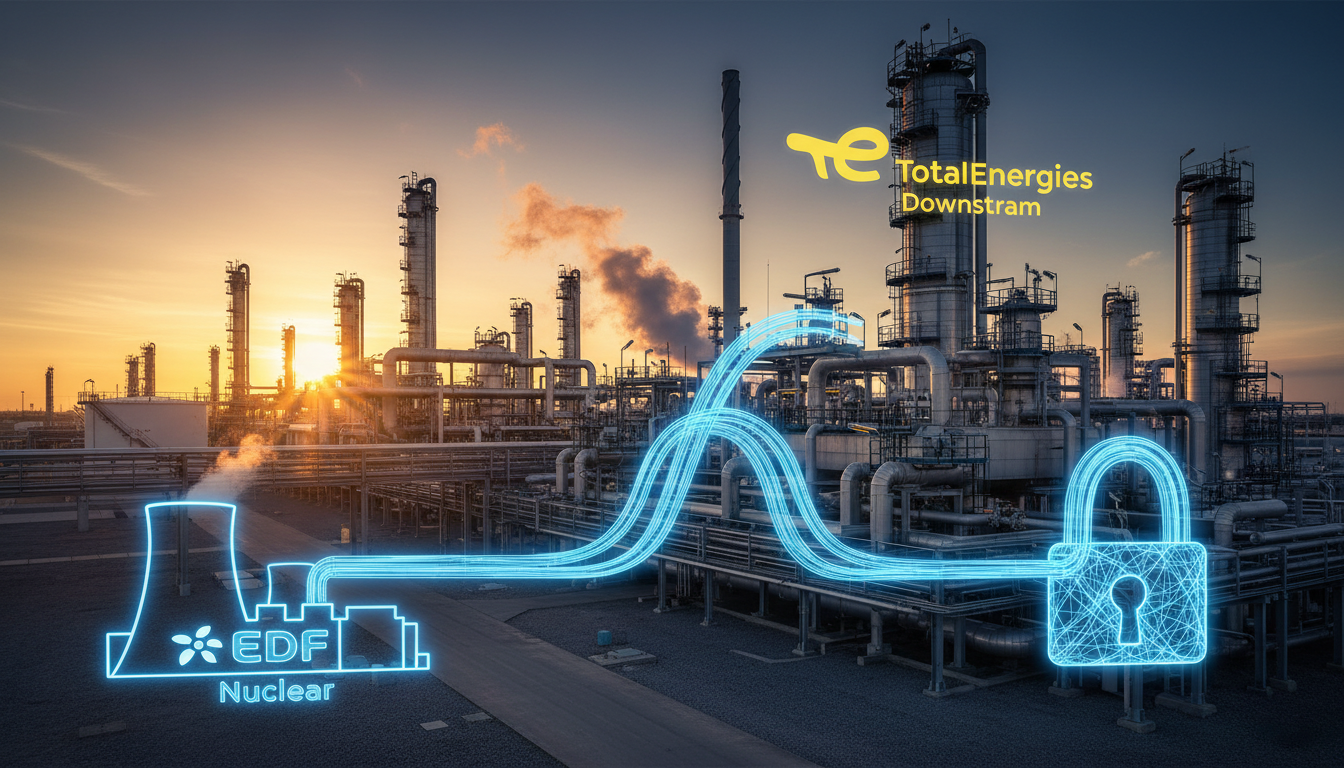
Energy supermajor TotalEnergies recently executed a significant 12-year power purchase agreement with French utility EDF, securing a substantial portion of its domestic refining and chemical sites’ electricity requirements from nuclear sources. This strategic alliance underscores TotalEnergies’ aggressive pivot towards industrial decarbonization and its overarching energy transition goals, presenting a clear investment signal for stakeholders focused on sustainable growth within the oil and gas sector.
The landmark deal dictates that EDF will dedicate a share of its operational nuclear fleet’s output to TotalEnergies’ French industrial footprint. This commitment will fulfill approximately 60% of the electricity demand for TotalEnergies’ refining and chemicals facilities in France, representing an estimated 400 megawatts (MW) of continuous power. For TotalEnergies, this arrangement unlocks access to competitively priced, low-carbon nuclear power, providing long-term energy security for its highly electricity-intensive operations. Concurrently, EDF benefits from sharing the inherent risks and costs associated with the variability of nuclear power generation, creating a mutually advantageous partnership.
TotalEnergies Bolsters Low-Carbon Power Portfolio for Industrial Assets
Patrick Pouyanné, Chairman and CEO of TotalEnergies, emphasized the contract’s importance in providing a secure, long-term, and competitive low-carbon electricity supply for its major French industrial sites. This move aligns directly with TotalEnergies’ ambitious target to power 100% of its refining and chemical operations across Europe and the United States exclusively with low-carbon electricity. The company’s comprehensive strategy aims to significantly reduce its Scope 2 emissions from the refining and chemicals segment, targeting a cut of over 2 million tons of CO2 equivalent (MtCO2e) annually compared to its 2015 baseline.
Detailed in its recent “Sustainability and Climate – 2026 Progress Report,” TotalEnergies outlines its multifaceted approach to achieving these decarbonization objectives. Specifically for its European refining and chemical industrial assets, the company plans to secure up to 5.2 terawatt-hours (TWh) per year of electricity. This supply will originate in part from TotalEnergies’ expanding European renewable energy portfolio, which currently boasts 1.8 TWh/year in operational capacity and an additional 3.4 TWh/year under active development. Furthermore, the company leverages its portfolio of guarantees of origin to supplement this renewable supply.
Across the Atlantic, TotalEnergies is similarly advancing its clean energy commitments for its U.S. refining and chemical operations. Approximately 1.2 TWh/year will flow from its robust renewable energy projects located in Texas. Existing assets, specifically the Danish and Myrtle facilities already online, contribute around 1 TWh/year to this total. The company expects to bridge any remaining supply gaps from its pipeline of new renewable projects in the United States, with contributions commencing in 2026, solidifying a comprehensive, future-proof energy strategy for its critical infrastructure.
Integrated Power Segment Fuels Growth and Financial Returns
Beyond simply consuming low-carbon power, TotalEnergies has strategically positioned itself as a significant producer of electricity, particularly from renewable sources. By the close of 2025, the energy giant had amassed a gross installed generation capacity of 34 gigawatts (GW) from renewables, steadily progressing towards an ambitious target of 80 GW by 2030. This expansion forms a cornerstone of its integrated power strategy, driving substantial growth and promising robust financial returns.
TotalEnergies projects an increase in its annual electricity production to between 100-120 TWh by 2030, with a dominant share coming from renewable generation. This aggressive expansion is backed by a substantial capital allocation to low-carbon energies, primarily directed towards the Integrated Power segment. The company plans to invest an impressive $3-4 billion per year for the period spanning 2026 to 2030. This investment includes an average of approximately $1 billion per year over five years in shares, facilitated through its transaction with EPH, further underscoring its commitment to this transformative segment.
The financial performance of the Integrated Power segment demonstrates its growing contribution to TotalEnergies’ overall profitability. In 2025, this segment generated a healthy cash flow of $2.6 billion. Projections indicate this figure will surpass $3 billion in 2026, reflecting the accelerating momentum of its clean energy operations. Crucially, TotalEnergies anticipates the Integrated Power segment will become net cash flow positive from 2027 onwards, signaling a pivotal moment where its substantial investments begin to yield self-sustaining financial strength and returns for investors.
Strategic Diversification into Low-Carbon Molecules
TotalEnergies’ forward-looking investment strategy extends beyond electricity generation to encompass a targeted focus on low-carbon molecules. The company is actively investing in the development and production of biofuels, sustainable aviation fuels (SAF), biogas, hydrogen, and its various derivatives, including e-fuels. This diversification is pursued under an “equity light” business model, which leverages strategic partnerships to optimize capital deployment and accelerate market entry. This approach allows TotalEnergies to tap into emerging markets for sustainable products while managing financial exposure, showcasing a pragmatic yet ambitious strategy for the energy transition.
