

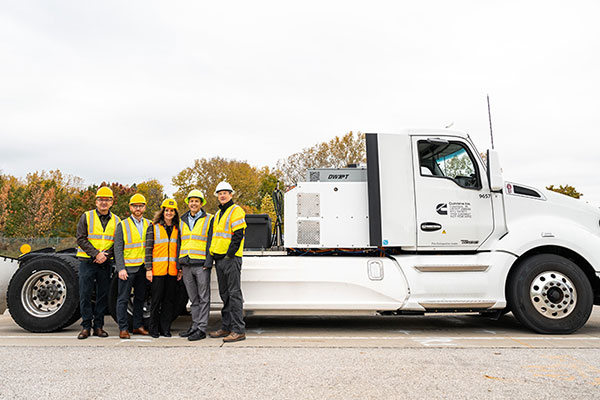
A stretch of highway in Indiana just did something that has never been done before in the U.S.: It charged a heavy-duty electric truck while it was driving.
What’s Related
Researchers at Purdue University successfully tested a short section of road that wirelessly sends power through the pavement and into a moving electric semi truck. During the test, the truck drove at highway speeds while receiving energy from coils embedded beneath the road surface.
The project marks the first time a U.S. highway has been shown to charge a heavy-duty electric truck while it is in motion. Purdue researchers said the system delivered enough power to support real-world freight vehicles, not just passenger cars or small test platforms.
“Transferring power through a magnetic field at these relatively large distances is challenging,” said Dionysios Aliprantis, Professor of Electrical and Computer Engineering at Purdue. “And what makes it more challenging is doing it for a heavy-duty vehicle moving at power levels thousands of times higher than what smartphones receive.”

The Indiana Department of Transportation embedded these Purdue-designed coils before covering them with concrete highway pavement. The coils transmit power to receiver coils attached to the underside of an electric heavy-duty truck. (Purdue University photo/Kelsey Lefever)
The test took place on a quarter-mile segment of roadway near Purdue’s campus. Coils installed under the pavement send power upward to a receiver mounted underneath the truck as it drives over the road. The truck does not need to stop or plug in to receive energy.
Researchers say the goal is to reduce charging downtime and address range concerns on long routes.
“This could be a game-changer for the electrification of heavy-duty transportation,” said Aliprantis. “It could allow trucks to charge as they move, which would significantly reduce the need for large onboard batteries.”
While the roadway segment is still a test installation, Purdue researchers say it shows how highways could eventually play a direct role in keeping electric trucks powered during daily operations. Future work will focus on scaling the technology and understanding what it would take to deploy the system more widely.
