

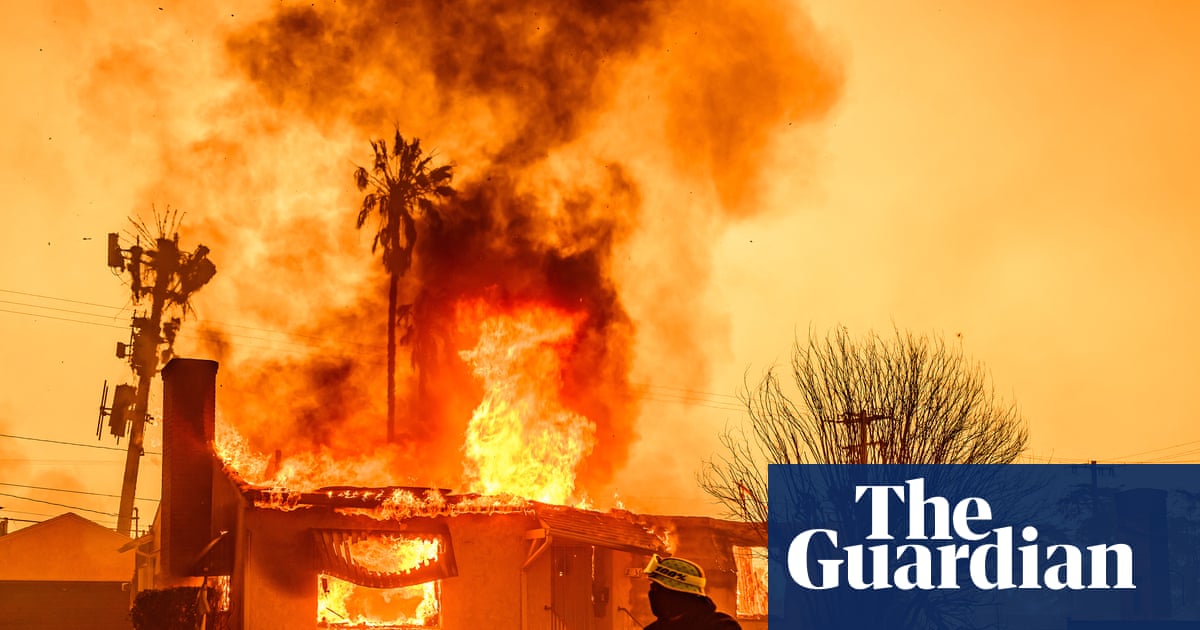
Donald Trump has presided over a dangerous erosion in US capacity to prepare for and respond to natural disasters, according to emergency management experts.
The first year of his second term was marked by crackdowns on climate science that produced world-class weather forecasts and the gutting of frontline federal agencies – policies that have left the country, already struggling to keep pace with severe storms, even more at risk.
Deep budget cuts and massive firing sprees shrank emergency response agencies, including the Federal Emergency Management Agency (Fema), the agency tasked with coordinating national disaster responses, and the National Oceanic and Atmospheric Administration (Noaa), considered a global crown jewel for climate science.
After Trump took office in January, his administration also worked quickly and diligently to claw back funding for climate-resilience initiatives, cancel research contracts and pull down data relied on by industry and the public alike.
The worst effects, experts say, may not reveal themselves until catastrophe strikes. But in a year marked by three category 5 hurricanes, record summer humidity and heat, and deadly fires and floods, the cracks have already begun to show.
Fema, bereft of strong leadership and sinking under low morale and large gaps in its workforce, went into hurricane season without a plan in place. Gutted weather-balloon networks in Alaska failed to adequately warn residents in advance of what would become one of the most destructive storms in state history. It took administration officials more than 72 hours to authorise the deployment of federal search-and-rescue teams after the Guadalupe river in Texas surged into a summer camp and through nearby communities in July, a flood that left more than 135 people dead.
Even as Trump sought to slash federal funding, the cost of disasters continued to climb.
In the first half of 2025 alone, damage from weather and climate disasters across the nation totaled more than $101bn, according to Dr Adam Smith, who tracked the data for Noaa until the federal database that cataloged these costs was discontinued in May. “That cost is by far the most costly first half of any year on record dating back to 1980,” he said. Smith now works as the senior climate impacts scientist for the non-profit Climate Central, where he is continuing to build the database.
“We are in the perfect storm,” said Monica Medina, who served as the principal deputy administrator of Noaa during the Obama administration. Ever-escalating threats are being met with a crumbling safety net, she added, as mismanagement and cuts in funding corrode an emergency response system already close to the brink.
“We need to have a whole new attitude about preparedness for the types of weather events we are seeing,” she said. “People will suffer. It is just that simple.
‘This is what it looks like when things fall apart’
Emergency management has long been messy. Vaguely defined areas of responsibility for preparation and recovery sprawl across multiple levels of government and a chaotic matrix of non-profits, businesses and individuals.
Investments made under Joe Biden took aim at some of these problems and initiated a broader focus on environmental justice and building resilience in vulnerable, disadvantaged communities where it was needed most. Biden’s Bipartisan Infrastructure Law injected billions of dollars into climate-resilience projects, including improving threatened waterways, supporting underpaid federal wildland firefighters, and protections against extreme heat.
“We needed to go a lot further, but we had a good start,” said Shana Udvardy, senior climate resilience policy analyst at the Union of Concerned Scientists.
Fema, however, was already facing a catastrophe of its own.
Grappling with staffing constraints, funding shortfalls and an ever-expanding mission caused by the increasing frequency, severity and cost of extreme weather events, a federal analysis created for Congress recommended more money for the beleaguered agency, and investing in the federal disaster workforce to ensure shorter deployments, more support and better training that would curb widespread burnout.
Trump went in a decidedly different direction.
“We want to wean off of Fema, and we want to bring it down to the state level,” the president said at a briefing on hurricane and wildfire preparedness in June, claiming the agency was too expensive and “doesn’t get the job done”. “The Fema thing has not been a very successful experiment,” the president concluded.
A taskforce created by the president was due to publish recommendations in December that would greatly determine Fema’s fate, but the vote on a draft report was pulled after details revealing the dramatic reductions being considered was leaked to the press.
“The council report recommendations as reported would gut Fema, leaving states to shoulder the burden of disasters and putting disaster victims at risk of serious harm, especially those with the least resources,” Udvardy said. “Council members should release their original report,” she added, urging more congressional oversight of what’s proposed.
With the agency’s future hanging in limbo, capacity was systemically slimmed throughout the year.
Hundreds of millions of dollars in national preparedness funding was cut in 2025, and Fema lost roughly a third of its full-time staff – experienced leaders among them – to firings, retirements and resignations.
Congressionally appointed advisory councils that provide science-based recommendations were disbanded, and Kristi Noem, the Department of Homeland Security secretary, put Fema on a much tighter rein, requiring personal approval for spending over $100,000 – an amount easily surpassed by often-costly disaster contracts and grants – gumming up the agency’s ability to rapidly respond when disasters struck.
More than a dozen Fema workers were investigated and put on forced leave after they signed an open letter to Congress warning of the dangerous outcomes that could come from the administration’s changes.
Now on its third acting administrator in less than a year – none of whom were approved by Congress or had substantial emergency experience – leadership is frail and staff have reported exceedingly low morale, with confusion about core mission and fears of reprisal for speaking out.
States are not yet equipped to pick up the slack. “There are budget cycles, there’s legislation. It could take years to make these changes,” said Bill Turner, the emergency management director at the Connecticut department of emergency services and public protection, who also serves as the resilience committee chair for the National Emergency Management Association, a non-profit professional association for US state and territory directors. “We need time to adjust.”
The problem is especially concerning for smaller towns and rural communities. Many don’t even have dedicated emergency management departments.
Local work to prepare has also been limited by the administration’s crackdown on climate-resilience policies that interfere with Trump’s energy-extraction priorities. Grant programs, including Building Resilient Infrastructure and Communities (Bric), Hazard Mitigation Assistance (HMA) and Next Generation Warning System (NGWS) – which support states and communities in completing risk-reduction projects – were also suspended or blocked by the Trump administration.
“A lot of the states are just trying to figure out what the future looks like,” Turner said.
But the problems go beyond Fema. Holes in preparedness have grown even in areas Trump has said he prioritizes, including preventing catastrophic wildfire.
Trump championed firefighters and called for bolstering preparedness for a year-round fire season, using the devastating Los Angeles wildfires as a call to action. In June, Trump signed an executive order that claimed to strengthen mitigation and improve land management practices. He also oversaw efforts to create a new federal firefighting force, housed in the Department of the Interior, long called for by firefighters and experts.
But after slashing thousands of jobs from already understaffed land management agencies, including the US Forest Service, lots of essential work was left undone. Chaos reigned as fire risks began to mount over the summer, and firefighting crews reported being left without power for weeks due to cut maintenance workers, paychecks being late or halved because administrative roles were left empty, or having to mow lawns outside their offices, manage campsites and do plumbing work at their barracks in addition to their other duties.
Hazardous fuels reduction work – which includes prescribed burning, brush clearing and other techniques to cull highly flammable vegetation from high-risk areas – was down roughly 38% in 2025, according to a new analysis by Grassroots Wildland Firefighters, an organization made up of current and former federal wildland firefighters.
“This is what it looks like when things fall apart,” said Udvardy, “and it’s going to take years to build it all back up.”
A profound impact
Once considered a global leader in climate science and weather forecasting, the US has sharply changed direction under Trump, starting with Noaa, the agency tasked with the nation’s weather forecasting and climate monitoring.
Thousands of staff left, including hurricane hunters, researchers, meteorologists and operations staff, and the holes left behind hobbled the agency’s ability to perform essential functions right as severe storms began to brew.
In the spring, roughly a quarter of the National Weather Service (NWS) forecast offices were lacking chief meteorologists. Several offices across the US also had to cease overnight monitoring due to staff shortages, and weather balloon launches that collect data for forecasting had to be vastly reduced, undermining accuracy. By September, hundreds of jobs were unfilled after one in seven NWS workers left through resignations, retirements or firings.
The NWS was given permission to begin refilling its ranks in late July, reopening 450 of the roughly 550 jobs cut, after policymakers and the public raised grave concerns over impacts on public safety. But progress has been sluggish. In December, only 80 final job offers had been accepted, CNN reported.
Even if those jobs are restaffed, experts have lamented the enormous amount of experience lost – roughly 27,000 years of collective experience tallied from Noaa job losses alone.
The White House canceled the contracts that produced legally mandated national climate assessments, websites that were relied on by local governments, states, businesses and residents to prepare for climate events, and pulled climate.gov, a widely used portal chock-full of resources, from public view.
Nine Noaa stations tracking tsunami-causing earthquakes went offline at the end of November, after the administration pulled funding from a lab that’s spent decades monitoring seismic activity; satellite instruments that track carbon dioxide levels and provide intel on water and air pollution are also on the chopping block.
While these losses are expected to have a profound impact on the American public, they will be felt globally, too. Scientists and forecasters around the world depend on US satellites, studies and intelligence, including data-sharing that tracks severe weather across Europe, coordination of disaster response in the Caribbean, and the monitoring of deforestation and the effects of the climate crisis in the Amazon rainforest.
“This is an essential part of the social safety net we depend on the government to provide – that is why we pay taxes – and this administration is dismantling it,” Medina said, pointing to US research that she said has long provided a public good at extremely low cost. The gaps in data and research and the loss of scientists from the federal workforce will be challenging to build back, even if the government changes course.
“You can’t just buy the data you never collected,” she added. Even corporations hoping to meet the demand rely on federal forecasts and infrastructure. “The private sector sits on top of a foundation of government science that is falling apart,” she said.
No longer relying on the federal government
The disasters of today are already packing a punch. But during the next decade, Earth is expected to blow past the critical 1.5C threshold, officials with the United Nations Environment Programme said in November, and extreme events will get exponentially worse.
“Each year above 1.5 degrees will hammer economies, deepen inequalities and inflict irreversible damage,” the UN secretary general António Guterres said in November in Belém, Brazil, speaking at the global Cop climate summit, where a US delegation was notably absent for the first time.
Trump has repeatedly sown doubt in the climate crisis and in policies to protect against it, and has consistently worked to undermine scientific warnings, shifts to renewables by other governments, domestic and international, and rolled back regulations in the US. In 2025, the Environmental Protection Agency made cuts to climate and resilience programs, limited clean air and water investigations and enforcement, and moved to rescind the endangerment finding under the Clean Air Act, which links greenhouse gas emissions to poor public health outcomes.
Facing a future with less federal support as extremes intensify, emergency managers have encouraged the public to stay vigilant.
“Everyone has a role in preparedness,” Turner said. “We’re not going to let the noise change the core of what we do every day.”
But big gaps remain – and they might grow.
“We are trying to break down that misconception that after a major disaster, the state or federal government will be able to come in and make you whole,” he said.
