

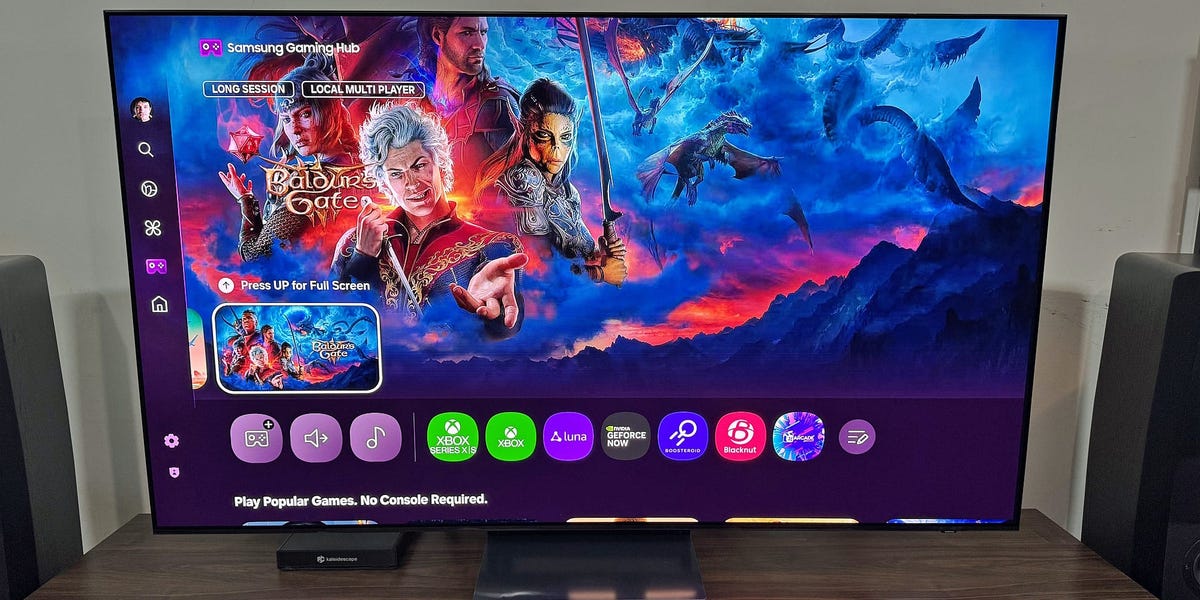
If you’ve been gaming as long as I have, you’ve watched the medium evolve from simple 2D side-scrollers to sprawling, photo-realistic worlds. And as games have grown more ambitious, the screens we play them on have had to level up, too. Today’s best gaming TVs look nothing like the tiny tube TVs of yesteryear. Modern displays deliver crisp 4K resolution, bright HDR highlights, and ultra-fast refresh rates that make every swing, jump, and dodge feel silky smooth.
To get the most out of a PS5, Xbox, Switch 2, or PC, certain display features are essential. That’s where my work as a professional TV reviewer comes in. My team and I have tested the best gaming TVs across different price ranges to find the top performers. The Samsung S90F earns my highest recommendation for most people, offering excellent image quality, low input lag, wide viewing angles, and even built-in support for Xbox Game Pass streaming. But if you’re shopping on a budget, the TCL QM6K stands out as one of the most affordable sets with a fast 144Hz refresh rate.
Every TV I recommend includes HDMI 2.1 support to unlock advanced gaming features. And if you’re new to terms like VRR, ALLM, or input lag, the FAQ section below breaks everything down.
Our top picks for the best gaming TVs
Best overall: Samsung S90F – See at Amazon
Best budget: TCL QM6K – See at Amazon
Best anti-glare: Samsung S95F – See at Amazon
Best high-end: LG G5 – See at Amazon
Best overall
Samsung 65-inch S90F OLED 4K TV
The S90F is an impressive midrange OLED and one of our favorite new displays of 2025. It gets a bit brighter than last year’s S90D and offers better color volume than similar LG OLED models.
The Samsung S90F is the best gaming TV overall, striking an impressive balance between price and performance. As a midrange OLED, it delivers everything most gamers need for a top-tier experience without creeping into premium-price territory.
All four HDMI ports support HDMI 2.1, so you can plug in multiple consoles and still unlock features like VRR, ALLM, and super-fast response times. The panel also supports refresh rates of up to 144Hz with a PC or 120Hz with a console. When paired with systems that utilize these features, the S90F delivers smooth motion with none of the stuttering, tearing, flickering, or blurring that can disrupt immersion.
John Higgins/Business Insider
The S90F also excels in terms of general picture quality. Its OLED panel produces deep black levels and an infinite contrast ratio, since each pixel controls its own light output. That means you won’t see the uneven patches of brightness, blooming, or backlight issues that are common on LED and QLED TVs. Colors appear rich and accurate, fine details remain crisp, and dark shadows blend seamlessly into a dimly lit room. Black levels do rise a bit in bright environments, but never enough to distract from gameplay.
The S90F also has an edge over similarly priced LG OLEDs thanks to its quantum dot color technology. This allows the TV to reach higher brightness while maintaining strong color saturation. In testing, our reviewer measured a peak brightness of around 1,460 nits, which is outstanding for an OLED at this price point. HDR games benefit the most, with punchier highlights and more dramatic contrast. Just keep in mind that only the 55-, 65-, and 77-inch models use this quantum dot OLED panel — other sizes use standard WOLED and won’t get quite as bright.
Viewing angles are another strong point. The S90F maintains excellent color and contrast even when you’re seated off to the side, making it ideal for rooms with multiple seating positions or local multiplayer nights.
Finally, Samsung gives the S90F a leg up with its cloud gaming support. The built-in Gaming Hub on Tizen offers apps like Xbox Game Pass, Nvidia GeForce Now, and Amazon Luna, so members can stream games without owning a console or PC. All you need is a Bluetooth controller. Just note that cloud performance depends heavily on your internet connection, and these services tend to work best for casual or less demanding titles.
Read our Samsung S90F 4K TV review.
Visit our guides to all of the best TVs and the best Samsung TVs.
Best budget
TCL 65-inch QM6K QLED 4K TV
The QM6K is an excellent entry-level Mini LED TV with solid contrast, vibrant colors, and decent black levels. However, its HDR brightness capabilities are limited compared to step-up models.
TCL’s QM6K QLED TV offers a full suite of advanced gaming features at a budget-friendly price. The 65-inch model is often available for $550, making it one of the most affordable 144Hz TVs on the market.
Like all of my best gaming TV picks, the QM6K has full HDMI 2.1 support with VRR and ALLM. But this set only supports HDMI 2.1 via two of its four HDMI ports, so it’s not quite as stacked when it comes to connectivity as pricier options from Samsung and LG.
Still, given its relatively low cost, the QM6K punches way above its class. The set can enable 4K/120Hz support on a PS5 or Xbox Series X and can even display 4K/144Hz with a PC. Those capabilities are rare to find on a TV in this tier, and they enable smoother motion when paired with compatible sources.
Steven Cohen/Business Insider
The QM6K uses a QLED screen with a Mini LED backlight. This means the TV has narrower viewing angles and lower contrast than that of an OLED. However, the QM6K still performs quite well for a display of this type. It has local dimming to adjust its backlight across multiple zones, which enables solid black levels and minimal blooming. Black levels don’t disappear into a dark room the way they do on an OLED, but the QM6K does a good job of minimizing uneven patches of brightness.
That said, the QM6K is notably dimmer than pricier TVs. During my review, I measured 557 nits on a 10% HDR test pattern and 736 nits on a 50% test pattern. Those aren’t bad numbers for a budget-friendly HDR TV, but they fall short of the 1,000-nit mark that most HDR content is mastered for. This means bright HDR games won’t look quite as punchy and impactful as they would on TVs with higher luminance. Likewise, QLED TVs like the QM6K have slower response times than OLED TVs, which causes games to look a bit blurrier in motion.
But even with those limitations, I was still impressed with the QM6K’s colorful images while swinging around New York City in “Marvel’s Spider-Man” on PS5 with VRR and 120Hz enabled. The picture is a bit duller and not quite as sharp as I’ve seen on more expensive sets, but that’s to be expected given the price difference.
For smart TV navigation, the QM6K uses the Google TV interface, which is one of my favorites thanks to its intuitive design and seamless integration with Google services. On the downside, though, Google TV does not have built-in access to the Xbox or Luna app, but it does support Nvidia GeForce Now.
Read our TCL QM6K 4K TV review.
Visit our guide to all of the best TCL TVs.
Best anti-glare
Samsung 65-inch S95F OLED 4K TV
The S95F is Samsung’s latest flagship 4K TV. It’s one of the top high-end displays of 2025 and uses an advanced QD-OLED panel with an anti-glare matte screen.
The Samsung S95F OLED stands out from other picks in this guide for one big reason: its matte screen. While most TVs use glossy panels that maintain strong contrast but reflect every lamp and window in sight, the S95F’s matte coating significantly reduces glare. If you’re set up in a room with lots of ambient light, this is easily one of the best gaming TVs you can buy.
During testing in a bright room environment, I didn’t encounter any of the usual mirror-like reflections that glossy TVs struggle with. The panel’s impressive brightness helps, too — in its most accurate picture mode, the S95F reached a peak of around 2,170 nits, which is incredibly bright for an OLED. HDR games look rich and vibrant, and Samsung’s quantum dot technology ensures colors stay vivid even at high luminance.
However, there is one tradeoff to the matte design. The anti-reflective screen scatters light in a way that can make black levels look lifted in bright rooms, especially during dark scenes. With the lights off, the S95F still delivers deep, inky black levels, but perceived contrast takes a hit when ambient light spills across the screen.
For daytime gaming, this isn’t a major issue, but movie lovers might notice it. Ultimately, the question becomes whether you value reduced glare or perfect contrast more. But if reflections are a constant annoyance in your space, I’d say the S95F’s compromise in black levels is worth the trade.
Specs-wise, the S95F also ticks every gaming box: it features HDMI 2.1 on all four ports, VRR, ALLM, and an upgrade from the S90F’s 144Hz refresh rate to a 165Hz maximum when connected to a PC. Samsung’s Tizen interface also features a dedicated gaming menu and built-in access to cloud services, such as Xbox Game Pass.
Read our Samsung S95F 4K TV review.
Visit our guide to all of the best 4K TVs.
Best high-end
LG 65-inch G5 OLED 4K TV
The G5 is LG’s flagship OLED TV for 2025. It’s one of the brightest OLED TVs we’ve ever seen, delivering high-end image quality and an elegant design that can hang flush on your wall.
LG’s G5 is one of the best gaming TVs for premium image quality. Though all of the TVs in this guide deliver a good picture, the G5 is a step above. Of course, it has an equally high price tag to match its high-end performance.
Like the Samsung OLED TVs I recommend, the G5 features an infinite contrast ratio, wide viewing angles, and supports HDMI 2.1 on all four of its ports. This enables VRR, ALLM, and 4K gaming at up to 120Hz with a PS5 or Xbox Series X. Like the Samsung S95F, the G5 also supports up to 4K/165Hz with a PC. This is only beneficial for people with systems powerful enough to play games at frame rates higher than 144 FPS, but it’s a cool perk for those who can take advantage of it.
The other key area where the G5 shines (literally) is peak brightness. In fact, this is the brightest OLED TV I’ve tested. Though the G5 doesn’t use quantum dots like Samsung’s OLEDs, it uses a four-stack OLED panel design to achieve a similar boost in luminance. During my review, I measured a peak of around 2,400 nits. When coupled with the TV’s pixel-level contrast, this high brightness enables some of the most impressive HDR performance I’ve seen.
Steven Cohen/Business Insider
While playing various titles like “Cyberpunk 2077,” “The Last of Us Part 1,” “Spider-Man,” “No Man’s Sky,” “Dragon’s Dogma 2,” and “Baldur’s Gate 3,” I was floored by the G5’s excellent image quality, with sharp textures, vibrant colors, and bold highlights. Using a PS5 with 120Hz enabled, the TV provided smooth motion, and I didn’t experience any ghosting or flicker while playing VRR-compatible games.
When the G5 first launched in the spring, the TV suffered from issues with posterization when displaying certain types of HDR content, including some games. This resulted in some gradations of colors looking blocky rather than smooth, particularly in skies and light sources. I never ran into any egregious instances of false contouring during my testing, but those worried about the issue will be happy to hear that LG has since released a firmware update to correct it. No TV’s picture performance is perfect, but the G5’s image quality gets about as close as I’ve seen.
The G5 uses LG’s webOS smart TV interface, and this platform is solid. I don’t love how the homepage highlights shopping recommendations by default, but it offers access to all the best streaming services, and there’s a dedicated gaming section with cloud streaming apps. Most notably, LG is the only TV brand other than Samsung that supports the Xbox app through its smart TV system.
The TV also stands out with its elegant design and thin profile. It includes a wall mount that lets you hang it with virtually no gap. On the downside, the G5 doesn’t actually come with a traditional pedestal stand, so if you can’t mount the display, you’ll need to buy a TV stand separately.
Read our LG G5 4K TV review.
Visit our guide to all of the best LG TVs and the best OLED TVs.
How we test gaming TVs
Steven Cohen/Business Insider
To find the best gaming TVs, our team of experts reviewed several top models using a testing methodology informed by more than a decade of experience covering home entertainment products.
To narrow our selection, we focused on TVs that support key gaming-specific features, including HDMI 2.1 capabilities. We evaluated image quality, motion, and lag while gaming using various systems, including a PS5, Xbox, and Nintendo Switch. Tests involving 120Hz output and VRR performance were primarily conducted using a PS5 with compatible titles.
In addition to gaming-related functions, we also assess overall picture performance, smart TV capabilities, and general value. After all, a great gaming TV should also be a great all-around TV for various uses.
To measure peak brightness and color, we use meters and industry-standard test patterns. We also use a selection of demo clips to evaluate picture elements like contrast control, HDR highlights, color smoothness, and upscaling. In addition to specific tests, we live with each TV we review for several weeks, using it on a day-to-day basis as we would any TV we own. This allows us to spot glitches that might otherwise be missed.
Gaming TV FAQs
Steven Cohen/Business Insider
What features should you look for in a gaming TV?
High refresh rate – TVs with high refresh rates can present smoother motion when playing video games that support high frame rates. Entry-level TVs have 60Hz screens, which are enough to display games at 60 frames per second (FPS). However, some PS5 and Xbox Series X games are capable of rendering at higher frame rates, with both consoles supporting an output of up to 4K at 120Hz. So, to take full advantage of their capabilities, you need a 4K TV with a 120Hz refresh rate.
All of the best gaming TVs in this guide support at least 120Hz, and some models even support 144Hz and 165Hz. Those latter refresh rates are only beneficial if you have a powerful gaming PC that can render games at frame rates above 120 FPS.
Variable Refresh Rate (VRR) – In addition to a high refresh rate, it’s also beneficial to get a gaming TV that supports Variable Refresh Rate (VRR). This means that the TV can adjust its refresh rate to match shifting frame rates while you’re playing a game. This results in reduced stuttering and screen tearing, which can otherwise occur when frame rates fluctuate during gameplay.
Auto Low Latency Mode (ALLM) – All of the best gaming TVs are capable of switching to a specific gaming mode that provides lower latency, so there’s less of a delay between gaming inputs and what you see on screen. If a TV also supports ALLM, it will automatically recognize gaming sources over HDMI and switch to this mode, so you don’t have to do anything manually.
Gaming bar menu – Many TV brands have a dedicated gaming pop-up menu that can be toggled on their TVs when they’re connected to a gaming source. These handy menus offer convenient access to gaming-specific features and a quick view of gaming-related display details, including the current resolution and frame rate. All of our picks for the best gaming TVs have this feature.
Cloud streaming – Some TVs now include built-in access to cloud gaming services, like Xbox Game Pass, Nvidia GeForce Now, and Amazon Luna. These services allow members to play games via streaming without needing a console or PC. LG and Samsung both offer the most robust support for these services.
Are QLEDs or OLEDs better for gaming?
QLED TVs and OLED TVs both have pros and cons regarding gaming performance, so which is best depends on your specific needs.
OLED TVs provide the best contrast, black levels, and viewing angles, all of which contribute to the most impressive overall image quality. This type of display is also known for having very low input lag, which ensures that the TV’s video signal responds quickly when you press buttons on your gamepad. Top OLED TVs are also capable of delivering excellent brightness, but midrange OLEDs tend to be dimmer than midrange QLED TVs.
OLED TVs are also technically susceptible to burn-in, which can cause static images to get permanently stuck on the screen. However, burn-in is rare, and OLED TVs have unique features designed to prevent it, including pixel-shift modes and logo dimmers. In general, those with typical viewing habits shouldn’t worry about burn-in.
QLED TVs, on the other hand, present no risk for burn-in. That said, QLED TVs can’t control their contrast as precisely as OLEDs, which can lead to inconsistencies in black levels and patchy brightness. Top QLED TVs with advanced local dimming can greatly reduce those issues, but even the most expensive QLED displays can’t quite match the infinite contrast ratio of an OLED. Likewise, QLED TVs typically have slower response times than OLEDs, which can cause some games to look blurrier in motion than they do on OLED TVs.
On the plus side, top QLED models can get brighter than even the most advanced OLED TVs. This can make high-end QLED TVs a better fit for people who game in rooms with lots of windows and ambient light.
For more details about the benefits and drawbacks of different display types, visit our QLED vs. OLED comparison.
Should you use the HGiG setting when playing HDR games?
Yes, if your TV supports HGiG or a similar function, you should use it when playing HDR video games.
HGiG is a gaming setting on some TVs. If selected, it disables the TV’s tone-mapping when displaying high-dynamic-range (HDR) video games. Deactivating tone mapping is essential if you want to achieve an accurate HDR image with a PS5, Xbox Series X/S, or Nintendo Switch 2. With tone mapping off, you can use each console’s HDR setup wizard to properly adjust contrast levels to match your TV’s capabilities. If tone mapping were left on, these setup wizards would not function correctly, resulting in an image that is either too bright or too dark.
LG and TCL specifically label this setting as “HGiG,” but other TV manufacturers have similar functions under different names. For instance, you can deactivate tone mapping by changing the Game HDR setting to Basic on a Samsung TV.
What is HDMI 2.1?
HDMI 2.1 is a standard for transmitting digital video and audio. The best gaming TVs all feature HDMI 2.1 inputs, and many gaming devices feature HDMI 2.1 outputs. The HDMI 2.1 specification offers a bandwidth of up to 48Gbps and is required to enable full support for gaming features like VRR, ALLM, and 4K at 120, 144, or 165Hz.
What cables do you need to get 4K/120Hz?
You need an Ultra High Speed HDMI cable to send and receive 4K/120Hz signals. These cables are rated for a bandwidth of 48Gbps, which is enough to send the data needed to display 4K/120Hz video properly. For cable recommendations, check out our guide to the best HDMI cables.
What size gaming TV is best?
The best gaming TVs are all available in various sizes, with the most common options being 55, 65, and 77 inches. Some models, like the LG G5 and TCL QM6K, are also available in larger 83-, 85-, 97-, or 98-inch sizes. Meanwhile, other models, like the Samsung S90F, are also made in smaller 50-, 48-, 43-, or 42-inch sizes.
Which is best for you depends on your room’s size and your budget. Generally speaking, larger TVs cost more than smaller versions of the same model. If you have the funds and space to work with, bigger TVs offer the most immersive experience. On the other hand, smaller gaming TVs can also work well as computer monitors.
For size-specific display recommendations, check out our additional TV buying guides:

