

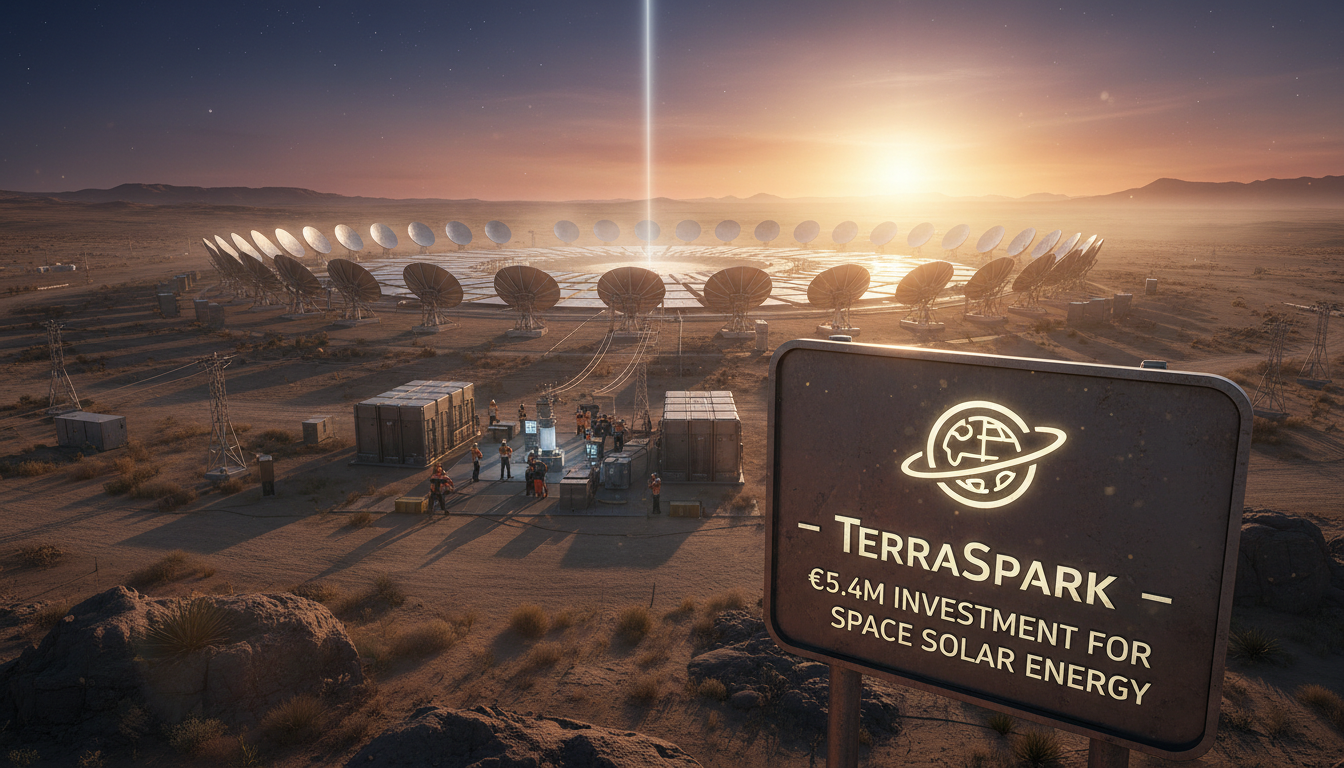
Luxembourg-based space technology innovator TerraSpark has successfully closed a pre-seed funding round, securing €5.4 million (approximately USD$6.2 million) to propel its ambitious space-based solar power (SBSP) initiatives. This capital injection underscores a growing investor appetite for disruptive energy solutions capable of addressing the escalating global demand and critical infrastructure vulnerabilities. For investors monitoring the evolving energy landscape, TerraSpark represents a compelling, albeit nascent, player targeting a future where power generation transcends terrestrial limitations.
Founded in 2025, TerraSpark is at the forefront of developing a revolutionary system designed to harness solar energy directly from orbit and transmit it wirelessly to Earth. This innovative approach promises to deliver a continuous, weather-independent power supply, fundamentally altering the paradigm of renewable energy generation. By utilizing radio frequency for energy transmission, the company aims to make electricity available “orbit by orbit,” unfettered by daylight cycles or meteorological conditions that typically plague ground-based solar installations.
Addressing Global Energy Imperatives from Orbit
The vision behind space-based solar energy directly confronts several pressing challenges facing the global energy sector. Fragile grid infrastructures, relentless growth in energy demand, and constrained transmission capacities are creating an increasingly volatile environment for energy markets. TerraSpark’s solution offers the potential for a constant, high-capacity energy source, independent of geographical location or atmospheric interference, ensuring global accessibility and enhanced energy resilience. For long-term investors in the oil and gas sector, understanding such emerging technologies is crucial for anticipating future market shifts and identifying diversification opportunities.
TerraSpark’s strategic roadmap prioritizes de-risking its groundbreaking technology through a phased implementation. Before deploying its systems in orbit, the company plans to commercialize radio frequency-based wireless energy transmission for industrial applications here on Earth. This initial step is designed to rigorously demonstrate the safety, efficiency, and regulatory compatibility of its core transmission technology. This pragmatic approach provides a tangible pathway for validation and revenue generation, offering a degree of assurance to early-stage investors in a venture with significant long-term potential.
Leadership Commentary and Strategic Outlook
Jasper Deprez, founder and CEO of TerraSpark, articulated the immediate relevance of their work, stating, “Space-based solar power has long been considered something for the distant future. Across Europe, energy resilience is now a practical concern, not an abstract one. With our step-by-step approach and starting with commercially viable systems on Earth, we are convinced that space-based solar power can become real infrastructure within a realistic timeframe.” His comments highlight the shift from theoretical exploration to practical implementation, driven by urgent geopolitical and economic factors impacting energy security – a domain traditionally dominated by fossil fuels.
The company is poised to initiate its initial pilot applications and demonstration use cases in the coming months, with plans to showcase wireless power supply for events. Looking further ahead, TerraSpark has set an aggressive timeline for orbital development. An orbital technology demonstrator is targeted for deployment by 2027, followed swiftly by the development of its first full-scale space-to-Earth power transmission system, aiming for operational readiness by 2028. These milestones represent critical checkpoints for investors evaluating the company’s progress and the viability of its ambitious vision.
Investment Backing and Strategic Importance
The pre-seed funding round saw participation from a syndicate of notable investors, including Daphni, Sake Bosch, Better Ventures, the Hans(wo)men Group, the Luxembourg Business Angel Network, and Karaoke Club. This diverse group of backers signals broad confidence in TerraSpark’s technological promise and its potential to disrupt the energy landscape. The capital infusion is earmarked specifically for advancing the company’s core technology, facilitating its initial pilot applications, and preparing for the critical live tests necessary to validate its systems.
Tina Dreimann, Founder and Managing Director of Better Ventures, emphasized the unique combination of expertise within TerraSpark, stating, “TerraSpark combines European space expertise with the experience required to scale technology, a mix that is critical to building resilient energy infrastructure.” This perspective underscores the complex interplay of advanced engineering and market execution essential for bringing a project of this magnitude to fruition. For investors tracking global energy transitions, companies like TerraSpark represent a frontier of innovation that could reshape demand patterns, energy pricing, and the long-term strategic value of traditional energy assets.
Implications for the Broader Energy Market
While still in its early stages, the development of space-based solar power carries profound implications for the entire energy sector, including traditional oil and gas. A truly continuous, carbon-free energy source, delivered globally, could dramatically alter the energy mix and reduce reliance on fossil fuels for baseload power. Investors in established energy companies must monitor such advancements closely, as they present both a potential long-term competitive threat and an opportunity for strategic partnerships or portfolio diversification into next-generation energy solutions. The successful scaling of SBSP could alleviate grid pressure, enhance energy independence for nations, and contribute significantly to global decarbonization efforts, ultimately influencing crude oil and natural gas demand trajectories in the coming decades. TerraSpark’s journey is a vivid reminder that the energy future is being forged not just in wells and pipelines, but increasingly, beyond Earth’s atmosphere.
