While the spotlight often shines on gold as the quintessential safe-haven asset, smart money is increasingly turning its attention to silver, quietly positioning for a significant breakout. The investment thesis for silver diverges notably from gold, rooted not just in its monetary heritage but, more critically, in its escalating industrial utility. This fundamental shift in silver’s demand profile, combined with broader macroeconomic forces, presents a compelling narrative that oil and gas investors cannot afford to ignore, signaling potential broader implications for the entire commodity complex.
Silver’s Industrial Surge and the Energy Nexus
The white metal is strategically positioned at the epicenter of several transformative global industries, including Clean Energy, Artificial Intelligence, Defence, and High-Tech manufacturing. These sectors are not merely growing; they are undergoing a once-in-a-generation demand boom that is profoundly impacting silver’s fundamentals. Proprietary data indicates that global silver demand climbed from 993 million ounces in 2016 to a staggering 1.16 billion ounces in 2024. Concurrently, supply has struggled to keep pace, slipping from 1.06 billion ounces to 1.02 billion ounces over the same period. This dynamic has flipped a historical surplus into a persistent structural deficit, a condition typically preceding significant price appreciation.
For oil and gas investors, this industrial demand explosion for silver holds crucial implications. The foundational requirement for expanding clean energy infrastructure, powering AI data centers, and fueling high-tech manufacturing is, ultimately, energy. Whether it’s the massive power grids for solar installations, the electricity demands of semiconductor fabrication, or the logistical energy required to transport advanced materials, these industries are significant consumers of both traditional and renewable energy sources. This creates a sustained demand floor for natural gas (for power generation and industrial feedstock) and various crude oil products (for transportation, petrochemicals, and manufacturing processes), intertwining silver’s industrial supercycle with the energy sector’s long-term outlook.
Dollar Weakness, Hard Assets, and Oil Market Volatility
A significant tailwind behind the broader hard asset rally, including silver’s potential meteoric rise, is the ongoing erosion of the U.S. dollar’s value. The greenback has experienced substantial declines, with a notable fall of over 11% in 2025, marking its steepest annual decline since the early 1970s. Market analysts anticipate further depreciation, with some projections suggesting another 10% drop by 2026 as global confidence in the currency potentially wanes. Factors such as aggressive fiscal policies, record deficits, and mounting political pressure on the Federal Reserve to cut interest rates are cited as undermining the dollar’s long-standing safe-haven appeal.
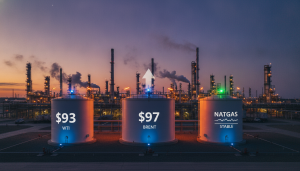
This seismic shift into hard assets directly impacts the energy market. Crude oil, a globally traded and dollar-denominated commodity, often benefits from dollar weakness as it becomes relatively cheaper for international buyers holding stronger currencies. This can stimulate demand, acting as an inflationary hedge. However, the market currently presents a complex picture. As of today, Brent crude trades at $90.38 per barrel, reflecting a significant daily dip of 9.07%, having seen an intraday range between $86.08 and $98.97. WTI crude mirrors this trend, standing at $82.59, down 9.41% on the day, with a range of $78.97 to $90.34. Gasoline prices are also feeling the pressure at $2.93 per gallon, a 5.18% drop. Zooming out, our proprietary 14-day Brent trend data reveals a notable decline from $112.78 on March 30th to today’s $90.38, representing a $22.4 or nearly 20% reduction. This immediate volatility, even amidst a weakening dollar narrative, highlights the multifaceted pressures on energy prices and underscores the importance of a nuanced investment approach.
Investor Focus: Navigating Supply, Demand, and Future Outlook
Our first-party intent data from investors reveals a keen focus on the future trajectory of oil prices and the factors influencing global supply. Readers are actively asking: “what do you predict the price of oil per barrel will be by end of 2026?” and “What are OPEC+ current production quotas?” These questions underscore the prevailing uncertainty and the critical role of supply-side management and macroeconomic trends in shaping investor sentiment. The current market volatility, exemplified by recent price movements, only amplifies these concerns, pushing investors to seek clarity on the fundamental drivers that will dictate future market conditions.
The immediate outlook for crude prices will be heavily influenced by a series of critical events in the coming days. The OPEC+ Joint Ministerial Monitoring Committee (JMMC) meeting on April 19th, followed by the full OPEC+ Ministerial Meeting on April 20th, will be paramount. These gatherings are expected to provide crucial insights into production quotas, directly addressing investor concerns about supply management in a volatile global economy. Following these high-stakes discussions, the API Weekly Crude Inventory reports on April 21st and 28th, alongside the EIA Weekly Petroleum Status Reports on April 22nd and 29th, will offer essential data on U.S. supply-demand dynamics. Furthermore, the Baker Hughes Rig Count on April 24th and May 1st will signal future domestic production trends. The outcomes of these events, particularly OPEC+’s stance on output levels, could either exacerbate the recent price declines or provide a much-needed floor, especially if coordinated cuts are announced to counter demand concerns or support prices in a weakening dollar environment.
The Commodity Supercycle: Energy’s Position in a Hard Asset Renaissance
The observed “decade accumulation phase” in silver, characterized by structural deficits and a clear path to historical highs of $50, $75, and even $100 per ounce, suggests a broader revaluation of tangible assets. This phenomenon, often termed a commodity supercycle, implies sustained periods of above-trend price growth driven by structural shifts in demand and supply. If silver, propelled by its industrial utility and the flight from fiat currency, is indeed entering such a supercycle, it is highly probable that other fundamental commodities, particularly energy, will either follow suit or experience significant tailwinds.
The intertwining of industrial demand for silver with the energy sector means that a rising tide in one could lift the other. The global push for energy transition, while emphasizing renewables, still requires massive inputs of traditional energy for manufacturing, infrastructure development, and as a reliable base load. Furthermore, the geopolitical landscape, supply chain vulnerabilities, and underinvestment in new production capacity continue to provide structural support for oil and natural gas prices. Investors should view the silver narrative not in isolation, but as a bellwether for a broader hard asset renaissance where energy, as the lifeblood of global industry and economic activity, plays an indispensable role. Monitoring these interconnected commodity cycles will be key to identifying lucrative opportunities and managing risks in the evolving investment landscape.