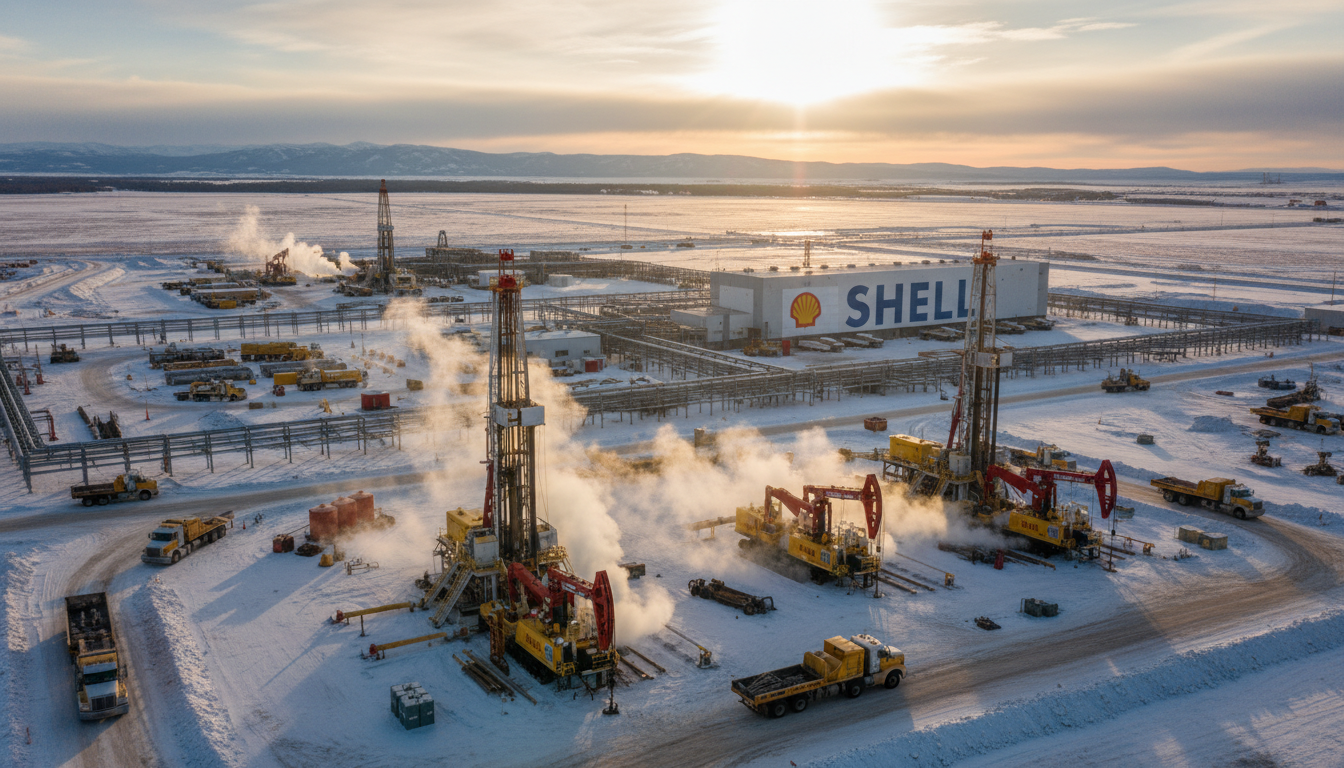
Shell’s $13.6 Billion ARC Acquisition: A Definitive Shift to Canadian Shale
Shell plc has made a decisive move to significantly bolster its upstream portfolio, agreeing to acquire ARC Resources Ltd. in a transaction valued at approximately $13.6 billion, or $16.4 billion when accounting for ARC’s existing debt. This landmark deal fundamentally reshapes Shell’s position in North America, establishing Canada’s prolific Montney shale basin as a strategic core for the energy giant. Investors are keenly watching how this substantial commitment to unconventional assets will integrate into Shell’s global strategy and its implications for long-term production growth and shareholder value.
Establishing Canada as a “Heartland”: Strategic Rationale and Asset Integration
The acquisition of ARC Resources is a clear declaration of Shell’s intent to deepen its footprint in high-quality, low-cost upstream assets. ARC’s extensive operations in the Montney formation, spanning British Columbia and Alberta, complement Shell’s existing Groundbirch assets within the same basin. This consolidation is set to add an impressive 370,000 barrels of oil equivalent per day (boed) to Shell’s production profile and approximately 2 billion barrels of oil equivalent (boe) in proved plus probable reserves. Shell CEO Wael Sawan underscored the strategic importance, stating the deal “establishes Canada as a heartland for Shell.”
This move is not merely about scale; it’s about strategic alignment. The combined entity positions Shell to target a compound annual production growth rate of around 4% through 2030, a significant upward revision to its outlook. Crucially, the focus remains on assets characterized by lower operating costs and a pathway to reduced emissions intensity, aligning with the broader industry trend towards more sustainable production. The integrated Montney operations will also play a critical role in supplying natural gas to the LNG Canada project, an asset in which Shell holds a significant stake, thereby strengthening its value chain from upstream production to global export.
Current Market Dynamics and Valuation Context for a Mega-Deal
Executing a deal of this magnitude in the current commodity environment provides critical context for investors. As of today, Brent crude trades at $111.78 per barrel, reflecting a 1.25% gain, while WTI crude stands at $105.9, up 0.79%. This robust pricing environment, particularly the recent surge in Brent which has climbed from $99.36 on April 13th to $111.7 by April 30th – a substantial increase of $12.34 or 12.4% in just two weeks – frames the $13.6 billion valuation. Our readers are frequently asking for a base-case Brent price forecast for the next quarter and tracking the 2026 weekly trend for crude oil, indicating a strong interest in the sustainability of current price levels.
Shell’s decision to commit such significant capital to Canadian shale at these elevated price points suggests a long-term bullish outlook for natural gas and oil demand, particularly for assets with competitive cost structures and clear market access like LNG Canada. The premium offered to ARC shareholders, a mix of cash and Shell shares, signals Shell’s confidence in the asset quality and future value creation. This acquisition, therefore, is not just a bet on current prices but a strategic investment in a resilient, long-life asset base designed to thrive across various commodity cycles.
Forward Outlook: Approvals, LNG Exports, and Market Signals
The transaction is slated for completion in the second half of 2026, subject to critical shareholder and regulatory approvals. This timeline means the full integration and impact on Shell’s financial results are still some way off, but the strategic implications are immediate. The enhanced supply of natural gas from the Montney basin is directly tied to Canada’s burgeoning LNG export capacity, a key driver for future demand and pricing for Canadian gas.
Investors should closely monitor upcoming market intelligence for further insights into the global supply-demand balance that will shape the environment for this integrated Montney operation. Key dates to watch include the EIA Short-Term Energy Outlook on May 2nd and the IEA Oil Market Report on May 12th. These reports will provide crucial updates on global energy consumption patterns, production forecasts, and inventory levels, all of which will influence the long-term viability and profitability of Shell’s expanded Canadian portfolio. Further, the bi-weekly Baker Hughes Rig Count reports on May 1st and May 8th will offer real-time indicators of drilling activity, reflecting the industry’s response to prevailing market conditions.
Consolidation Trends and Investor Takeaways
Shell’s acquisition of ARC Resources is emblematic of a broader trend of consolidation sweeping through the North American shale sector. Major players are increasingly looking to optimize their portfolios by acquiring high-quality, contiguous acreage that offers scale, operational synergies, and a clear path to market. This strategy allows for more efficient capital deployment and can lead to improved returns.
For investors, this deal provides several key takeaways. Firstly, it reiterates Shell’s commitment to upstream growth within a framework of capital discipline and emissions reduction. Secondly, it highlights the strategic importance of Canadian natural gas resources, particularly their linkage to growing global LNG demand. Finally, in an environment where our readers are actively inquiring about which OPEC+ members are over-producing and the broader dynamics of crude oil trends, Shell’s move to secure stable, internally controlled production in a politically secure basin like Canada offers a degree of insulation from geopolitical supply risks. This acquisition is a long-term play, positioning Shell for sustained growth and resilience in a dynamic global energy landscape.