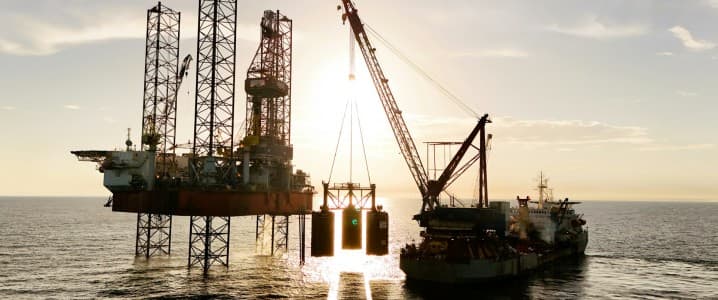
In a move underscoring its long-term strategic commitment to natural gas and integrated energy projects, Shell and its partner Sunlink Energies and Resources Limited have taken a final investment decision (FID) on the HI gas project offshore Nigeria. This significant development, slated for startup by the end of the decade, highlights Shell’s disciplined approach to capital allocation even as the broader energy market grapples with pronounced volatility. For investors, this FID signals a clear pathway for Shell to bolster its liquefied natural gas (LNG) portfolio, leveraging existing infrastructure and tapping into a projected surge in global gas demand, particularly from Asia.
Shell’s Strategic Play Amidst Market Headwinds
The HI gas project is designed to deliver a substantial 350 million standard cubic feet of gas per day at peak production, equivalent to approximately 60,000 barrels of oil equivalent per day, directly to Nigeria LNG (NLNG). Shell maintains a significant 25.6% interest in NLNG, making this project a synergistic expansion within its established operations. The infrastructure plan is comprehensive, involving a wellhead platform with four wells at the HI field, a pipeline to transport multiphase gas onshore to Bonny, and a new gas processing plant at Bonny. From this plant, processed gas will flow to NLNG, with condensate routed to the Bonny Oil and Gas Export Terminal. This integrated approach minimizes greenfield risk and optimizes existing value chains.
This long-term investment decision by Shell arrives at a particularly turbulent time for crude oil markets. As of today, Brent crude is trading at $90.38, marking a sharp 9.07% decline within the day, with its range fluctuating between $86.08 and $98.97. Similarly, WTI crude is at $82.59, down 9.41%. This immediate downturn is part of a more significant trend: Brent crude has shed nearly 20% over the last 14 days, falling from $112.78 on March 30 to its current level. Despite these pronounced short-term price corrections in the crude complex, Shell’s FID on a decade-long gas project underscores a strategic pivot towards gas as a transitional fuel, less susceptible to immediate geopolitical and inventory-driven crude price swings.
Nigeria: A Core Hub for Shell’s Integrated Gas Ambitions
Shell’s decision to expand its gas footprint in Nigeria through the HI project reinforces the country’s critical role in the supermajor’s global energy strategy. This project directly contributes to Shell’s commitment to bring upstream and integrated gas projects online between 2025 and 2030, targeting a combined peak production exceeding 1 million barrels of oil equivalent per day. More broadly, it aligns with Shell’s ambitious plan to grow its global LNG volumes by an average of 4-5% annually through 2030. The company anticipates adding 12 million tons of LNG capacity by the end of the decade from projects currently under construction across Canada, Qatar, Nigeria, and the UAE. Nigeria’s established LNG export infrastructure and Shell’s significant equity stake in NLNG make it a natural fit for such expansion, providing a stable, long-term outlet for new gas volumes.
Furthermore, Shell’s commitment to Nigeria extends beyond gas. Last December, the company announced the FID for the development of the Bonga North deep-water project. This subsea tie-back to the Shell-operated Bonga Floating Production Storage and Offloading (FPSO) facility holds an estimated recoverable resource volume of over 300 million barrels of oil equivalent and is projected to reach a peak production of 110,000 barrels per day, with first oil also anticipated by the end of the decade. These simultaneous, large-scale FIDs in both oil and gas demonstrate Shell’s deep and enduring strategic presence in Nigeria, viewing it as a robust platform for future production growth and shareholder value.
Investor Outlook: Navigating Volatility and Long-Term Value
Given the recent sharp declines in crude prices, investors are understandably asking about the outlook for oil per barrel by the end of 2026, and what actions OPEC+ might take to stabilize the market. These questions directly tie into the immediate future of the energy sector. The upcoming OPEC+ Joint Ministerial Monitoring Committee (JMMC) Meeting on April 19, followed by the full Ministerial Meeting on April 20, will be critical junctures. Any decisions regarding current production quotas or potential adjustments will heavily influence crude price trajectories in the short to medium term. Weekly inventory reports, such as the API Crude Inventory on April 21 and 28, and the EIA Weekly Petroleum Status Report on April 22 and 29, will also offer crucial insights into supply-demand balances.
While the market awaits these pivotal events, Shell’s focus on long-cycle gas projects like HI provides a degree of insulation from the daily vagaries of the crude market. LNG offers portfolio diversification and a growth vector aligned with global decarbonization efforts, albeit as a transitional fuel. Shell’s internal projections for global LNG demand to surge by 60% through 2040, driven largely by economic growth in Asia, underscore the strategic rationale behind these investments. For investors, Shell’s dual strategy – maintaining a strong position in high-value oil projects like Bonga North while aggressively expanding its integrated gas and LNG portfolio – presents a compelling case for resilient long-term value creation, even against a backdrop of fluctuating commodity prices and evolving energy transition narratives.
The Broader LNG Landscape and Shell’s Positioning
As the world’s top LNG trader, Shell’s insights into the global gas market carry significant weight. The company’s consistent messaging, reiterated by President Integrated Gas Cederic Cremers, points to a robust growth trajectory for LNG, fueled by increasing energy demand and the need for cleaner-burning alternatives to coal. The HI project in Nigeria is a tangible manifestation of this strategy, joining other major capacity additions globally. This includes ongoing developments in Canada, Qatar, and the UAE, all contributing to Shell’s target of adding 12 million tons of LNG capacity by the close of the decade.
This expansion positions Shell to capitalize on anticipated demand growth, particularly from industrial and power generation sectors in emerging economies. The integrated nature of the HI project, from upstream gas production to liquefaction via NLNG, ensures efficiency and control over the value chain, maximizing returns. For investors seeking exposure to the evolving energy landscape, Shell’s deliberate and substantial investments in integrated gas projects like HI, alongside its continued commitment to high-value deepwater oil, signal a balanced and forward-looking strategy designed to deliver sustainable growth and shareholder returns well into the next decade, irrespective of short-term market turbulence.


