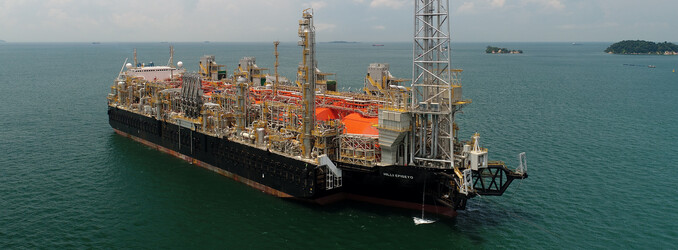
Seatrium’s recent contract win from Golar to upgrade the FLNG Hilli Episeyo is more than just a routine shipyard deal; it’s a bellwether for the strategic importance of floating liquefied natural gas (FLNG) in the global energy landscape. This significant project, destined for a two-decade deployment in Argentina’s Vaca Muerta region, underscores a fundamental shift in energy investment towards robust, long-term gas infrastructure. For astute investors, this development signals continued confidence in LNG as a pivotal transition fuel, offering both sustained demand and diversification from the often-volatile crude oil markets. As the energy sector navigates complex supply-demand dynamics and decarbonization pressures, FLNG solutions like the Hilli Episeyo are emerging as critical assets, enabling rapid, flexible, and scalable monetization of remote gas reserves.
FLNG Hilli Episeyo: A Long-Term Bet on Global Gas Demand
The decision to undertake extensive upgrades on the FLNG Hilli Episeyo, preparing it for a 20-year mission off Argentina’s Rio Negro province, speaks volumes about the enduring appeal of natural gas, particularly from prolific resources like the Vaca Muerta shale formation. Set to recommence operations in 2027 with a nameplate capacity of 2.45 million tonnes per annum (MMt/year), the Hilli Episeyo represents a long-term commitment to supplying international markets with LNG. The scope of work, including life extension, winterization, and the installation of a new soft-yoke mooring system, is comprehensive, reflecting the high stakes and extended operational lifespan envisioned for the vessel. This project not only reinforces Golar’s position in the FLNG sector but also solidifies Seatrium’s reputation for delivering complex, high-quality production units, building on previous successes like the FLNG Gimi, which recently began commercial operations. Investors following the energy transition narrative should view this as a clear signal: LNG is not merely a short-term bridging fuel but a foundational component of the future energy mix, driving substantial, multi-decade infrastructure investments.
Navigating Market Volatility with Strategic Gas Investments
While the long-term outlook for LNG remains robust, the broader energy market continues to exhibit significant price fluctuations. As of today, Brent crude trades at $98.01 per barrel, representing a notable 3.24% increase within the day’s trading range, which saw prices dip to $94.42 before recovering. This daily bounce follows a more challenging period, where Brent saw a 12.4% decline over the past two weeks, falling from $108.01 on March 26th to $94.58 on April 15th. WTI crude similarly saw a gain of 1.72% today, settling at $89.65. This persistent volatility in crude prices underscores the strategic value of diversifying energy portfolios with assets tied to long-term gas contracts, such as FLNG projects. The Hilli Episeyo upgrade, with its two-decade operational horizon, offers a degree of revenue stability and predictability that can be particularly appealing when compared to the short-term swings in the oil market. For investors, the focus on gas liquefaction infrastructure like FLNG offers a compelling avenue to tap into consistent global energy demand, somewhat insulated from the immediate geopolitical and supply-side pressures impacting crude oil.
Upcoming Catalysts and the Broader Energy Horizon
While the FLNG Hilli Episeyo project has a clear timeline with yard entry scheduled for Q3 2026 and operations commencing in 2027, the broader energy investment landscape is shaped by a continuous stream of near-term events. For savvy investors, understanding these upcoming catalysts is crucial for contextualizing long-term plays like FLNG. In the coming weeks, market participants will closely watch key industry and OPEC+ announcements. The Baker Hughes Rig Count reports, scheduled for April 17th and April 24th, will offer insights into North American drilling activity, an important barometer for future supply. More significantly, the OPEC+ Joint Ministerial Monitoring Committee (JMMC) meeting on April 18th, followed by the full Ministerial Meeting on April 20th, could dictate global crude supply strategies for the next quarter. Although these are primarily oil-focused events, their outcomes inevitably ripple through the entire energy complex, influencing investor sentiment and capital allocation decisions across all hydrocarbon segments, including gas infrastructure. Additionally, the regular API and EIA weekly crude inventory reports on April 21st/22nd and April 28th/29th will provide granular data on immediate supply-demand balances, offering tactical trading opportunities and informing short-term market views that can impact broader energy valuations.
Addressing Investor Focus: Beyond Crude Price Volatility
Our proprietary reader intent data reveals a consistent focus among investors on immediate market fundamentals and price discovery. Common questions include “What is the current Brent crude price?” and “What are OPEC+ current production quotas?” These inquiries highlight a natural preoccupation with the oil market’s daily dynamics and supply-side management. However, the strategic investment in the FLNG Hilli Episeyo provides a critical lens through which to view these concerns. While investors are understandably seeking a “base-case Brent price forecast for next quarter,” the underlying commitment to long-term gas liquefaction projects like Hilli Episeyo underscores a parallel investment thesis driven by structural energy transition trends. It signals that beyond the immediate crude price fluctuations, substantial capital is being deployed into projects that meet the enduring, multi-decade demand for natural gas as a cleaner alternative to other fossil fuels. This divergence in investment focus—short-term crude price speculation versus long-term gas infrastructure deployment—is a key takeaway for investors looking to build resilient portfolios that capture both immediate market opportunities and future energy shifts. The Hilli Episeyo’s 20-year commitment to Argentina’s Vaca Muerta, a major shale play, exemplifies this strategic long-term vision, emphasizing reliability and energy security over cyclical market swings.