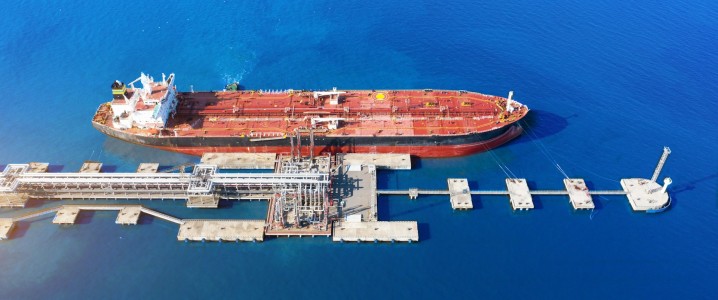
The global oil market is once again navigating choppy waters, as recent U.S. sanctions targeting Chinese entities for their alleged involvement in handling Iranian crude trigger immediate logistical shifts and introduce fresh uncertainty into an already complex supply chain. These geopolitical maneuvers are not just abstract policy; they are directly rerouting supertankers, forcing immediate operational adjustments for major players like Sinopec, and sending ripples through crude prices. For astute investors, understanding these real-time disruptions and their compounding effects is crucial for positioning portfolios in the weeks and months ahead.
Immediate Supply Chain Rerouting and China’s Strategic Response
The U.S. Treasury’s recent announcement, sanctioning over 100 individuals, tankers, and specifically the Rizhao Shihua Crude Oil Terminal, has had an immediate and tangible impact on global shipping routes. Our proprietary shipping data reveals that three very large crude carriers (VLCCs), originally destined for Rizhao, China, have swiftly diverted course. Two of these vessels are now en route to the bustling port of Ningbo Zhoushan on China’s East China Sea, while the third is heading north to Tianjin. These tankers are carrying significant volumes of crude from diverse origins, including Brazil, West Africa, and the UAE, highlighting the broad reach of these sanctions beyond just Iranian barrels.
The Rizhao Shihua Crude Oil Terminal is a critical node in China’s energy infrastructure, strategically located in Shandong province, a hub for the country’s independent refiners. State major Sinopec holds a 50% stake in this terminal, which historically handles a substantial fifth of its imported crude volumes. Treasury Secretary Scott Bessent emphasized the intent to “degrade Iran’s cash flow by dismantling key elements of Iran’s energy export machine,” a move that directly impacts China, given its position as the largest buyer of sanctioned Iranian crude. While China reported a 3.9% increase in total oil imports for September, averaging 11.5 million barrels daily (though down 4.55% from August), the logistical hurdles created by these sanctions introduce new complexities. Chinese oil importers are likely to explore alternative strategies, including the costly and time-consuming transfer of crude from VLCCs to smaller vessels for delivery to other Sinopec refineries, further straining an already tight shipping market and adding to operational expenses.
Market Volatility Amidst Geopolitical Tension: A Price Snapshot
The immediate aftermath of these supply chain disruptions, coupled with broader market sentiment, is clearly reflected in current crude prices. As of today, Brent crude trades at $90.38 per barrel, marking a significant 9.07% decline within the day’s range of $86.08 to $98.97. Similarly, WTI crude has seen a sharp drop to $82.59, down 9.41%, trading between $78.97 and $90.34. Gasoline prices have followed suit, currently at $2.93, a 5.18% decrease. This downward pressure, despite the logistical complications and potential for tighter regional supply, underscores investor apprehension regarding global demand outlooks and the efficacy of current supply management.
Looking at the broader trend, our data shows Brent crude has experienced a substantial retreat over the past two weeks, falling from $112.78 on March 30th to today’s $90.38 – a staggering 19.9% decline. This pronounced volatility highlights the market’s sensitivity to both perceived supply abundance and demand concerns, with geopolitical events like the recent sanctions acting as powerful catalysts for price swings. Investors are grappling with how these rerouted shipments and increased costs for Chinese refiners will ultimately translate into global supply-demand balances, especially when juxtaposed against macroeconomic headwinds.
Navigating the Road Ahead: Key Events for Energy Investors
The unfolding situation in China’s oil import landscape adds another layer of complexity as we look to a busy calendar of upcoming energy events. Investors should closely monitor these dates, as they offer crucial insights into how global producers and data agencies will respond to current market dynamics. This weekend, the focus turns to the Middle East, with the OPEC+ Joint Ministerial Monitoring Committee (JMMC) Meeting on April 19th, immediately followed by the full OPEC+ Ministerial Meeting on April 20th. Given the recent significant price drops and the logistical uncertainties stemming from the China sanctions, a key question for our readers – and the market at large – is what OPEC+ current production quotas are and whether the alliance will consider adjusting output to stabilize prices or maintain its current strategy amidst evolving supply signals. Any hints of further cuts or a commitment to current levels will have profound implications for future crude prices.
Domestically, the regular cadence of inventory reports will be critical. The API Weekly Crude Inventory reports on April 21st and 28th, followed by the EIA Weekly Petroleum Status Reports on April 22nd and 29th, will provide vital data. Investors will be scrutinizing these figures for any signs of inventory builds or draws that could be influenced by delayed vessel arrivals in China or other market shifts. Will the rerouted cargoes manifest as temporary builds in alternative ports, or will they highlight regional deficits elsewhere? Furthermore, the Baker Hughes Rig Count on April 24th and May 1st will offer a glimpse into North American production trends, indicating how producers are reacting to the current price environment and contributing to the global supply picture.
Addressing Investor Outlooks: The Price of Oil by Year-End
One of the most pressing questions we’ve observed from our readership this week is, “what do you predict the price of oil per barrel will be by end of 2026?” This reflects a deep-seated desire for clarity amidst ongoing market turbulence. While offering precise year-end predictions is inherently challenging given the multitude of variables, the recent sanctions on China’s import infrastructure add another layer of uncertainty to the calculus. The short-term logistical snarls and increased costs for Chinese refiners could exert upward pressure on refined product prices in Asia, potentially impacting demand. However, the broader macroeconomic picture, including global economic growth forecasts and the strength of the U.S. dollar, remains a dominant factor for crude prices.
Looking forward, the interplay between supply management by OPEC+, the resilience of U.S. shale production, and the evolving geopolitical landscape will dictate the trajectory of oil prices. Should the rerouting of crude become a prolonged, more expensive standard for Chinese imports, it could create regional price premiums and increase overall supply chain costs. However, if global demand falters significantly, even these supply-side pressures might be insufficient to prevent further price erosion. Investors must remain agile, focusing on the quarterly earnings of key players and monitoring global energy security developments. Companies with diversified supply chains and robust refining capabilities may prove more resilient in this environment, while those heavily exposed to specific sanctioned entities or regions could face increased headwinds.


