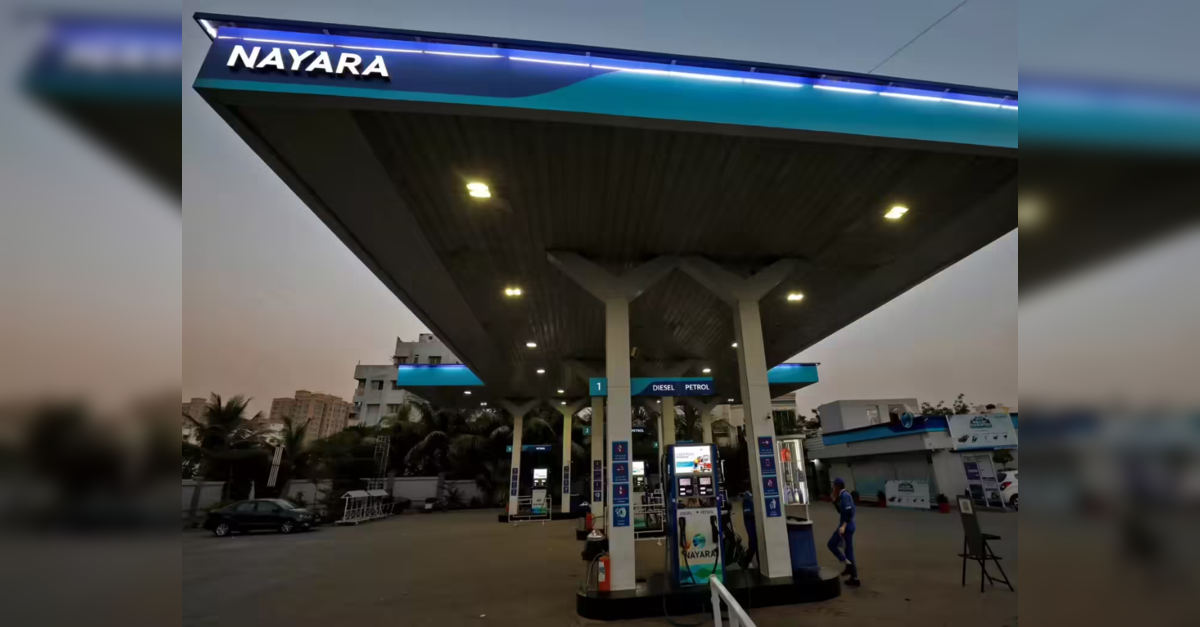
The global oil and gas market is once again confronting the intricate challenge of sanctions enforcement and the relentless pursuit of market access. Recent maneuvers by Nayara Energy Ltd., an Indian refiner with significant Russian backing, underscore a deepening opacity in refined product flows. Our proprietary intelligence indicates a clear attempt to circumvent EU sanctions through ship-to-ship (STS) transfers, a tactic that introduces significant unknowns into supply assessments and investor risk models. This development demands a closer look, especially as we navigate a period of heightened crude volatility and anticipate critical OPEC+ decisions.
Sanctions Evasion: Unmasking the Shadow Fleet’s Tactics
Nayara Energy, facing the brunt of EU sanctions imposed last month, has visibly escalated its efforts to keep its refined products flowing into the global market. Our review of real-time vessel tracking and satellite imagery confirms a pivotal ship-to-ship transfer off the coast of Oman. The Tempest Dream, laden with over 360,000 barrels of gasoline, offloaded its cargo to the larger tanker Wu Tai. This operation, completed recently, saw the Tempest Dream lighten its load significantly before indicating a return to Nayara’s Vadinar terminal in western India, while the Wu Tai now holds approximately 460,000 barrels, with capacity for more. This isn’t merely an operational detail; it’s a deliberate strategy to mask the origin of the fuel, a common practice in the shadow fleet operations that complicate market transparency. Adding another layer of complexity, both the Tempest Dream and the Wu Tai have been previously blacklisted by the UK, with the Wu Tai also sanctioned by the EU for involvement in Russian oil trade. For investors striving to understand true supply dynamics, these covert transfers, executed by a sanctioned entity using sanctioned vessels, represent a substantial challenge. The lack of clear accountability and the deliberate obscuring of trade routes make it increasingly difficult to accurately model global supply-demand balances, influencing everything from freight rates to regional product prices.
Nayara’s Struggle Amidst Broader Refined Product Headwinds
The immediate fallout for Nayara Energy has been significant. The Indian refiner, 49% owned by Russia’s Rosneft PJSC, has been grappling with feedstock shortages and has been compelled to reduce run rates at its Vadinar refinery. Furthermore, even existing fuel exports that were already at sea prior to the EU’s July 18 sanctions faced considerable delays in finding buyers, with one cargo ultimately diverted to China after four weeks of uncertainty. This highlights the practical difficulties even sophisticated players face when navigating a suddenly hostile sanctions environment. However, this localized disruption at Nayara arrives in a market that is already seeing downward pressure on refined product prices. As of today, gasoline trades at $2.93, marking a notable 5.18% decline within the day, with its range spanning from $2.82 to $3.1. This general softening in gasoline prices suggests that while specific entities like Nayara face export hurdles, the broader market may be either sufficiently supplied or experiencing demand headwinds that outweigh individual supply disruptions. Investors are keenly asking about the performance of refiners in this environment, and Nayara’s predicament offers a stark example of how geopolitical events can impact operational efficiency and market access, even if the broader refined product market is simultaneously experiencing price corrections driven by other factors.
Crude Volatility and Impending OPEC+ Decisions
The context for Nayara’s clandestine activities is a crude market undergoing significant shifts. Brent crude is currently trading at $90.38, reflecting a sharp 9.07% decline today, with a day range between $86.08 and $98.97. Similarly, WTI crude stands at $82.59, down 9.41% within the same period. This recent downturn is not an isolated event; our 14-day trend data shows Brent crude has plummeted from $112.78 on March 30 to $91.87 by April 17, representing an 18.5% erosion of value. This substantial correction sets the stage for critical upcoming events. Investors are closely monitoring the OPEC+ Joint Ministerial Monitoring Committee (JMMC) meeting tomorrow, April 18, followed by the Full Ministerial meeting on Sunday, April 19. A key question on investors’ minds, as our reader intent data shows, is “What are OPEC+ current production quotas?” The steep price decline in recent weeks will undoubtedly place immense pressure on the cartel to assess its strategy. Will they maintain current production levels, signaling confidence in underlying demand, or will they consider further cuts to stabilize prices? Their decision will be a major determinant for oil price trajectories, influencing investor outlooks for the remainder of 2026. Beyond OPEC+, we anticipate further market signals from the API Weekly Crude Inventory report on April 21 and the EIA Weekly Petroleum Status Report on April 22, both providing crucial insights into US inventory levels and demand dynamics. The Baker Hughes Rig Count on April 24 will also offer a forward look into future supply potential.
Navigating Increased Market Opacity and Investment Risk
The ongoing saga of sanctioned crude and refined products finding their way to market through covert channels, exemplified by Nayara Energy’s recent actions, introduces a persistent layer of uncertainty for energy investors. These shadow flows distort traditional supply-demand models, making it harder to predict the impact of official sanctions or even OPEC+ policy decisions. For investors seeking to forecast crude prices by the end of 2026, understanding the interplay between official supply (like OPEC+ quotas) and unofficial, opaque flows is paramount. The market is increasingly bifurcated, with a transparent legitimate trade and a growing, less visible shadow market. This complexity necessitates a sophisticated approach to data analysis and risk assessment. Companies involved in legitimate trade may face competitive pressures from cheaper, unsanctioned-origin barrels, while those inadvertently caught in the web of shadow transactions risk reputational damage and legal repercussions. Vigilance regarding vessel movements, ownership structures, and the implications of geopolitical tensions on trade routes will be crucial for navigating this evolving landscape. Ultimately, the ability to discern genuine market signals from the noise of covert operations will be a key differentiator for successful energy investment strategies in the coming quarters.


