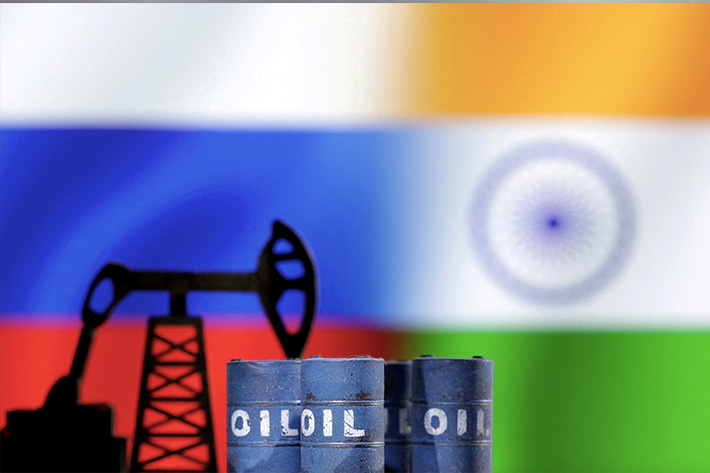
India, a colossal energy consumer and a pivotal player in global crude markets, has initiated a significant recalibration of its oil import strategy. Recent data reveals a notable reduction in its reliance on Russian crude, marking a return to more diversified sourcing. This shift, driven by a complex interplay of geopolitical pressures and strategic trade agreements, carries profound implications for global oil flows, pricing dynamics, and investment opportunities in the energy sector. As investors navigate a volatile market, understanding these fundamental shifts is crucial. Today, Brent crude trades at $94.74, reflecting a robust 4.77% gain, while WTI crude sits at $91.68, up 4.87%, signaling a strong rebound from the precipitous decline of nearly 20% observed in Brent over the past 14 days, from $118.35 to $94.86.
India’s Strategic Pivot: Reshaping Global Crude Flows
In January, India dramatically scaled back its imports of Russian oil, pushing Moscow’s share in the nation’s overall crude mix to its lowest point since late 2022. This reduction saw Russian crude imports fall to approximately 1.1 million barrels per day, accounting for just 21% of India’s total oil intake for the month. This marks a stark contrast to volumes that peaked at 2 million barrels per day in the aftermath of the Ukraine invasion. The primary catalyst for this pivot appears to be a recent interim tariff deal with the United States, which removed a punitive 25% tariff on Indian exports that had been imposed due to New Delhi’s continued purchases of Russian oil. While India maintains its energy decisions are purely economic, the timing and magnitude of this shift underscore the potent influence of geopolitical considerations on national energy strategies. Filling the void, Middle Eastern suppliers surged to capture approximately 55% of India’s overall imports in January, their highest share since late 2022, demonstrating the market’s rapid adaptability to re-route significant volumes.
Navigating Market Volatility Amid Shifting Supply Chains
The re-routing of India’s crude supply comes against a backdrop of significant market volatility, a key concern for many investors asking, for instance, “is WTI going up or down?” Today’s strong performance, with Brent at $94.74 and WTI at $91.68, represents a sharp reversal from the recent downward trend that saw Brent crude shed nearly 20% of its value in just two weeks. This dynamic underscores the complex interplay of demand signals, geopolitical developments, and supply chain adjustments. The reduction in Indian purchases from Russia means a greater volume of Russian crude must find new homes, predominantly China, which has now superseded India as Russia’s top seaborne crude buyer since November. This re-balancing acts as a drag on global oil prices by increasing competition among producers for market share. Conversely, the increased demand for Middle Eastern, Latin American, and even Western grades by India adds upward pressure on prices for those specific crudes. Investors must therefore consider not just the headline price of Brent or WTI, but also the differential pricing and regional supply-demand balances that are increasingly influenced by these large-scale shifts in purchasing patterns.
Forward Outlook: Declining Russian Flows and Key Economic Indicators
The trend of declining Russian oil imports by India is anticipated to continue. Industry analysts project February import levels to average between 1 million and 1.2 million barrels per day, further decreasing to around 800,000 barrels per day in March. These projections suggest a gradual, rather than abrupt, unwinding of India’s reliance on Russian crude, allowing for a more managed transition across global supply chains. For investors seeking to understand the longer-term trajectory of oil prices, especially those asking “what do you predict the price of oil per barrel will be by end of 2026?”, closely monitoring key economic indicators and forward-looking reports is paramount. The shift in India’s purchasing patterns will undoubtedly influence global demand forecasts. Furthermore, the explicit warning from the US administration to closely monitor India’s future oil imports and potentially re-impose tariffs underscores the continued geopolitical sensitivity around these trade flows, adding an element of ongoing risk to market stability.
Upcoming Events and Strategic Investor Considerations
For savvy oil and gas investors, the coming weeks present several critical data points and events that will shape market sentiment and price action. Tomorrow, 2026-04-21, the OPEC+ JMMC Meeting is scheduled. This gathering of key oil-producing nations could yield important signals regarding future production quotas and market stabilization efforts, directly impacting global supply and, consequently, crude prices. As India diversifies its sourcing, OPEC+’s decisions on output levels become even more crucial in balancing global supply. Furthermore, the EIA Weekly Petroleum Status Reports, due on 2026-04-22 and 2026-04-29, will provide granular insights into U.S. crude inventories, refinery utilization, and product demand. These reports are vital for assessing short-term supply-demand balances and can trigger immediate price reactions. Looking slightly further ahead, the EIA Short-Term Energy Outlook on 2026-05-02 offers comprehensive forecasts on global supply, demand, and prices through the end of 2026, serving as a cornerstone for investors formulating their long-term strategies. Understanding these upcoming catalysts and their potential impact on the evolving energy landscape, shaped by significant shifts like India’s crude re-balancing, is essential for positioning portfolios effectively in the dynamic oil and gas sector.